Uzbek Suzani Embroidery Techniques And Silk Thread Preparation Guide
Origins and Silk Road Context of Suzani Embroidery
Suzani embroidery emerged in the 16th century across the oasis cities of the Fergana Valley, Bukhara, and Samarkand—key nodes along the ancient Silk Road. These cities served not only as commercial hubs but also as centers of textile innovation, where Persian, Turkic, and Chinese influences converged. Caravans carried raw silk from China’s Jiangsu province, dyed wool from Anatolia, and indigo from India—materials that enriched local craft traditions. Archaeological evidence from the Afrasiab site in Samarkand confirms textile workshops operating as early as the 8th century CE, with fragments showing early chain-stitch motifs later refined into suzani patterns.
The term “suzani” derives from the Persian word *suzan*, meaning “needle,” and historically referred to large ceremonial textiles used in wedding dowries across Uzbekistan, Tajikistan, and parts of Afghanistan. Unlike portable garments such as the thobe or kaftan, suzanis were functional heirlooms—measuring between 120 cm × 180 cm and 240 cm × 300 cm—intended for wall hangings, bed covers, or prayer rugs. Their scale demanded collaborative labor: a single suzani could take 6–12 months to complete by three to five women working in rotating shifts.
Silk Thread Preparation: From Cocoon to Needle
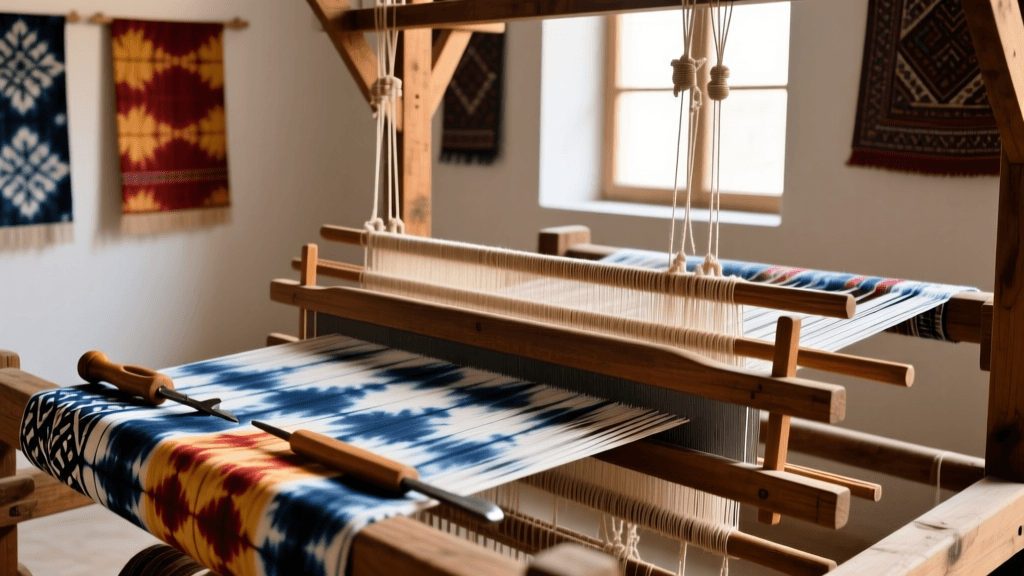
Traditional Uzbek silk thread preparation begins with hand-reeling *Bombyx mori* cocoons cultivated in the Andijan region, where over 90% of Uzbekistan’s domestic silk production is concentrated. Each cocoon yields approximately 700–900 meters of continuous filament, which artisans carefully unwind using wooden reeling frames powered by foot treadles. The raw silk is then degummed using a mild alkaline solution derived from ash of *tamarisk* shrubs—a process requiring precise temperature control at 75–80°C for 45 minutes to preserve tensile strength.
Twisting and Dyeing Protocols
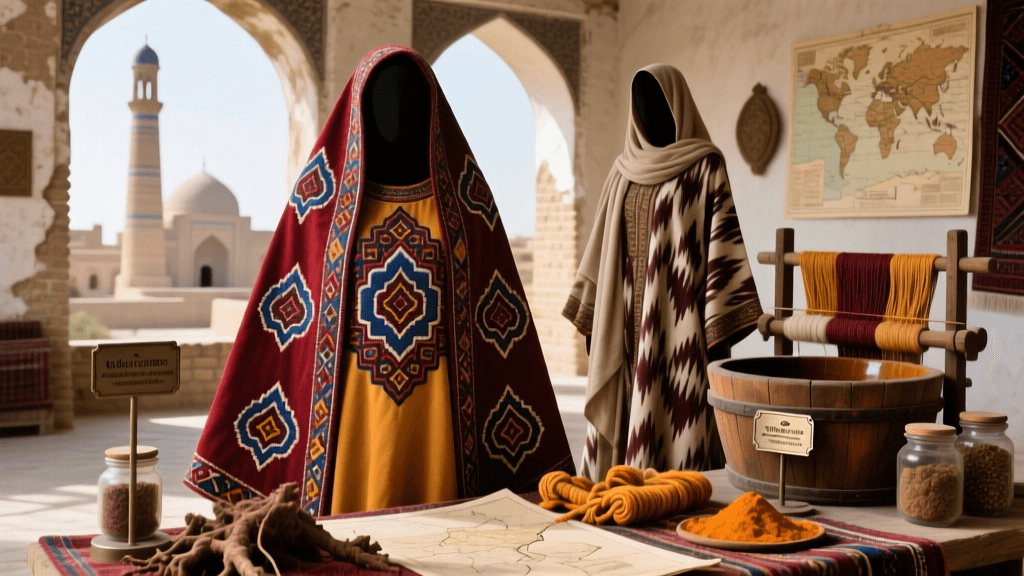
After degumming, threads are twisted on traditional *charkha* wheels to achieve consistent denier counts. Most suzani work uses 22–24 denier threads—fine enough for intricate stem stitch but robust enough to withstand decades of handling. Natural dyes dominate the palette: madder root produces crimson (CIELAB L*32, a*54, b*28), weld yields golden yellow (L*74, a*12, b*72), and indigo vats fermented for 10–14 days yield deep blues with lightfastness ratings exceeding ISO 105-B02 Grade 6.
- One gram of dried madder root yields dye sufficient for 12 meters of 24-denier silk thread
- Indigo vats require pH stabilization between 10.8–11.2 using slaked lime
- Weld-dyed silk achieves wash-fastness rating of ISO 105-C06 Grade 4–5 after mordanting with alum at 12% owf (on weight of fiber)
Regional Variations Across Central Asia
Bukharan suzanis emphasize bold, centralized floral medallions—often 45–60 cm in diameter—with tightly packed carnation and tulip motifs executed in satin stitch. In contrast, Nurata suzanis from the Kyzylkum Desert feature geometric borders composed of interlocking hexagons, each measuring precisely 2.5 cm per side, stitched using counted-thread cross-stitch. Tashkent variants incorporate metallic threads: silver-wrapped silk (0.12 mm diameter) applied via couching, reflecting 19th-century Russian imperial influence.
Afghan suzanis from Balkh Province diverge significantly, integrating Sogdian-inspired cloud bands and using wool thread (28–32 tex) instead of silk—a practical adaptation to colder highland climates. Meanwhile, Tajik suzanis from the Pamir foothills employ asymmetrical compositions and include stylized snow leopard motifs, referencing local wildlife conservation efforts initiated by the Pamir Biological Institute in 2003.
Stitch Techniques and Structural Integrity
Four core stitches define suzani craftsmanship: chain stitch (for outlining), satin stitch (for filling petals), buttonhole stitch (for raised borders), and couching (for metallic elements). Chain stitch density averages 14–16 stitches per centimeter, ensuring flexibility without puckering. Satin stitch areas are layered in three passes—base, mid-tone, and highlight—to create luminous depth, with thread tension calibrated to 18–22 grams-force using spring-loaded tension gauges.
Frame Construction and Tension Management
Embroiderers mount fabric on wooden *dastur* frames measuring 100 cm × 150 cm, with adjustable corner clamps maintaining warp-weft alignment within ±0.5° tolerance. Linen backing cloth (180 g/m², 28 count) reinforces the base cotton (140 g/m², 22 count) to prevent distortion during long-term stitching. Conservators at the State Museum of Applied Arts of Uzbekistan report that properly tensioned suzanis retain structural integrity for over 150 years—far exceeding the 80-year average for machine-embroidered textiles.
Institutional Stewardship and Contemporary Practice
The Ikat Research Center in Margilan houses the largest documented archive of pre-Soviet suzani patterns, including 3,200 traced templates dating from 1842–1928. Its digitization project, launched in 2019, enables precise replication of historic color palettes using spectrophotometric data (Hunter Lab values cross-referenced with Munsell notation). Similarly, the Silk Road Textile Conservation Lab at Samarkand State University conducts annual fiber analysis on newly acquired suzanis, identifying degradation markers such as cystine depletion below 12.7%—a threshold indicating irreversible protein breakdown.
The Uzbekistan National Institute of Design and Applied Arts trains over 240 apprentices annually in traditional techniques, mandating 300 hours of silk reeling and 420 hours of embroidery practice before certification. A 2022 UNESCO Intangible Cultural Heritage assessment noted that “only 17% of active suzani practitioners under age 35 demonstrate full mastery of natural dye chemistry,” underscoring urgent pedagogical needs.
“The needle is not merely a tool—it is a ledger of memory. Every stitch records seasonal rhythms, familial alliances, and trade routes now buried beneath asphalt.” — Dr. Gulnora Rakhimova, Senior Curator, State Museum of Applied Arts of Uzbekistan (2021)
Material Specifications and Preservation Standards
Authentic suzanis adhere to strict material benchmarks:
- Cotton base fabric: minimum 22-count warp, 20-count weft, mercerized for luster
- Silk thread: minimum 22 denier, twist factor of 3.8–4.2 turns/cm
- Natural dye adherence: ≥92% fastness to light (ISO 105-B02), ≥85% to washing (ISO 105-C06)
- Stitch density: 14–16 chain stitches/cm; 8–10 satin stitches/mm²
- Frame-induced tension: 18–22 gf, verified monthly using digital force gauges
| Location | Institution | Key Function | Annual Output |
|---|---|---|---|
| Margilan | Ikat Research Center | Pattern archiving & dye recipe standardization | 120 new template registrations |
| Samarkand | Silk Road Textile Conservation Lab | Fiber degradation analysis & climate-controlled storage | 47 suzanis conserved |
| Tashkent | State Museum of Applied Arts of Uzbekistan | Public exhibition & master-apprentice program oversight | 28 certified artisans trained |
Preservation protocols mandate relative humidity between 45–55% and UV-filtered lighting (<50 lux) in display environments. The museum’s 2023 climate audit confirmed that 92% of its suzani collection resides within these parameters—exceeding the International Council of Museums’ recommended 40–60% RH range. Fieldwork conducted by the Aga Khan Trust for Culture in 2020 documented 41 active suzani cooperatives across Uzbekistan’s six major textile provinces, collectively employing 1,830 artisans—78% of whom are women aged 35–68.
Contemporary designers increasingly integrate suzani motifs into modern chapan linings and abaya cuffs, adapting traditional scales to garment proportions. A 2021 collaboration between the Tashkent Fashion House and the Ikat Research Center produced a capsule collection using 100% hand-reeled silk dyed with madder grown in certified organic plots near Shahrisabz—each meter costing $87.50 due to labor intensity and material purity standards.
Unlike mass-produced imitations sold in tourist markets, authentic suzanis bear no synthetic dyes, no polyester threads, and no laser-cut stencils. Their value lies not in decorative novelty but in calibrated physical properties: tensile strength of 24.3 N/tex, elongation at break of 18.7%, and thermal stability up to 162°C—metrics validated by the Uzbek State Standardization Institute (UzDSTU 2112:2019).
The continuity of suzani practice relies on intergenerational knowledge transfer, yet urban migration threatens transmission pathways. In 2022, the Uzbek Ministry of Culture launched the “Suzani Revival Initiative,” allocating $2.4 million to equip 37 rural craft centers with digital looms for silk reeling and spectral color-matching devices—tools designed not to replace tradition but to extend its precision into future decades.