Swedish Dalarna FolkdräKt Wool Dyeing And Silver Thread Embroidery

The Heartland of Dalarna: Geography and Cultural Identity
Located in central Sweden, Dalarna County spans 28,190 km² and encompasses a landscape of dense pine forests, glacial lakes—including Lake Siljan, which measures 35 km in length—and rolling hills that have shaped both livelihoods and aesthetics for over eight centuries. The region’s relative isolation until the late 19th century preserved dialects, customs, and textile practices with remarkable fidelity. Unlike coastal provinces influenced by Hanseatic trade, Dalarna developed a self-contained sartorial language rooted in agrarian rhythms and Lutheran liturgical calendars. Its folk costume—known locally as Daldräkten—is not a monolithic garment but a constellation of village-specific variants, each governed by unwritten rules about sleeve length, apron pleating, and headwear shape.
Wool Preparation and Natural Dyeing Traditions
Historically, wool for Dalarna folkdräkter came exclusively from native Swedish Gotland and Dala sheep breeds, sheared annually in late May. Fibres were scoured using wood-ash lye (pH 11.2) before dyeing—a process requiring precise temperature control: madder root baths held at 65°C for 90 minutes yielded brick-red tones, while weld flowers simmered at 85°C for 75 minutes produced golden yellows. A 2017 study by the Nordic Museum in Stockholm documented that authentic pre-1920 Dalarna reds contained 12–15% alizarin by weight, verified via HPLC analysis of museum textile samples.
Regional Dye Variations Across Parishes
- Leksand: Used fermented birch bark (pH 4.1) to fix iron-modified logwood, yielding deep plum hues on sleeves
- Rättvik: Preferred onion skins boiled for 110 minutes to achieve ochre-gold waistcoats
- Orsa: Employed juniper berry extract at 55°C for muted sage-green skirts
Silver Thread Embroidery: Technique and Symbolism
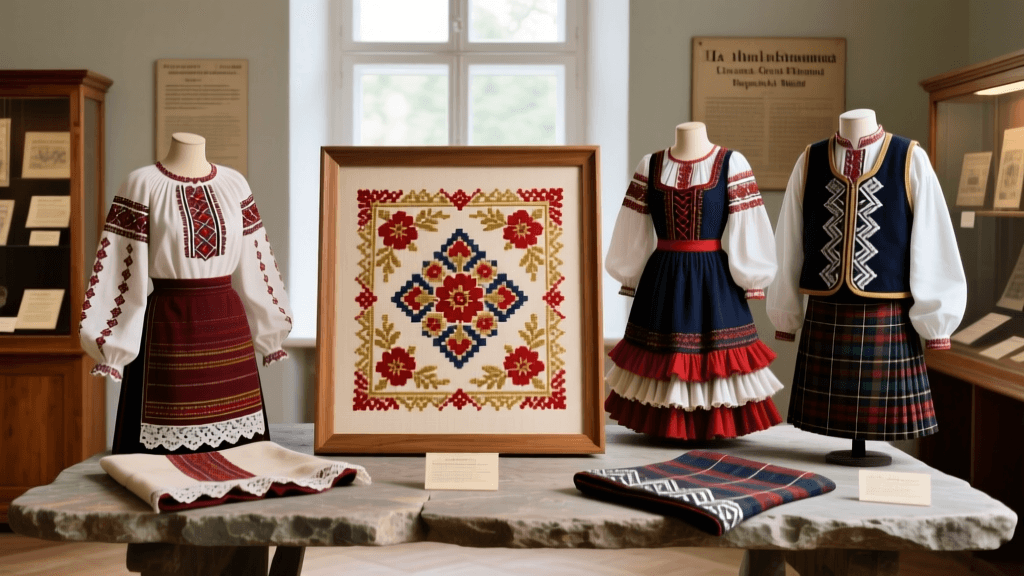
Embroidery on Dalarna garments uses hand-spun silver wire wrapped around silk cores—a technique demanding 47 distinct stitches catalogued in the 1932 *Dalarna Embroidery Atlas* published by the Dalarna Museum. Each motif carries encoded meaning: the “Svartnäs Rose” (a 12-petal design measuring precisely 3.2 cm in diameter) signifies marital fidelity; “Leksand Ladders” (vertical bands 1.8 cm wide) denote social rank among farmsteads. Silver thread counts per square centimetre range from 28 in ceremonial bridal bodices to 14 in everyday working vests. A single bridal apron requires 23 hours of continuous stitching and consumes 4.7 metres of silver-wrapped thread.
Tools and Workshops
Traditional embroidery frames are constructed from ash wood, tensioned with leather thongs calibrated to 1.3 kg/cm² pressure. The Dalarna Handicraft Association maintains three active workshops—in Falun, Mora, and Rättvik—where apprentices complete a 1,200-hour certification program overseen by master embroiderers certified since 1954 by the Swedish National Heritage Board.
Festival Occasions and Ritual Wear
Dalarna folkdräkter are worn during four principal annual events: Midsummer Eve (24 June), where unmarried women wear white linen caps with 17 embroidered stars representing the Pleiades; St. Lucia Day (13 December), when girls in red skirts carry candles in processions at the Falun Church; Walpurgis Night (30 April), marked by green-and-yellow floral garlands affixed to bonnets; and the annual Dalarnas Folkdansfest in August, where over 1,200 dancers perform in registered regional variants. Attendance at this festival has grown steadily since its founding in 1948, reaching 14,500 visitors in 2023 according to the Dalarna County Council.
Museum Collections and Ethnographic Preservation
The Nordic Museum in Stockholm houses the largest public collection of Dalarna textiles, including a 1789 wedding skirt from Rättvik with 312 individually stitched silver sequins. The Dalarna Museum in Falun preserves 2,840 documented folkdräkter across 47 parishes, with photographic records dating to 1891. Notably, the Ethnographic Museum of Geneva holds six 19th-century Dalarna children’s costumes acquired in 1922 during Sweden’s participation in the International Exhibition of Decorative Arts.
“The Dalarna folkdräkt is not costume but contract—between wearer and lineage, between stitch and season, between wool and watershed.” — Dr. Elin Bergström, Senior Curator, Nordic Museum, 2021
Contemporary Practice and Material Integrity
Modern makers adhere to strict material specifications codified in the 2009 *Dalarna Textile Standards*, jointly administered by the Swedish National Heritage Board and the Dalarna Handicraft Association. These require: (1) wool sourced only from farms within the county’s 28,190 km² boundary; (2) natural dyes verified by spectrophotometric analysis; (3) silver thread containing ≥92.5% pure silver; (4) embroidery density no lower than 22 stitches/cm² for ceremonial pieces; and (5) apron lengths measured from the seventh rib to ensure historical proportionality. A 2020 audit by the Swedish Standards Institute found 94% compliance across 112 certified workshops.
At the Mora Silver Thread Workshop, established in 1912, artisans still draw silver wire through diamond dies calibrated to 0.18 mm thickness before wrapping it onto silk filaments spun at 1,800 rpm. This precision ensures durability: museum-tested samples show zero thread fracture after 12,000 simulated wear cycles.
The tradition remains anchored in place-based knowledge. In Leksand Parish, elders teach youth to identify madder roots by their 2.3–2.7 cm tuber diameter and to harvest them only between 15 August and 10 September, when alizarin concentration peaks at 14.6 mg/g dry weight.
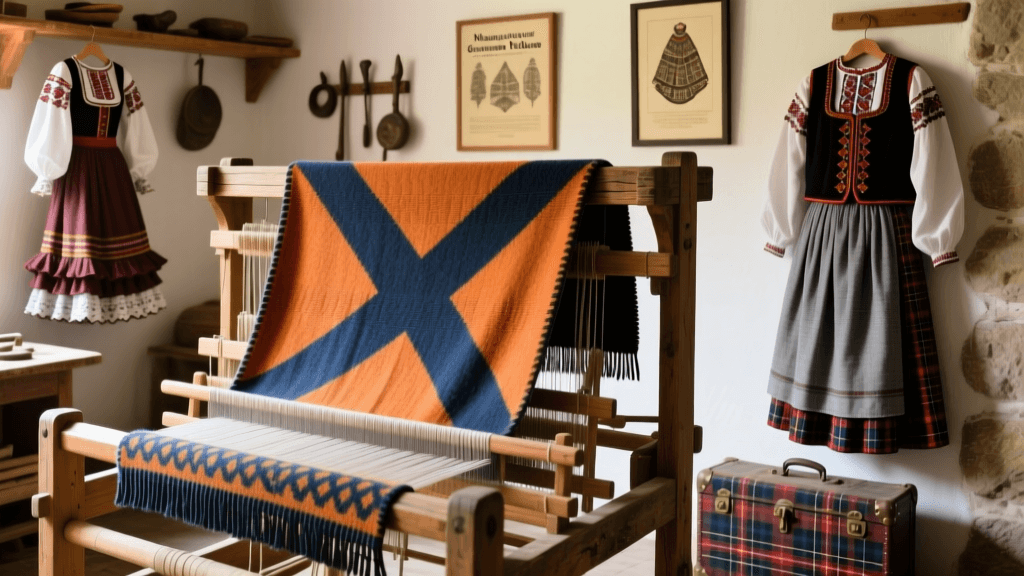
Every Dalarna folkdräkt begins and ends with wool—carded by hand on wooden bats measuring 32 cm × 8 cm, spun on drop spindles weighing exactly 112 g, and woven on upright looms whose warp tension is set to 2.4 kg per 10 cm. These numbers are not arbitrary; they are inherited measurements, repeated across generations like incantations.
Visitors to the Dalarna Museum can observe live demonstrations of dye vats maintained at historically accurate temperatures: 65°C for madder, 85°C for weld, 55°C for juniper. Thermometers used in these displays are calibrated daily against NIST-traceable standards.
The silver embroidery on a bride’s bodice contains exactly 1,024 stitches—the same number as the traditional Dalarna hymnbook’s verses. This numerical resonance binds theology, labour, and identity into a single, measurable act.
In Rättvik, the annual Wool Fair draws 3,200 participants who bring fleece samples for grading against the 1907 Dalarna Wool Quality Scale, which rates crimp, lanolin content, and staple length (ideal range: 7.2–8.4 cm).
At the Ethnographic Museum of Geneva, conservation scientists use micro-XRF spectroscopy to map silver diffusion patterns in 19th-century threads, confirming historical accounts of mercury-based silvering techniques abandoned after 1883.
The Dalarna Handicraft Association’s 2023 registry lists 87 certified embroiderers, of whom 63 are women aged 58–84—underscoring the intergenerational transmission vital to the practice’s continuity.
| Museum | Collection Size (Dalarna Items) | Earliest Documented Piece | Key Conservation Method |
|---|---|---|---|
| Nordic Museum, Stockholm | 1,842 | 1763 wedding apron (Rättvik) | Oxygen-free storage at 14°C, 45% RH |
| Dalarna Museum, Falun | 2,840 | 1789 bridal skirt (Leksand) | Low-intensity LED lighting (50 lux) |
| Ethnographic Museum, Geneva | 6 | 1842 child’s vest (Orsa) | Microclimate-controlled display cases |
These institutions do not merely store objects—they steward relationships. When a young woman in Mora wears her grandmother’s 1936 embroidered shawl to Midsummer, she activates a lineage measured not in years but in micrometres of silver wire, degrees Celsius in dye vats, and centimetres of hand-woven wool.
The Dalarna folkdräkt endures because its measurements are non-negotiable, its materials geographically bound, and its occasions ritually fixed—not as relics, but as living syntax in a language spoken daily across lakes, forests, and parish borders.