Sardinian Pibiones Weaving & Heritage Brands Guide 2026
The Renaissance of Sardinian Textile Heritage in 2026
As the global fashion industry continues its aggressive pivot toward sustainability and "quiet luxury" in 2026, hyper-regional European folk dress has moved from museum archives to the forefront of artisanal slow fashion. Nowhere is this more evident than in Italy, where the rugged, isolated interior of Sardinia has safeguarded some of the continent's most complex and ancient textile traditions. For collectors, cultural historians, and conscious consumers, Sardinian traditional garments—specifically those utilizing pibiones (grain) weaving and orbace (coarse, water-resistant wool)—represent the pinnacle of Mediterranean heritage craftsmanship.
Unlike mass-produced regional souvenirs, authentic Sardinian folk dress is a living tradition. In 2026, a new generation of heritage brands and weaving cooperatives are merging centuries-old loom techniques with contemporary ecological standards, utilizing naturally dyed, locally sourced wools. According to the Regione Sardegna's cultural heritage portal, the island's artisanal textile sector has seen a remarkable resurgence, driven by international demand for traceable, zero-kilometer garments that tell a profound historical story.
Understanding Pibiones and Orbace: The Core of Sardinian Dress
To appreciate the value of Sardinian heritage garments, one must understand the two foundational techniques that define the island's sartorial identity: the raised pibiones weave and the rugged orbace cloth.
The Pibiones Technique: Weaving in Three Dimensions
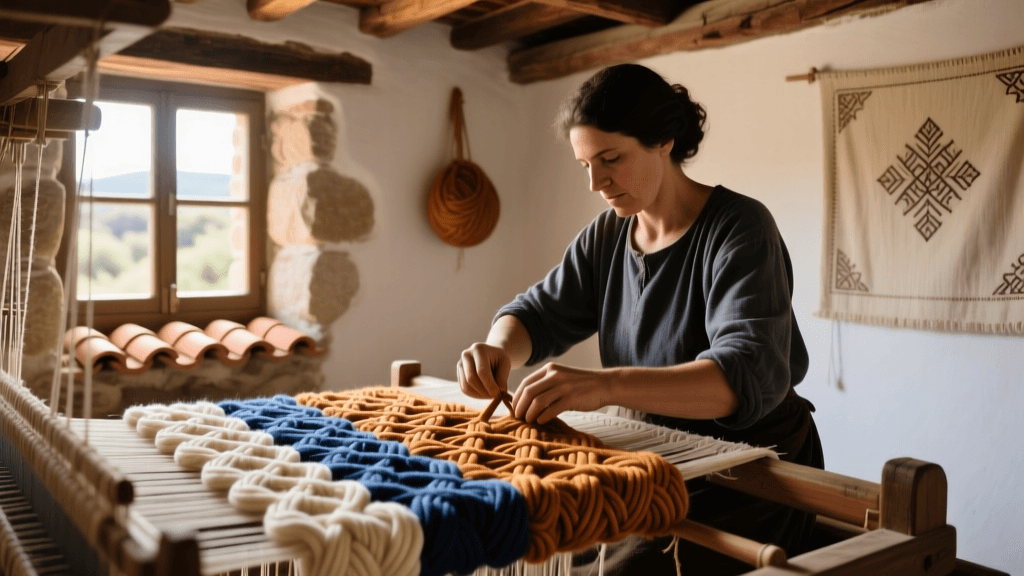
Pibiones (meaning "grains" or "seeds" in the Sardinian language) is a highly specialized weaving technique that creates a raised, textured pattern on the surface of the fabric. The weaver achieves this by wrapping the weft yarn around a smooth wooden or metal rod laid across the warp threads. Once the rod is removed, the loops remain as raised "grains" that form intricate geometric, floral, or avian motifs. In traditional Sardinian folk dress, pibiones is most famously used to create the mantesu or pannedda, the heavy, beautifully patterned fringed shawls worn by women during festivals and religious processions.
Orbace Wool: The Fabric of the Shepherd
While pibiones represents the decorative soul of Sardinian dress, orbace represents its rugged heart. Orbace is a coarse, heavy, and naturally water-resistant woolen cloth woven from the fleece of local Sardinian sheep. Historically, it was the primary material for the mastruca (or best'e peddi), the iconic sleeveless shepherd's vest worn with the fleece facing inward for warmth or outward to shed rain. In 2026, heritage brands are reviving orbace not just for historical reenactments, but as a premium, sustainable outerwear textile prized for its durability and distinct, earthy texture.
Top Italian Heritage Brands and Cooperatives (2026)
When sourcing authentic Sardinian garments, buyers must look beyond commercial boutiques and seek out established weaving cooperatives and master artisans. These organizations ensure fair wages for weavers and maintain strict adherence to traditional loom methods. Below is a comparison of the most prominent heritage hubs operating in 2026.
| Cooperative / Brand Hub | Primary Region | Signature Technique & Garment | 2026 Price Range (Authentic Pieces) |
|---|---|---|---|
| Tessitura di Samugheo | Oristano (Central-West) | Pibiones weaving; heavy shawls and tapestries | €350 - €900 |
| Cooperativa di Aggius | Gallura (North) | Multi-harness loom weaving; traditional rugs and manigas (cuffs) | €200 - €650 |
| Artigiani del Nuorese | Nuoro (Barbagia) | Orbace wool processing; bespoke mastruca vests | €450 - €1,200 |
| Tessitura di Morgongiori | Oristano (Central) | Flame-stitch inspired weaving; delicate veils and table linens | €150 - €500 |
For those researching the deep ethnographic roots of these garments, the Istituto Superiore Regionale Etnografico (ISRE) in Nuoro remains the ultimate authority. Their archives and associated museums provide the baseline for what constitutes an authentic regional silhouette, ensuring that modern cooperatives do not dilute the historical accuracy of the costume sardo.
How to Identify Authentic Sardinian Folk Garments
The commercialization of Italian folk dress has led to an influx of machine-made imitations. In 2026, discerning buyers should apply the following authentication checklist when investing in Sardinian heritage textiles:
- The Reverse-Side Test (Pibiones): Turn the fabric over. Authentic pibiones will show the distinct, slightly messy loops or wraps where the yarn was wound around the rod. Machine-made jacquard imitations will look flat and uniform on the reverse side.
- The Tactile Check (Orbace): Genuine orbace is intentionally coarse and stiff when new. It should feel dense and slightly oily to the touch due to the natural lanolin retained during the minimal, traditional washing processes. If the wool feels overly soft or chemically treated, it is likely industrially processed merino.
- Natural Dye Indicators: Heritage cooperatives in 2026 are increasingly returning to botanical dyes. Look for the muted, complex tones of rubia peregrina (wild madder) for brick reds, or walnut husks for deep, variegated browns. Neon or perfectly uniform synthetic colors are a red flag for mass production.
- The Fringe (Frisura): Hand-knotted fringe on a mantesu shawl should exhibit slight, natural irregularities. Machine-tied fringe is uniformly tight and lacks the structural tension variations of human hands.
Integrating Heritage Pieces into a Modern Wardrobe
One of the most exciting developments in the 2026 European folk dress revival is the styling of traditional garments for contemporary life. While a full, multi-layered Sardinian festival costume (su costumene) is reserved for cultural events like the Cavalcata Sarda or the Festino di Sant'Efisio, individual heritage pieces are highly versatile.
A finely woven pibiones shawl can be draped over a modern, minimalist linen dress to add profound textural contrast and historical weight to an evening outfit. Similarly, a tailored orbace vest, stripped of its traditional brass buttons and re-fitted by a contemporary tailor, serves as an exceptional, weather-resistant alternative to the standard tweed waistcoat in autumn and winter menswear. The Sardegna Turismo artisanal routes often highlight boutique workshops where visitors can commission these modernized, bespoke adaptations directly from the weavers.
Caring for Orbace Wool and Pibiones Textiles
Investing in heritage Italian garments requires a commitment to proper textile conservation. Because these pieces are constructed from natural, minimally processed fibers, standard modern laundry practices will destroy them.
- Cleaning: Never submerge orbace or heavy pibiones shawls in water. The agitation will cause the coarse wool to felt and shrink catastrophically. Rely on professional dry cleaners who specialize in heritage textiles, or use a specialized wool-brush to remove surface dust and debris.
- Airing Out: Sardinian wool garments naturally resist odors due to their lanolin content. Simply hanging the garment outside on a dry, breezy, and shaded day is often enough to refresh the fibers.
- Storage: Store shawls and vests flat or gently rolled to prevent stress on the raised pibiones grains. Always use blocks of untreated cedar wood to deter moths; avoid chemical mothballs, which will permanently taint the wool with a harsh synthetic odor and degrade the natural fibers over time.
Conclusion
The survival of Sardinian pibiones weaving and orbace wool production is a testament to the resilience of Italian regional identity. By supporting heritage brands and weaving cooperatives in 2026, enthusiasts do more than acquire a beautiful garment; they become active patrons of an unbroken textile lineage that stretches back to the Nuragic civilization. Whether you are acquiring a heavy fringed shawl from Samugheo or a rugged shepherd's vest from Nuoro, you are wrapping yourself in the very soul of the Mediterranean.