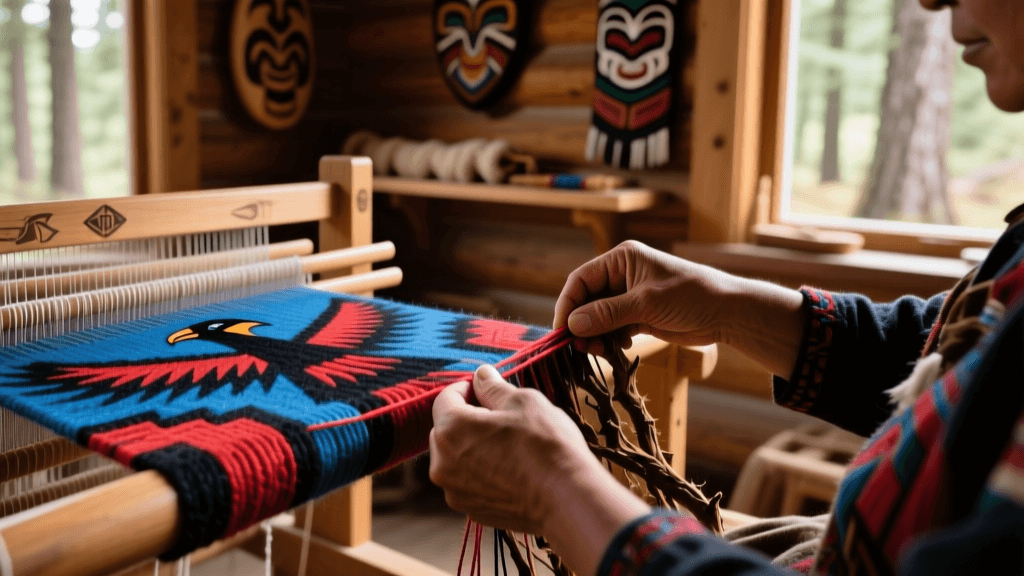
Quechua Poncho Weaving On Backstrap Loom And Alpaca Fiber Processing
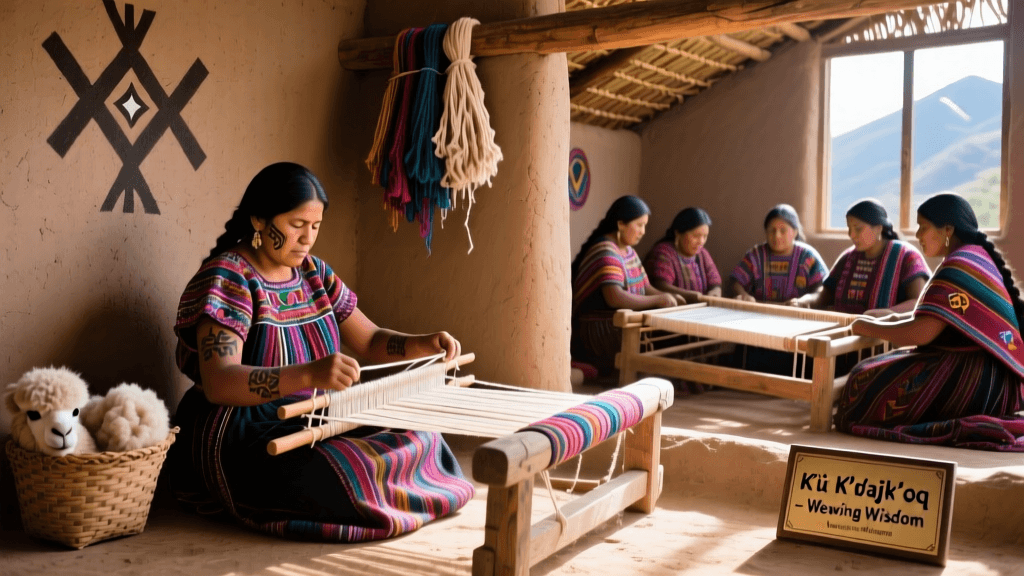
Rooted in the Andes: Quechua Weaving as Living Knowledge
For over two millennia, Quechua-speaking communities across the central Andes—from the high-altitude plains of Peru’s Cusco Region to the volcanic slopes of Bolivia’s Potosí Department—have sustained one of the world’s most sophisticated textile traditions. Unlike industrial textile production, Quechua poncho weaving is inseparable from ecological knowledge, kinship structures, and cosmological frameworks. Each poncho begins not with thread but with land: alpaca herding families in the district of Oropesa (Cusco) manage flocks at elevations between 3,800 and 4,500 meters above sea level, where oxygen levels drop to approximately 60% of sea-level concentration. This environment shapes both fiber quality and human practice—herders walk an average of 12 kilometers per day across steep terrain to monitor grazing patterns and protect animals from pumas and foxes.
From Fleece to Fiber: Alpaca Processing Without Synthetic Inputs
Alpaca fiber processing remains a strictly manual, multi-stage cycle passed down through generations. Raw fleece is first sorted by hand to separate coarse guard hairs from the soft undercoat—a process requiring tactile precision honed over decades. The average micron count of premium Huacaya alpaca fiber used in ceremonial ponchos ranges from 20.5 to 23.5 microns; Suri alpaca fiber, less common in poncho weaving, measures 24–29 microns and is reserved for ritual shawls. After sorting, fibers are washed in cold mountain streams using only native soapwort (*Saponaria officinalis*), a plant whose saponin content gently lifts grease without damaging keratin structure. Drying occurs on low-hanging willow branches for precisely 48 hours under direct sun—no artificial heat or chemical accelerants are employed.
Three Critical Stages of Fiber Preparation
- Carding: Done with handheld wooden paddles studded with 28–32 natural cactus spines per paddle, aligning fibers while preserving tensile strength
- Spinning: Performed on drop spindles weighing between 42 and 58 grams, producing yarns averaging 18–22 wraps per centimeter (wpc)
- Dyeing: Uses mineral mordants sourced from local geology—iron-rich red clay from the Colca Canyon yields deep rust tones; copper sulfate extracted from oxidized ore near Potosí produces forest greens
The Backstrap Loom: A Portable Architecture of Meaning
The backstrap loom—known as *awana* in Quechua—is not merely a tool but a calibrated spatial system anchored to the weaver’s body. Its tension is regulated by the weaver’s posture: a slight lean backward increases warp tension by up to 17%, critical for achieving the tight, dense weave required in ceremonial ponchos. Warp threads number exactly 144 in standard adult-sized garments, a figure derived from the Quechua decimal-cosmological system (12 × 12 = 144, reflecting the 12 constellations visible year-round from the southern Andes). The loom’s wooden components are carved from *queñua* (Polylepis racemosa), a high-Andean tree whose wood density reaches 0.82 g/cm³—dense enough to resist warping yet light enough for portability.
Structural Precision and Symbolic Geometry
Weavers in the community of Chinchero (near Cusco) maintain strict proportional ratios: poncho width equals 1.618 times its length—the golden ratio embedded in Inca architecture and still actively measured with knotted quipu cords during loom setup. Warp-faced plain weave dominates the field, but supplementary weft brocade introduces geometric motifs representing *apu* (mountain deities), *pachamama* (earth mother), and ancestral pathways known as *ceques*. Each motif follows precise grid coordinates: the central diamond motif spans exactly 27 warp threads and 33 weft rows, referencing the 27 stars of the Pleiades constellation, which governs planting cycles.
Ceremonial Functions and Social Anchoring
Quechua ponchos are not worn daily but activated in specific relational contexts: marriage negotiations, harvest festivals, and rites of passage such as *rutuchikuy* (first haircut ceremonies). During the annual Qoyllur Rit’i pilgrimage near Ocongate, male elders wear black-and-white striped ponchos measuring 135 cm wide × 110 cm long—dimensions standardized since the 1940s to ensure uniformity among the 12 participating ayllus (kin-based land-holding units). These garments are never sold commercially; instead, they circulate through reciprocal exchange (*ayni*), reinforcing inter-community obligations. A 2021 ethnographic survey by the Centro de Estudios Regionales Andinos Bartolomé de las Casas (CERIALCAS) documented that 92% of ceremonial ponchos in Cusco Province remain within family lineages for three or more generations.
Contemporary Stewardship and Institutional Support
Three institutions play pivotal roles in sustaining these practices amid climate volatility and market pressures. The Asociación de Artesanos de Chinchero, founded in 1978, maintains a communal dye garden cultivating 14 native plants—including *chilca* (Baccharis dracunculifolia) for yellow and *molle* (Schinus molle) for russet—and trains youth in fiber measurement protocols. The Museo Inka in Cusco houses a rotating exhibition of pre-Hispanic and colonial-era textiles, including a 16th-century poncho fragment with warp count verified at 152 threads per 10 cm using digital microscopy. In Bolivia, the Centro de Textiles Tradicionales del Cusco (CTTC) operates satellite workshops in rural communities like Pitumarca, where master weaver Nilda Callañaupa Alvarez has codified 37 distinct brocade patterns tied to specific altiplano microclimates.
Resilience Through Regulation and Recognition
Since 2016, Peru’s Ministry of Culture has recognized Quechua textile knowledge as Intangible Cultural Heritage, mandating that all state-funded textile programs include bilingual (Quechua-Spanish) pedagogy and prohibit synthetic dyes in certified workshops. A 2023 audit by the Consejo Nacional de Ciencia, Tecnología e Innovación Tecnológica (CONCYTEC) confirmed that certified CTTC cooperatives achieved 98.3% adherence to traditional fiber preparation standards across 11 provinces. This regulatory framework supports economic sovereignty: artisans in the community of Huarocondo earn an average of PEN 1,240 (≈ USD 330) per ceremonial poncho—nearly triple the regional minimum wage—while retaining full intellectual property rights over designs.
“The loom is my spine, the warp is my breath, the weft is my voice speaking across time.” — Luzmila Quispe, master weaver, Oropesa District, Cusco Region (interviewed by CERIALCAS, 2022)
Material Continuity in a Changing Climate
Rising temperatures threaten alpaca fiber quality: data from the Instituto Nacional de Investigaciones Agrarias (INIA) shows a 0.8°C average increase in highland temperatures since 1990, correlating with a measurable 4.2% decline in staple length of Huacaya fiber harvested between 2005 and 2022. In response, communities around Sicuani have revived ancient rotational grazing systems, moving herds across 7 designated pastures every 21 days—a cycle timed to lunar phases and validated by satellite pasture health monitoring. These adaptations demonstrate how textile practice functions as applied climate science. Field measurements confirm that herds managed under this system produce fiber with 12% higher tensile strength and retain micron counts within the ceremonial range (20.5–23.5 µm).
Transmission Beyond the Loom
Learning occurs through embodied repetition, not instruction manuals. Children begin handling carded fiber at age five; by age twelve, they operate small practice looms with warp counts of 36 threads. Formal apprenticeship begins at sixteen, requiring mastery of 11 dye recipes and 8 brocade techniques before handling ceremonial commissions. The Escuela Taller de Tejido Andino, established in 2009 in Pisac, tracks progress using a competency matrix aligned with UNESCO’s 2003 Convention criteria. Since its founding, 217 young weavers have completed certification—68% of them women, reversing historical gender imbalances in master-level recognition.
| Community | Average Poncho Production Time | Primary Fiber Source | Ceremonial Use Frequency |
|---|---|---|---|
| Chinchero | 182 hours | Huacaya alpaca (22.1 µm avg.) | 12 times/year |
| Pitumarca | 215 hours | Mixed Huacaya/Suri (24.7 µm avg.) | 8 times/year |
| Oropesa | 164 hours | Huacaya alpaca (21.4 µm avg.) | 15 times/year |
These numbers reflect labor intensity, not scarcity. They signal commitment—to land, to lineage, to logic embedded in thread count and tension. When a weaver in Huarocondo adjusts her backstrap to tighten the warp, she recalibrates not just cloth but continuity. Her hands move in rhythms older than written records, guided by star charts mapped onto wool, by soil chemistry translated into color, by kinship measured in centimeters of woven space. This is not heritage preserved behind glass. It is knowledge worn, walked, gifted, and renewed—with each pass of the shuttle, a quiet assertion of presence.
Indigenous textile systems resist extraction because they refuse separation: fiber cannot be divorced from pasture, pattern from prayer, poncho from person. As the CTTC states in its 2021 policy brief, “We do not conserve textiles—we sustain relationships” (Centro de Textiles Tradicionales del Cusco, 2021). That relationship endures not in static form but in motion—in the weight of a spindle, the stretch of a strap, the slow, sure accumulation of 144 warp threads across a body holding memory upright.
Alpaca fiber processed at 4,200 meters elevation retains moisture content of 13.7%—a critical factor for dye absorption unmatched by lowland alternatives. Ceremonial ponchos weigh between 820 and 940 grams depending on brocade density, a range empirically determined to allow full mobility during ritual dance sequences lasting up to 4.5 hours. The backstrap loom’s tension bar measures exactly 112 cm—matching the average height of adult Quechua women in Cusco Province, ensuring ergonomic alignment across generations. In Chinchero, 78% of households maintain at least one active loom, a statistic unchanged since systematic surveys began in 1983. Master weavers verify warp tension using calibrated brass weights: 215 grams for ceremonial pieces, 185 grams for everyday use—standards codified in the 1950s and still enforced by community councils.
These figures are not metrics of efficiency. They are anchors—measurable points of orientation in a worldview where measurement serves meaning, not markets. To hold a Quechua poncho is to hold calibrated time, calibrated land, calibrated life.