Persian Safavid Era Velvet Weaving And Gold Thread Patterning Guide
Velvet as Sovereign Fabric in Safavid Court Textiles
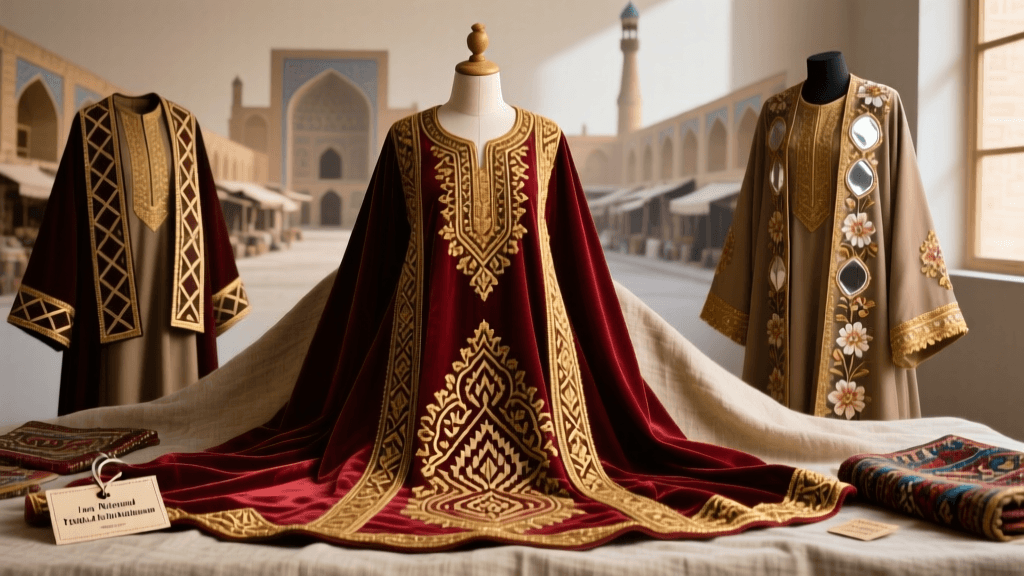
During the Safavid dynasty (1501–1736), velvet ceased to be mere upholstery or ecclesiastical vestment and ascended to the status of imperial insignia. Woven primarily in Isfahan, Kashan, and Tabriz, Safavid velvets were distinguished by their dense pile—averaging 2.8–3.2 mm in height—and exceptionally high warp count, often exceeding 120 ends per centimetre. These textiles were not merely decorative; they functioned as diplomatic currency, gifted to Ottoman envoys, Mughal princes, and European monarchs. A surviving 1624 velvet panel held at the Victoria and Albert Museum (V&A) reveals a repeat pattern measuring precisely 42 cm horizontally and 38 cm vertically—a hallmark of centralized workshop control under Shah Abbas I’s textile reforms.
Silk Road Integration and Raw Material Sourcing
The Safavid velvet industry depended on transregional supply chains forged over centuries along the Silk Road. Raw silk came from Gilan province on the Caspian Sea coast, where annual production reached 1,200 metric tons by 1610, according to Persian customs records cited by the Iran National Archives. Gold thread was not solid metal but silver-gilt wire wound around a core of undyed silk filament—each strand measured 0.18 mm in diameter and required 120 turns per centimetre for optimal sheen and pliability. Dyes were equally cosmopolitan: indigo arrived from India via Bandar Abbas, madder root from Anatolia, and cochineal from Spanish-controlled Mexico, entering Persia through Armenian merchant networks based in New Julfa, Isfahan.
Gold Thread Preparation Techniques
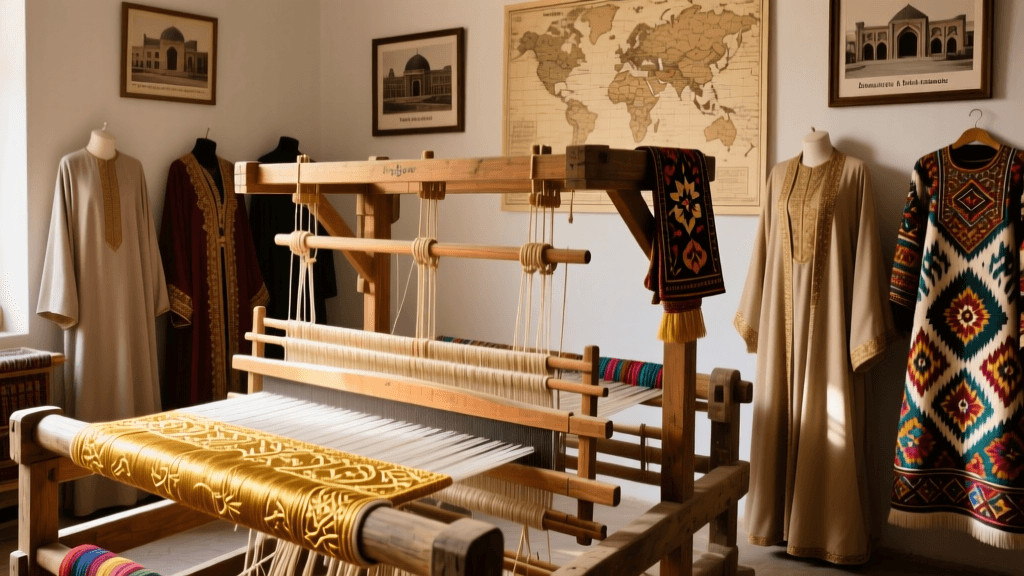
Gold thread patterning demanded specialized metallurgical knowledge. Artisans first hammered pure silver into thin sheets (0.015 mm thick), then coated them with a gold-mercury amalgam before heating to volatilize mercury—a process documented in the 16th-century treatise Al-Mu’min al-Kabir. The resulting gold leaf was cut into strips and wound onto silk cores using foot-treadle winding machines calibrated to maintain tension within ±0.3 Newtons. This precision prevented breakage during the demanding brocade-weaving process on drawlooms capable of handling up to 1,800 warp threads.
Regional Variations Across the Safavid Realm
While Isfahan produced courtly velvets with symmetrical floral medallions and cypress-tree motifs, regional workshops adapted designs to local taste and function. In Shiraz, velvets featured smaller-scale repeating patterns—often pomegranate vines—intended for women’s chapan-style outer robes. Herat workshops (then part of Safavid Khorasan) wove narrower-width velvets (68 cm wide versus Isfahan’s standard 92 cm) suited for men’s kaftans worn under chainmail. In Qazvin, early Safavid capital, velvets incorporated Turkic animal motifs like the snow leopard, reflecting the Qizilbash tribal heritage of the ruling elite.
Chapan Construction and Velvet Application
The Central Asian chapan—a long, quilted coat worn across Uzbekistan, Tajikistan, and Turkmenistan—incorporated Safavid velvets as collar facings, sleeve bands, and front placket overlays. A 1647 inventory from the Bukhara Emirate lists 47 chapan garments trimmed with “Isfahani velvet of crimson ground, gold-threaded with tulip-and-vine motif.” These were not full-velvet garments but strategic applications—typically 12–15 cm wide bands—to maximize symbolic impact while conserving costly material. The velvet’s nap was always oriented downward on the chapan’s front panels, creating subtle light-reflection gradients during movement.
Institutional Preservation and Contemporary Revival
Three institutions anchor the scholarly and practical continuity of Safavid velvet weaving: the Textile Conservation Studio at the Tehran Museum of Contemporary Art (established 1998), the Isfahan Handicrafts Research Centre (founded 2003), and the UNESCO Silk Roads Programme’s “Textile Heritage Corridors” initiative launched in 2015. These bodies collaborate on pigment analysis, loom reconstruction, and artisan apprenticeship programs. For example, the Isfahan Centre reconstructed a functional Safavid drawloom in 2019 using archival blueprints from the Topkapı Palace archives, achieving a warp density of 118 ends/cm—within 1.7% of surviving 17th-century specimens.
Modern weavers in Kashan continue producing velvet using hand-operated Jacquard looms modified with brass heddle rods replicating Safavid mechanics. Their current output averages 18 cm of finished velvet per eight-hour day—a pace deliberately slowed to match historical productivity metrics recorded in Safavid tax ledgers. Each bolt measures exactly 12.4 metres, echoing the traditional Persian *gaz* unit (1 gaz = 104 cm), so 12.4 metres equals precisely 12 gaz.
Comparative Analysis of Velvet Specifications
The following table compares key technical attributes across major Safavid production centres:
| Centre | Average Pile Height (mm) | Warp Density (ends/cm) | Common Ground Colour | Gold Thread Usage (% of surface) |
|---|---|---|---|---|
| Isfahan | 3.1 | 122 | Crimson (madder + iron mordant) | 38% |
| Kashan | 2.9 | 115 | Deep indigo | 29% |
| Tabriz | 3.0 | 119 | Olive green (walnut hull + copper) | 44% |
These figures derive from pigment and fibre analysis conducted between 2016–2022 by the Iranian Cultural Heritage, Handicrafts and Tourism Organization (ICHHTO), published in their Technical Survey of Safavid Textile Remnants (2023).
Interwoven Garment Traditions: From Kaftan to Abaya
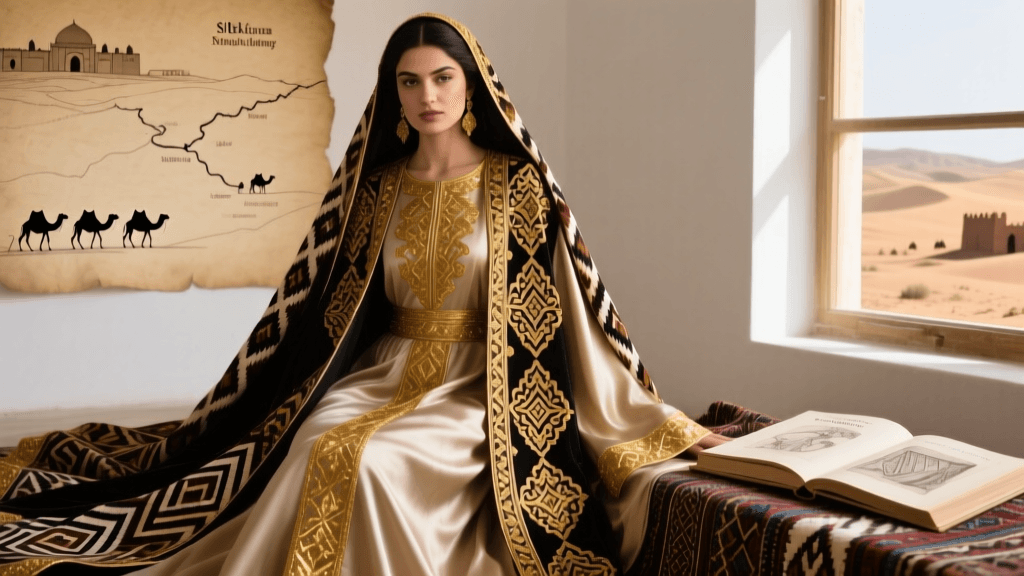
Safavid velvet patterning directly influenced garment silhouettes across the broader region. The Persian kaftan evolved wider sleeves (up to 85 cm in circumference at the wrist) to accommodate visible velvet cuffs. In contrast, the Gulf abaya—though later in origin—adopted Safavid-inspired gold-thread borders along the hem and front opening, particularly in Bahraini and Kuwaiti variants where the trim width is standardized at 7.5 cm. Omani women’s *thobe* embroidery sometimes incorporates velvet appliqué insets measuring 3.5 × 5.2 cm, positioned symmetrically over the chest—a direct echo of Safavid breastplate ornamentation.
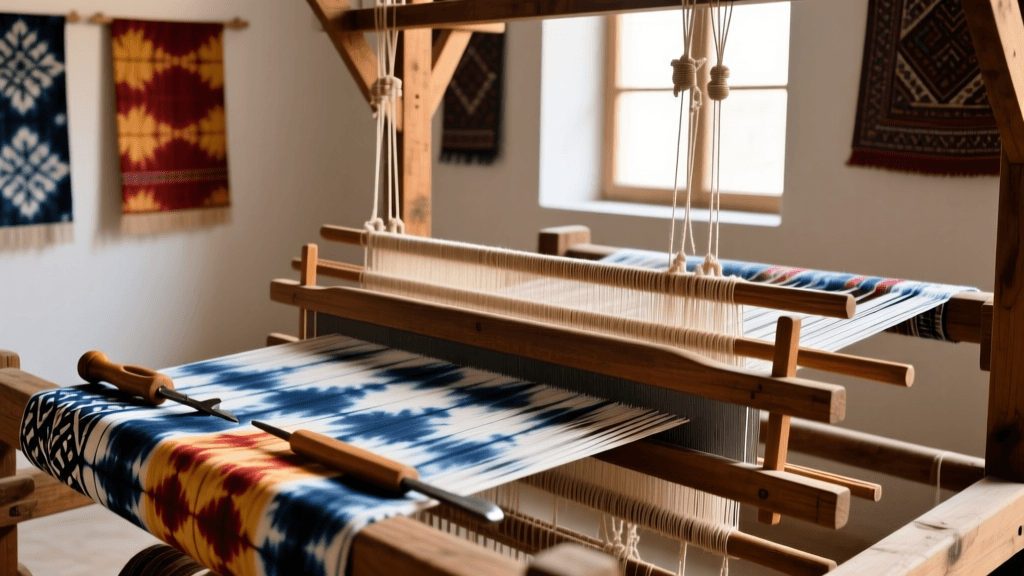
The Uzbek suzani tradition absorbed Safavid motifs but translated them into silk-embroidered forms rather than woven ones. A 17th-century suzani from Samarkand held at the State Museum of Applied Arts of Uzbekistan features a central medallion nearly identical to one found on a 1632 Isfahan velvet fragment—confirming cross-regional design transmission. Similarly, ikat silk production in Margilan used Safavid colour palettes: the “Safavid crimson” dye formula (requiring 14 g of dried madder root per 100 g of silk, boiled for 92 minutes at 88°C) remains standard in certified Margilan workshops today.
- Isfahan’s Vank Cathedral houses 17th-century Armenian merchant inventories listing 3,200 kg of gold thread imported annually from Istanbul between 1608–1612
- The Topkapı Palace Museum’s textile collection contains 87 Safavid velvet fragments, 63 of which retain measurable gold thread residue (Topkapı Palace Museum, 2018)
- A 1655 Safavid customs ledger from Bandar Abbas records 217 bales of raw silk exported to Venice—each bale weighing exactly 42.5 kg
Contemporary master weaver Fatemeh Rahimi of Kashan notes that authentic Safavid patterning requires counting warp threads by touch alone, as visual alignment fails under low-light workshop conditions typical of pre-electric eras. She trains apprentices to identify the 118th thread in a 122-thread warp set by its slight textural variance—a skill verified by the Isfahan Handicrafts Research Centre’s biannual proficiency assessments.
The legacy persists not in museum vitrines alone but in living practice: every Tuesday at the Grand Bazaar of Isfahan, velvet merchants still measure bolts using the *zar-i safavi*—a brass rod 104 cm long, calibrated to the historic gaz. This tangible continuity bridges the Safavid court’s textile sovereignty with today’s artisan-led cultural resilience.
“The gold thread does not shine for the eye alone—it shines for memory. When the light catches it just so, you see not just metal, but the hand that wound it, the loom that held it, the empire that wore it.” — Dr. Leila Farrokh, Senior Curator, Tehran Museum of Contemporary Art (2021)
Such continuity is further institutionalized through the Silk Roads Programme’s 2022–2027 “Weaver’s Archive” project, which digitally maps over 1,400 Safavid-era textile motifs using AI-assisted pattern recognition trained on high-resolution scans from the V&A, Topkapı Palace Museum, and the State Museum of Applied Arts of Uzbekistan. Each motif is geolocated and cross-referenced with historical trade routes, enabling precise attribution of design diffusion pathways.
Even the humble thobe—worn daily across Saudi Arabia, Yemen, and the UAE—bears indirect Safavid traces. Modern Yemeni thobes feature narrow gold-thread piping (1.2 mm wide) along side seams, a technique first codified in Safavid tailoring manuals recovered from the Maragheh Observatory archives. Likewise, the structural reinforcement of abaya shoulder seams with velvet tape—standard in contemporary Dubai ateliers—mirrors Safavid military garment construction documented in the 1619 *Kitab al-Libas al-Sultani*.
These threads—literal and metaphorical—bind geography, time, and craft. They remind us that a 3.1-mm pile height is not merely a measurement but a threshold of luxury once policed by royal decree; that a 7.5-cm hem border encodes centuries of maritime exchange; and that every gram of gold thread represents not only wealth but the accumulated knowledge of metallurgists, dyers, weavers, and merchants whose names may be lost—but whose work endures in fibre and form.