Pacific Northwest Chilkat and Ravenstail Robes 2026
Introduction to Northwest Coast Textile Traditions
The Pacific Northwest Coast is home to some of the most complex, visually striking, and culturally significant textile traditions in the world. For centuries, the Indigenous peoples of this region—most notably the Tlingit, Haida, and Tsimshian tribes—have crafted ceremonial garments that serve as profound expressions of clan lineage, spiritual power, and social status. As we navigate the cultural landscape in 2026, these ancient weaving techniques are experiencing a powerful renaissance. Driven by dedicated Indigenous artisans, cultural heritage organizations, and a renewed commitment to ancestral knowledge, the creation of Chilkat and Ravenstail robes is no longer just a historical footnote; it is a living, evolving practice that bridges the deep past with the vibrant present.
Understanding these garments requires looking beyond their striking visual impact. Each robe is a masterclass in mathematics, natural resource management, and spiritual discipline. According to the Sealaska Heritage Institute, the transmission of this knowledge from master weavers to apprentices is one of the most vital cultural preservation efforts occurring in the Americas today. This guide explores the intricate anatomy of these garments, the specific regional variations among tribes, and the practical realities of commissioning, sourcing, and preserving these masterpieces in 2026.
The Anatomy of a Chilkat Robe (Naaxiin)
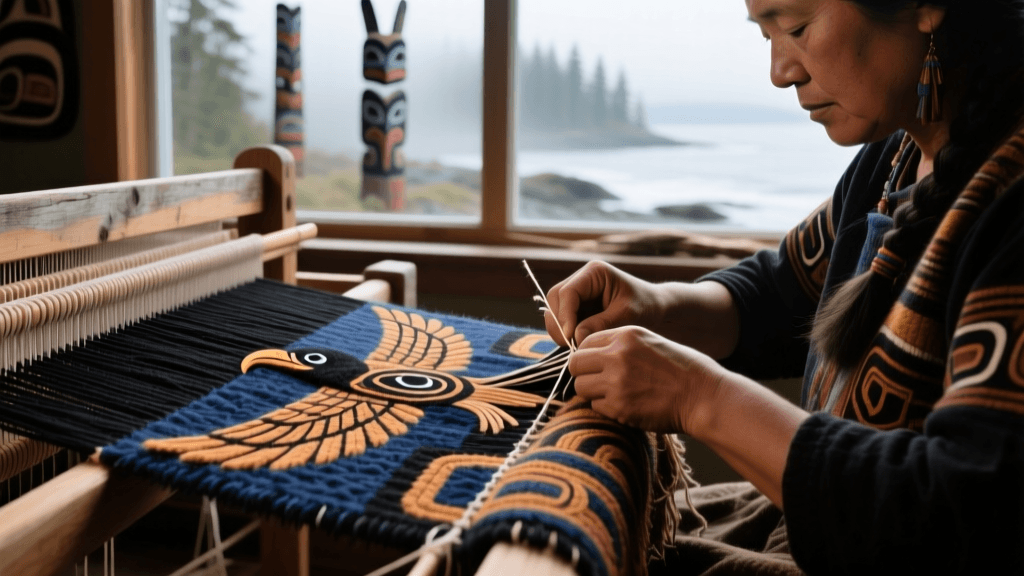
The Chilkat robe, known as Naaxiin in the Tlingit language, is arguably the most recognizable and technically demanding woven garment in North America. Unlike tapestry weaving, which is done on a rigid loom, Chilkat weaving is a form of finger weaving or twining. The weaver works from the top down, suspending the warp threads from a simple crossbar and using their fingers to twist the weft threads around the warps, creating intricate, curvilinear formline designs.
Formline Design and Pattern Boards
The hallmark of a Chilkat robe is its adherence to the Northwest Coast formline art system. The patterns are not freeform; they are meticulously planned using a painted wooden pattern board. Historically, these boards were painted by male artists, while the weaving was exclusively the domain of female master weavers. Today, in 2026, these gender roles have become much more fluid, with both men and women taking on the roles of pattern designer and master weaver. The designs typically feature a central diving whale or bear motif, flanked by symmetrical, stylized animal profiles that interlock seamlessly.
The Fringe and the Dance
A true Naaxiin is designed for movement. The bottom edge of the robe features long, flowing warp fringe. When the robe is worn during a ceremonial dance, the dancer spins and dips, causing the heavy fringe to flare outward in a mesmerizing, fluid motion that mimics the movement of water or the flight of an eagle. This kinetic element is essential; the garment is not considered complete until it has been danced.
Materials and Harvesting in 2026
The creation of a Chilkat robe relies on two primary materials: the wool of the mountain goat (Oreamnos americanus) and the inner bark of the yellow cedar tree. The preparation of these materials is a labor-intensive process that remains largely unchanged, though modern environmental factors have introduced new challenges.
Mountain Goat Wool
Mountain goat wool is prized for its durability, warmth, and ability to hold natural dyes. In 2026, sourcing ethical mountain goat wool requires careful coordination. Because mountain goats are not domesticated, wool is typically gathered from shed hair caught on brush, or from goats harvested by Indigenous hunters for subsistence. The wool must be meticulously cleaned, carded, and spun by hand. A single full-sized dancing robe requires the wool of approximately 10 to 15 mountain goats.
Yellow Cedar Bark
The inner bark (bast) of the yellow cedar provides the core of the warp threads, giving the robe its structure and weight. Harvesting cedar bark is a highly seasonal activity, traditionally done in late spring when the sap is running and the bark peels easily from the wood. However, climate shifts observed in the Tongass National Forest and surrounding regions in 2026 have slightly altered these harvest windows. Weavers must now carefully monitor local microclimates to ensure they harvest the bark at the precise moment of peak pliability, ensuring the core threads do not become brittle over time.
Ravenstail Weaving: The Geometric Predecessor
Before the curvilinear formline designs of the Chilkat robe became dominant, the Northwest Coast was defined by Ravenstail weaving. Ravenstail robes are characterized by their stark, striking geometric patterns, typically woven in natural white, dyed black, and yellow. The designs feature horizontal bands of zigzags, diamonds, and stepped pyramids.
Ravenstail weaving is, in many ways, even more technically restrictive than Chilkat weaving. The geometric patterns require the weaver to count threads with absolute precision; a single miscounted thread can throw off the entire symmetry of the garment. After nearly fading from practice in the late 19th and early 20th centuries, Ravenstail weaving has seen a massive resurgence. According to the Smithsonian National Museum of the American Indian, contemporary Indigenous artists have studied surviving 18th-century fragments in global museum collections to reverse-engineer and revive these complex geometric techniques, bringing Ravenstail back to the ceremonial dance floors of the Pacific Northwest.
Regional and Tribal Variations
While the overarching techniques of Chilkat and Ravenstail weaving are shared across the Northwest Coast, distinct regional and tribal variations exist. The following table outlines the primary differences in terminology, motif styling, and garment application among the three major weaving cultures of the region.
| Tribe | Native Term (Chilkat) | Primary Motif Style | Common Garment Application |
|---|---|---|---|
| Tlingit | Naaxiin | Fluid, Curvilinear Formline | Dancing Robes, Ceremonial Tunics |
| Haida | Naayin | Bold, Interlocking, Dense Formline | Robes, Leggings, Aprons |
| Tsimshian | Various Local Terms | Highly Symmetrical, Structured | Chief's Robes, Potlatch Garments |
These variations are subtle to the untrained eye but are immediately recognizable to community members. A Haida weaver might utilize thicker, bolder black formlines that interlock tightly, leaving very little negative space, while a Tlingit weaver might favor more expansive, flowing lines that allow the natural white of the mountain goat wool to breathe between the dyed sections.
Contemporary Revitalization and 2026 Market Realities
The market for authentic, hand-woven Northwest Coast robes in 2026 is defined by extreme scarcity, high demand, and a deep respect for the time required to produce them. A master weaver will spend anywhere from 1,200 to 2,000 hours completing a single full-sized Chilkat robe. This process often takes between 18 months and three years of dedicated, daily work.
Commissioning and Pricing
Due to the immense labor and the high cost of ethically sourced materials, the financial investment for a commissioned robe is substantial. As of 2026, a full-sized, master-woven Naaxiin typically ranges from $45,000 to $75,000 USD. Smaller garments, such as woven tunics, leggings, or Ravenstail collars, range from $8,000 to $25,000. These prices are not merely reflective of market demand; they are a necessary calculation to provide a living wage for the artisan over the years it takes to complete the piece. Buyers are typically tribal nations purchasing for cultural centers, museums, or high-ranking clan leaders commissioning pieces for potlatches and memorial ceremonies.
Apprenticeships and Education
To combat the historical loss of knowledge, organizations and tribal councils have heavily funded apprenticeship programs. In 2026, these programs pair emerging weavers with recognized masters, providing stipends that allow the apprentices to focus entirely on harvesting materials and mastering the complex finger-twining techniques without the burden of outside employment. This systemic investment is ensuring that the next generation of weavers is fully equipped to carry the tradition forward.
Caring for and Preserving Heritage Garments
Whether held in a museum archive or a private clan collection, the preservation of Chilkat and Ravenstail robes requires specialized care. The organic materials—wool and cedar bark—are highly susceptible to environmental damage if not properly managed.
- Light Exposure: Natural dyes, particularly the vibrant yellows derived from wolf moss or hemlock bark, are highly photosensitive. Garments must be stored in complete darkness and displayed only under UV-filtered, low-lux lighting.
- Humidity and Temperature: The ideal storage environment maintains a relative humidity of 45-55% and a stable temperature of around 65°F (18°C). Fluctuations can cause the cedar bark cores to expand and contract, leading to structural weakening of the warp threads.
- Pest Management: Mountain goat wool is a prime target for clothes moths and carpet beetles. Integrated Pest Management (IPM) strategies, including the use of pheromone traps and regular freezing protocols for newly acquired items, are essential in 2026 to prevent catastrophic infestations.
- Handling: Robes should never be lifted by the shoulders or the delicate fringe. They must be supported from underneath with acid-free tissue paper and stored flat in custom-built, archivally safe drawers rather than hung on hangers, which can cause irreversible stretching of the heavy textile.
Conclusion
The Chilkat and Ravenstail weaving traditions of the Pacific Northwest are far more than historical artifacts; they are vital, breathing expressions of Indigenous identity and resilience. As we move through 2026, the dedication of Haida, Tlingit, and Tsimshian weavers ensures that the rhythmic twisting of mountain goat wool and yellow cedar bark will continue to echo through the cedar longhouses and cultural centers of the Northwest Coast. By understanding the profound technical skill, cultural significance, and material realities of these garments, we can better appreciate and support the Indigenous artisans who keep this magnificent textile tradition alive.