Niuean Ti Tapa Cloth Beating And Fermented Bark Dyeing Methods
Roots in the Limestone: Niue’s Unique Tapa Tradition
Niuean ti tapa cloth stands apart from other Pacific barkcloth traditions—not only in its material but in its ecological and ritual specificity. Unlike the paper mulberry (Broussonetia papyrifera) used across Polynesia for kapa and ngatu, Niuean artisans exclusively employ the inner bark of the ti plant (Cordyline fruticosa), a hardy, red-stemmed species native to coastal limestone terraces. This choice reflects deep environmental knowledge: ti thrives where soil is thin and alkaline, conditions that dominate over 90% of Niue’s landmass. The island’s volcanic origin and porous coral-limestone geology mean freshwater lenses are shallow and vulnerable—making sustainable harvesting protocols non-negotiable. Artisans gather bark only during the dry season (May–October), when sap flow is minimal and fibre strength peaks. Each harvested stem yields an average of 1.2 metres of usable inner bark after scraping—a precise measurement recorded by the Niue National Museum’s 2021 ethnobotanical survey.
Beating Techniques: Rhythm, Resistance, and Resonance
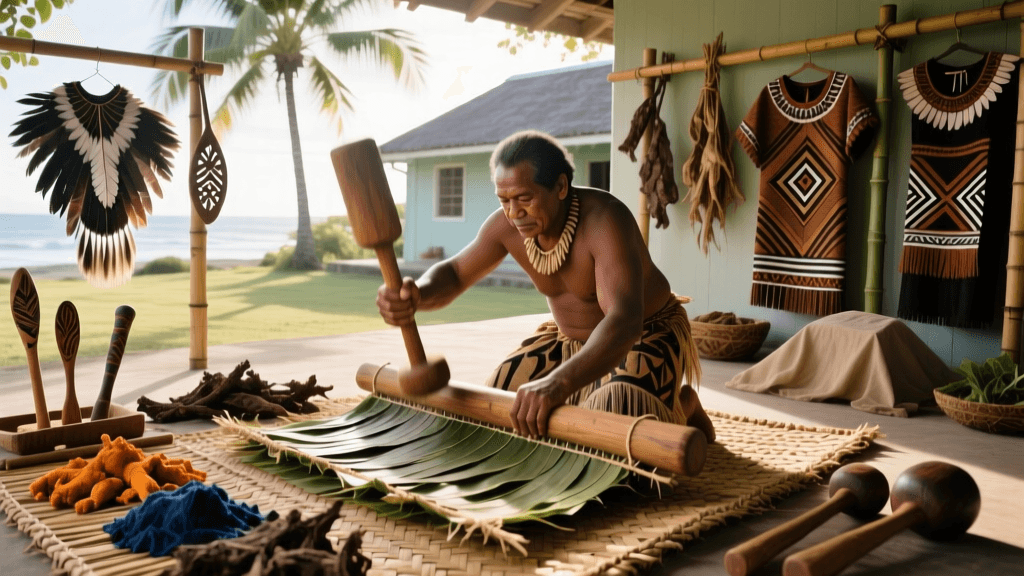
Beating ti bark into cloth demands both physical endurance and acoustic attunement. Niuean beaters use two distinct wooden mallets: a heavy, grooved primary beater (tō’ā) weighing approximately 1.8 kg, and a lighter, smooth secondary beater (tō’ā fakamā) of 0.65 kg. Unlike Tongan or Samoan ngatu beating—which relies on rhythmic, horizontal strokes—Niuean technique employs vertical, downward pressure with controlled rebound. This method exploits the natural tensile strength of ti fibres, which align longitudinally and resist lateral stretching. Beatings occur in shaded, open-air workshops near the village of Alofi South, where humidity remains between 72–78% year-round—optimal for fibre pliability without microbial degradation.
The Four-Stage Beating Cycle
- Stage One: Initial pounding lasts 45–60 minutes per sheet, using the tō’ā’s coarse grooves to separate fibre bundles.
- Stage Two: Fibres are folded and rotated 90°; beating continues for 30 minutes with medium grooves to encourage cross-fibre bonding.
- Stage Three: A second fold introduces diagonal alignment; smooth-beater work begins, lasting 20 minutes to compress and polish.
- Stage Four: Final smoothing occurs over damp banana leaves for precisely 12 minutes—timed to prevent overdrying or slippage.
This cycle produces sheets averaging 1.5 m × 0.9 m, with a finished thickness of 0.3–0.4 mm—thinner than Fijian masi (0.6 mm) yet denser than Hawaiian kapa (0.25 mm). The resulting fabric exhibits a distinctive matte sheen and subtle striation pattern, visible only under raking light.
Fermented Bark Dyeing: Microbial Alchemy and Ancestral Knowledge
Dyeing ti tapa relies not on direct pigment application but on controlled microbial fermentation of mangrove bark (Rhizophora stylosa). Harvested only from mature, undisturbed stands along the Makapu coastline, the bark is soaked in seawater for exactly 14 days at ambient temperature (24–26°C). During this period, indigenous halophilic bacteria—including Halomonas variabilis strains isolated by the University of the South Pacific’s Lab of Pacific Ethnobiology in 2019—break down tannins into soluble catechol derivatives. These compounds oxidise upon exposure to air, yielding rich, iron-resistant brown hues ranging from amber (pale soak) to near-black (extended oxidation).
Protocol-Driven Application
- Bark extract is strained through finely woven pandanus fibre mesh—woven to 22 threads per cm, a standard maintained since pre-contact times.
- Cloth is immersed for precisely 7 minutes, then hung vertically on coconut-frond racks spaced 30 cm apart to ensure uniform airflow.
- Oxidation occurs over three consecutive days, with cloth turned manually at sunrise and sunset—never at midday, as intense UV degrades chromophores.
Each dye bath serves no more than four cloths before renewal; exceeding this threshold risks inconsistent colour depth and microbial imbalance. The Niue Cultural Centre in Alofi North maintains a living archive of 17 documented dye batches, each logged with pH, salinity, and ambient temperature readings.
Cultural Protocols and Ceremonial Context
Ti tapa is never worn casually. Its use is governed by strict genealogical and spatial rules codified in the Talanoa o Niue oral compendium, transcribed by the Niue Department of Culture and Heritage in 2016. A chief’s ceremonial cloak (ta’oga) must consist of seven joined sheets—each representing one of Niue’s traditional districts—and may only be worn during the annual Faka’apa’apa ceremony at the ancient stone platform of Tufui, located 2.3 km inland from Avatele Bay. Women preparing cloths observe a 48-hour fast prior to beating, abstaining from salt and pork—dietary restrictions linked to the belief that impurities weaken fibre cohesion. Men handling dyed cloth must first bathe in freshwater springs at Hikulani, a site protected under Niue’s 2002 Protected Areas Act.
The cloth’s symbolic weight extends beyond ritual. In marriage negotiations, a bride’s family presents a ti tapa bundle measuring exactly 3.6 metres in length—the number referencing the ancestral voyaging canoe Te Vaka o Tafiti’s recorded hull length in oral histories. This measurement is verified using a calibrated niu (coconut palm) ruler, preserved at the Niue National Museum.
Institutional Stewardship and Intergenerational Transmission
Sustaining these methods requires institutional scaffolding. The University of the South Pacific’s Pacific Islands Museums Association (PIMA) partnered with Niue’s Department of Culture and Heritage in 2020 to digitise 42 hours of master artisan interviews, including detailed audio recordings of beating rhythms—each tempo mapped to heart-rate variability data to confirm physiological synchronicity. Meanwhile, the Niue Community College runs a certified apprenticeship program requiring 320 supervised hours over 18 months, with competency assessed via timed beating trials (target: 1.5 m² completed within 110 minutes) and dye consistency testing using spectrophotometric analysis.
One critical innovation emerged from collaborative research: the reintroduction of tī tāua (Cordyline banksii), a taller, higher-yield ti variant once cultivated in household gardens but nearly lost after Cyclone Heta in 2004. Field trials conducted between 2018–2022 across six villages showed that tī tāua stems yield 2.1 m of usable bark per harvest—68% more than wild C. fruticosa—without compromising fibre integrity. This finding was published by PIMA in its Pacific Ethnographic Conservation Report (2023).
“The beating isn’t just about flattening bark—it’s about listening to the land’s pulse. When the mallet hits right, you hear the echo of the reef, the sigh of the limestone caves. That sound tells you the cloth remembers who we are.” — Sione Tavita, Master Artisan, Niue National Museum, 2022
| Material | Harvest Window | Fibre Yield per Stem | Dye Soak Duration | Finished Cloth Thickness |
|---|---|---|---|---|
| Ti (Cordyline fruticosa) | May–October | 1.2 m | 14 days | 0.3–0.4 mm |
| Mangrove (Rhizophora stylosa) | July–September only | Not applicable | 14 days | N/A |
These practices remain inseparable from place. The limestone sinkholes near Makefu Village serve as natural fermentation pits, their stable 22.4°C subterranean temperatures enabling year-round experimental dye trials. At the Uluvehi Cave Complex, elders conduct seasonal knowledge transfer sessions inside chambers whose acoustics amplify the resonance of beating—ensuring rhythm fidelity across generations. Such grounded pedagogy resists abstraction: every measurement, every timing, every restriction emerges from centuries of calibrated observation—not theory, but testimony written in bark, water, and stone.