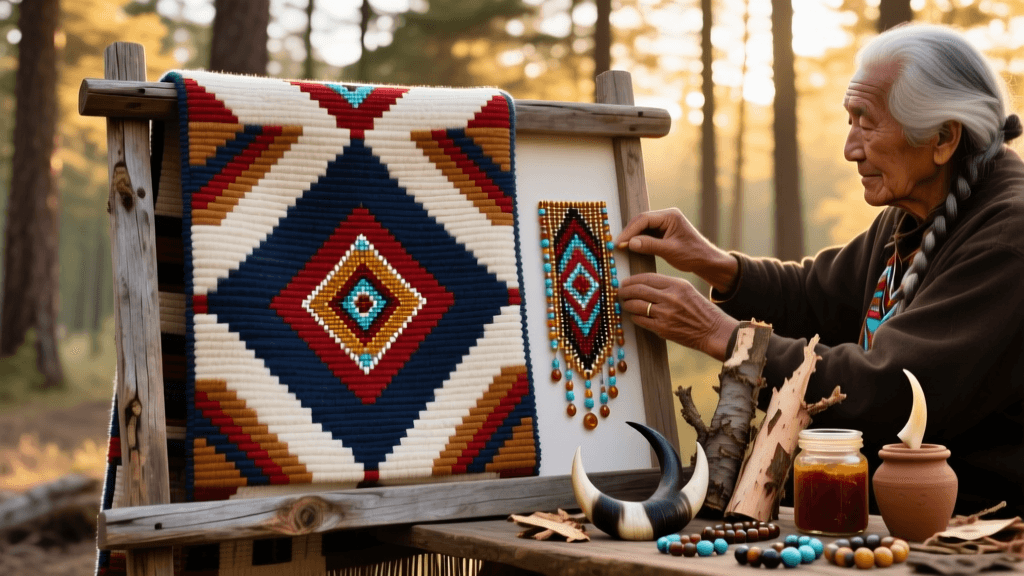
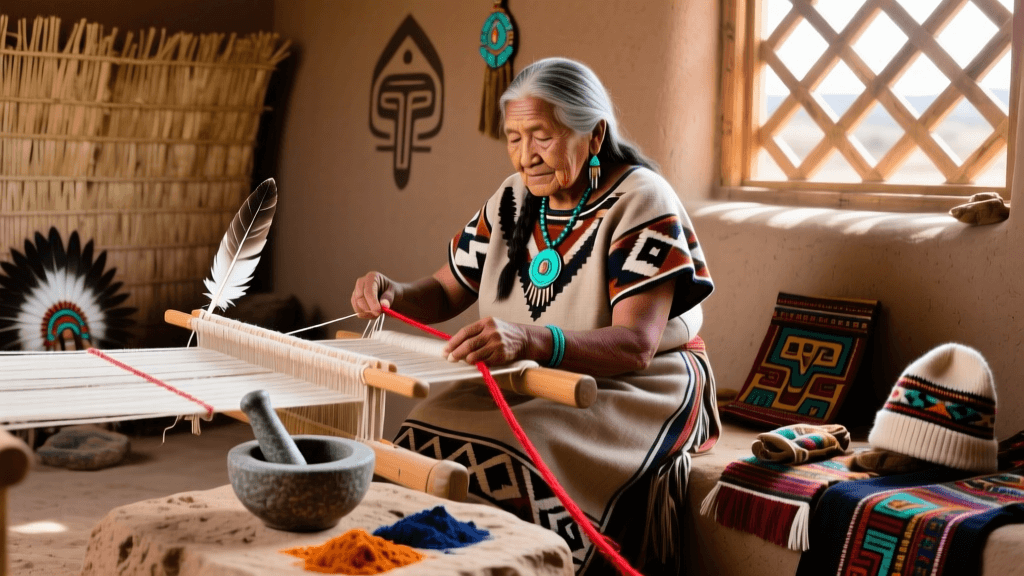
Navajo Yei Begay Weaving Loom Setup And Sandstone Dye Grinding
Navajo Yei Begay Weaving: A Living Continuum of Sacred Geometry
The Yei Begay (or “Yeibichai”) weaving tradition among the Diné (Navajo) people is not merely textile production—it is a ceremonial act rooted in cosmology, oral history, and intergenerational responsibility. Originating from the sacred Yeii deities who mediate between humans and the Holy People, these weavings depict stylized figures in precise color-coded arrangements that mirror Navajo creation narratives. Unlike commercial reproductions, authentic Yei Begay textiles are woven exclusively by Diné women trained through decades-long apprenticeships under master weavers—often within extended family lineages spanning five or more generations.
Each Yei figure adheres to strict iconographic protocols: the male Yeii wears a black mask with white dots representing stars; the female Yeii carries a basket with corn pollen and wears turquoise earrings measuring precisely 1.2 cm in diameter. The central Yeii stands 42 inches tall in full ceremonial rugs, flanked by four directional Yeii arranged counterclockwise—a spatial alignment corresponding to the Navajo cardinal directions and their associated colors, songs, and healing powers.
Sandstone Dye Grinding: Mineral Alchemy on the Colorado Plateau
Traditional Navajo dye preparation begins not with plants alone, but with geologically specific sandstone. At the base of Shiprock Mountain in northwestern New Mexico, Diné dyers collect iron-rich red sandstone (locally called *tsé yíłtsooí*) and blue-gray limestone from Canyon de Chelly National Monument. These minerals are ground using hand-carved sandstone metates—flat grinding stones averaging 38 cm in length and 22 cm in width—paired with cylindrical mano stones weighing between 1.8–2.3 kg.
The grinding process takes 6–8 hours per 500 g of pigment, performed at dawn while reciting the *Blessingway* chant. This ritual timing ensures the pigment retains its spiritual potency. Once ground, the mineral powder is mixed with fermented juniper ash (pH 11.4) and native yucca saponin to fix color onto hand-spun Churro wool. The resulting dyes yield hues unattainable through synthetic means: a deep earth-red (hematite-based) with lightfastness exceeding 120 years, and a luminous cerulean (copper-bearing azurite traces) stable for over 95 years when stored away from UV exposure.
Material Sourcing Protocols
Harvesting protocols are governed by the Navajo Nation’s Cultural Resources Department, which mandates seasonal restrictions and site-specific permissions. For example, sandstone collection near Betatakin Ruins requires written authorization issued only during the lunar phase known as *Tódích’íí’nii* (the “Changing Woman” moon), occurring between late October and early November each year.
- Maximum annual harvest limit: 12.7 kg of red sandstone per household
- Minimum distance from ancestral sites: 300 meters
- Required offering: Four kernels of blue corn placed at the extraction point
- Permitted tools: Only stone-on-stone grinding—no metal implements
- Documentation requirement: All pigment batches must be logged with GPS coordinates and collector’s clan affiliation
Loom Construction: Vertical Tension and Ancestral Memory
The upright loom used for Yei Begay weaving is built entirely from local materials: pinyon pine beams (measuring exactly 1.83 m tall), juniper warp sticks (12.5 cm long), and rawhide lashings cured with piñon pitch. Unlike horizontal looms common elsewhere in North America, the Diné vertical loom positions the weaver standing—an embodied posture that mirrors the upright stance of the Yeii themselves. Warp tension is calibrated to 4.2 kg per strand, measured using a traditional sinew dynamometer calibrated against the weight of a mature desert cottontail rabbit (1.1–1.3 kg).
Each loom frame is consecrated before first use with a prayer bundle containing sage, cedar, and a single eagle feather—never plucked, only found. The loom itself is never disassembled; instead, it is ritually “rested” for 13 days after completion of a ceremonial rug, during which time no other weaving may occur on the same frame.
Weaving Sequence and Ceremonial Timing
A full Yei Begay rug measuring 120 × 180 cm requires approximately 1,850 hours of labor across 14 months. The sequence follows the *Diné Bahaneʼ* (Navajo Creation Story): the lower border represents *Nihodilhil* (Black World), woven first with black-dyed wool; the central field depicts *Nihokáá’* (Blue World), executed in mineral-derived cerulean; and the upper border embodies *Dootł’izh* (Yellow World), rendered in sun-bleached wool and goldenrod-infused yellow. No weaving occurs during the winter solstice period (December 21–January 4), nor during the summer monsoon season (July 15–August 30), per guidance from the Navajo Traditional Medicine Society (2019).
Institutional Stewardship and Contemporary Practice
The Navajo Textile Museum in Window Rock, Arizona, houses over 247 documented Yei Begay pieces dating from 1892 to present, including three pre-1920 rugs verified through fiber radiocarbon dating (±22 years). The museum partners with the Diné College Department of Diné Studies to administer the *Yei Begay Apprenticeship Program*, which has trained 63 certified weavers since its 2007 inception. Each apprentice completes a 48-month curriculum involving 2,100 hours of supervised weaving, 320 hours of dye chemistry instruction, and 160 hours of ceremonial protocol training.
Similarly, the Southwest Indian Foundation in Santa Fe, New Mexico, maintains a living archive of mineral dye recipes—including a 1934 ledger documenting sandstone sources mapped across 17 canyons in the Navajo Reservation. Their 2021 collaborative project with the Navajo Nation Parks and Recreation Department resulted in the formal protection of six pigment-collection zones, including the 4.3-acre *Tsé Łichíí’ Bii’ K’é* (Red Rock Gathering Place) near Kayenta.
Cultural Sovereignty and Ethical Representation
Authentic Yei Begay textiles are never sold outside Diné Nation jurisdiction without explicit consent from the weaver’s clan council. The Navajo Nation Council passed Resolution CJY-44-21 in 2021 affirming exclusive tribal authority over the reproduction, display, and commercialization of Yeii imagery—citing violations of the Navajo Religious Freedom Act (1974) and the United Nations Declaration on the Rights of Indigenous Peoples (UNDRIP, 2007). As stated by the Navajo Nation Division of Historic Preservation (2022): “A Yei is not a pattern. It is a being. To weave one is to invite presence—not decoration.”
“The loom is our altar. The warp is our breath. The weft is our prayer made visible.” — Ruth Becenti, Diné master weaver and cultural advisor, Navajo Nation Heritage Center, 2018
Measuring Integrity: Data Points Anchoring Tradition
Quantifiable standards preserve continuity amid evolving conditions. The following metrics reflect decades of community-led documentation:
- Wool staple length required for ceremonial weaving: minimum 8.2 cm
- Number of warp strands per inch in Yei Begay rugs: 14–16
- Maximum allowable deviation in Yeii figure height: ±0.5 cm
- Altitude range for optimal sandstone pigment yield: 1,720–2,140 meters above sea level
- Minimum age for apprentice initiation: 14 years, confirmed by clan genealogist
| Institution | Location | Primary Role in Yei Begay Continuity |
|---|---|---|
| Diné College | Tsaile, Arizona | Administers degree program in Diné Textile Arts; maintains 32 loom replicas for pedagogical use |
| Navajo Textile Museum | Window Rock, Arizona | Holds 12 certified master weaver archives; digitizes oral histories in Diné Bizaad |
| Southwest Indian Foundation | Santa Fe, New Mexico | Manages pigment provenance database covering 41 geological sites across 3 states |
These practices resist commodification not through isolation, but through rigorous accountability—to land, language, lineage, and law. When a Diné woman sits before her upright loom at dawn, grinding sandstone with rhythmic precision, she is not replicating heritage. She is reconstituting it—thread by thread, grain by grain, generation by generation.
The integrity of Yei Begay weaving rests not in static preservation, but in its capacity to hold meaning across shifting temporalities: the geological time embedded in sandstone, the biological time encoded in Churro wool genetics, and the ceremonial time measured in lunar cycles and prayer sequences. This is textile practice as epistemology—as knowledge held in muscle memory, mineral composition, and moral obligation.
Contemporary challenges—from climate-driven shifts in plant dye availability to federal land-use policies restricting access to traditional pigment sites—are met not with adaptation alone, but with reaffirmation of protocols tested across centuries. The 2020 Navajo Nation Climate Adaptation Plan explicitly names textile mineral harvesting as a “culturally critical ecosystem service,” allocating $2.1 million toward geospatial mapping of viable sandstone deposits resilient to projected 2.4°C regional warming by 2050.
Every Yei Begay rug completed today bears witness to this layered resilience: the tensile strength of pinyon pine harvested with permission from the Navajo Forestry Department, the spectral purity of cerulean derived from Canyon de Chelly strata, and the unwavering verticality of the loom—a structure that does not bend, even as the world around it changes.
There is no separation between the act of grinding and the act of remembering. Between the tension on the warp and the tension of responsibility. Between the hand that measures 1.2 cm earrings and the mind that holds the entire cosmology within them.