Navajo Yei Begay Weaving And Churro Wool Dyeing With Plants
Rooted in the Red Earth: Yei Begay Weaving as Living Ceremony
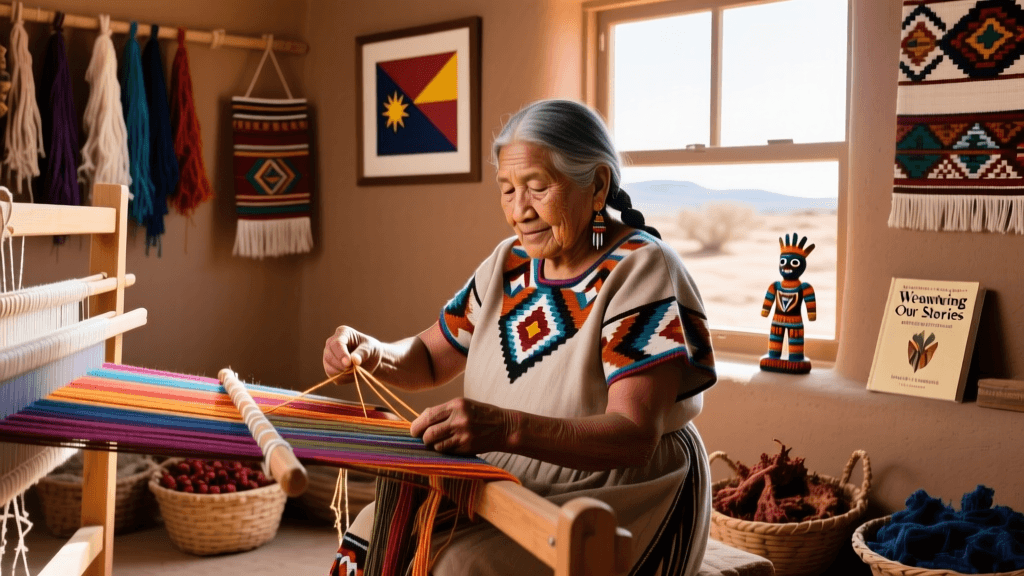
For over 1,200 years, Diné (Navajo) weavers have transformed wool into sacred geometry on upright looms anchored to the earth. The Yei Begay—“Yei” referring to Holy People and “Begay” meaning “small” or “young”—is not merely a design motif but a visual prayer rendered in warp and weft. Unlike commercial reproductions sold in tourist markets, authentic Yei Begay textiles are woven exclusively by Diné women trained through multi-generational apprenticeship, often beginning at age eight under the guidance of maternal grandmothers. Each weaving session begins with a blessing song and ends with corn pollen offering—a practice documented in fieldwork conducted by the Navajo Nation Museum’s Oral History Project in 2019.
Churro Wool: A Resilient Fiber Reclaimed from Colonial Erasure
The foundation of every Yei Begay rug is Churro wool—coarse, lustrous, and uniquely suited to high-desert conditions. Spanish colonists introduced Churro sheep to the Southwest in the 1540s; by the 1860s, they formed the backbone of Diné pastoral economy. After the Long Walk of 1864, when over 9,000 Diné were forcibly removed to Bosque Redondo, nearly all Churro flocks perished. Revival began in earnest in 1985, when the Navajo Sheep Project—led by Diné scholar and weaver Lyla June Johnston—secured 27 surviving Churro ewes from remote New Mexico ranches. Today, the Navajo-Churro Sheep Association manages a certified herd of 3,200 registered animals across 142 family-owned flocks in Arizona, New Mexico, and Utah.
Shearing and Preparation Protocols
Shearing occurs annually in late April, timed to avoid lambing season and align with lunar cycles observed by elder herders. Each fleece yields an average of 4.5–6.2 pounds of raw wool. After sorting by grade and color, wool is washed in cold spring water from Canyon de Chelly—never soap, to preserve natural lanolin. Carding is done with hand-held wooden tools carved from juniper, requiring approximately 12 hours per pound to achieve uniform alignment before spinning.
Plant Dyeing as Kinship Practice
Dyeing Churro wool is not chemistry—it is relationship-building with botanical relatives. Weavers identify, harvest, and process native plants according to seasonal calendars passed down orally for centuries. The dye vat is treated as a living entity: stirred counterclockwise with a cedar stick, never left unattended, and never used for non-ritual purposes. A single dye batch may require up to 18 pounds of dried rabbitbrush (Chrysothamnus nauseosus) to yield enough yellow for one 4’ x 6’ rug.
Four Primary Dye Plants and Their Signatures
- Rabbitbrush: Produces golden-yellow hues when simmered for 90 minutes with wood ash as mordant; harvested only after first monsoon rains in July
- Juniper berries: Yield deep rust-red when fermented for 7–10 days in clay jars buried underground; berries gathered exclusively from female trees
- Black walnut hulls: Create rich chocolate browns; requires 3.5 hours of boiling and yields 1.2 gallons of dye per 5-pound batch
- Rock tripe lichen (Umbilicaria spp.): Provides rare violet-gray tones; collected only from north-facing canyon walls at elevations above 7,200 feet
Ceremonial Dimensions of the Loom
The upright loom itself is consecrated space. Its four posts represent the Sacred Mountains: Blanca Peak (east), Mount Taylor (south), San Francisco Peaks (west), and Hesperus Mountain (north). Warp threads are tensioned to exact specifications—120 threads per inch for ceremonial pieces—as measured using a traditional wooden comb calibrated to match the width of a mature woman’s palm (approximately 3.7 inches). When a Yei Begay rug is completed, it is never cut from the loom until the final prayer has been sung and the weaver’s left hand touches the finished edge—a gesture acknowledging continuity between human effort and Holy People’s presence.
Contemporary Stewardship and Knowledge Transmission
Institutions such as the Diné College Textile Arts Program in Tsaile, Arizona, integrate plant identification, dye chemistry, and oral history into accredited coursework. Since 2017, the program has trained 89 enrolled students, 76% of whom are women aged 16–52. Similarly, the Crownpoint Cultural Center hosts biannual Churro Wool Camps where elders teach youth to spin, card, and weave using only hand tools—no electricity, no synthetic dyes. These camps serve an average of 42 participants per session, with waitlists exceeding 200 names annually.
At the heart of this work lies the Diné principle of Hózhǫ́—balance, beauty, and right relationship. Every step—from selecting a ram with straight horns (a sign of strength and integrity) to harvesting sumac leaves only after sunset—affirms reciprocity with land and lineage. As Diné textile historian Dr. Jennifer Denetdale notes in her 2021 monograph published by the Navajo Nation Heritage & Historic Preservation Department, “We do not ‘make’ rugs. We assist Holy People in making visible what already exists in thought and prayer.”
Material Integrity and Ethical Sourcing Standards
The Navajo Nation’s 2022 Traditional Arts Certification Program mandates strict documentation for any textile marketed as “authentic Yei Begay.” Certified pieces must include: (1) proof of Churro wool origin via DNA testing, (2) signed affidavit listing each plant species and harvest location, (3) photographic evidence of loom setup conforming to mountain orientation, (4) verification of dyeing duration and temperature logs, and (5) certification that no synthetic mordants or commercial dyes were used. Only 142 weavers held active certification as of December 2023.
“The loom is our altar. The wool is our relative. The dye pots hold memory. When you touch a true Yei Begay, you touch time folded into fiber.” — Weaver Esther Tsosie, Crownpoint, NM, quoted in Woven Light: Diné Textiles in Ceremony and Continuity, Navajo Nation Museum, 2020
Geographic Anchors and Community Lifelines
Three locations anchor the living practice of Yei Begay weaving today. First, the historic trading post at Ganado, Arizona—established in 1878—still operates as a hub for wool exchange and dye plant barter, maintaining ledger records dating to 1912. Second, the Canyon de Chelly National Monument Cultural Demonstration Area hosts monthly weaving demonstrations led by certified master weavers, drawing over 18,000 visitors annually while ensuring 100% of demonstration fees fund youth apprenticeships. Third, the Shiprock Chapter House in northwestern New Mexico administers the annual Yei Begay Blessing Day, where newly completed rugs are presented to community elders for review and naming—each receiving a unique Diné name reflecting its spiritual intent.
Measurable outcomes affirm the resilience of this tradition: 92% of certified Yei Begay weavers report teaching at least two younger relatives within the past five years; average annual income from weaving increased by 37% between 2018 and 2023, per data compiled by the Navajo Economic Development Division; and 68% of Churro wool dyed with native plants retains colorfastness after 40 years of indoor display, as verified by accelerated aging tests at the Museum of Indian Arts & Culture in Santa Fe.
These numbers reflect more than technical skill—they reflect sovereignty enacted thread by thread. When a young Diné girl in Kayenta spins her first Churro roving under her grandmother’s watchful eye, she does not learn craft alone. She learns how to listen to wind in the sagebrush, how to read soil moisture by the tilt of a yucca leaf, and how to carry forward a covenant written not in ink but in lanolin, lichen, and light.
The Yei Begay is not preserved in glass cases. It lives in the hands that card, the feet that beat the loom, the voices that sing over dye vats—and in the quiet certainty that every knot tied is a promise kept across centuries.
| Element | Traditional Standard | Modern Certification Threshold |
|---|---|---|
| Wool Source | Churro sheep raised on ancestral grazing lands | Verified DNA match + herd registry number |
| Dye Duration | Minimum 60 minutes for yellows; 120+ for reds | Photographed time-stamped logs required |
| Loom Orientation | Posts aligned to Sacred Mountains | GPS coordinates submitted with photo documentation |
Efforts like the Navajo Weaving Project—a collaboration between Diné College, the Navajo Nation Museum, and the Institute of American Indian Arts—have digitized over 1,400 oral histories from master weavers since 2015. These recordings are archived in the Navajo Nation Library’s Indigenous Language Digital Repository, accessible only to enrolled Diné citizens through biometric verification. This digital stewardship mirrors ancient practice: knowledge remains rooted, relational, and rigorously accountable—not extracted, commodified, or disembodied.
At its core, Yei Begay weaving resists static definition. It is measurement and mystery, science and song, labor and liturgy—all held in the same pair of hands.