Nanjing Yunjin Drawloom Weaving: 2026 Artisan Preservation Guide
The Renaissance of the Da Hua Lou: Yunjin Weaving in 2026
In the landscape of Asian traditional textiles, few techniques command the reverence and technical awe of Nanjing Yunjin, or 'Cloud Brocade.' Recognized for its intricate patterns, vibrant colors, and liberal use of gold and silver threads, Yunjin represents the pinnacle of Chinese silk weaving. As we navigate the textile renaissance of 2026, the ancient wooden drawloom—known as the Da Hua Lou—remains an irreplaceable marvel of mechanical engineering and human synchronization. Despite the rapid advancement of AI-driven textile manufacturing, the authentic creation of Yunjin brocade remains strictly bound to traditional wooden drawlooms and the memory-based oral coding of master artisans.
The year 2026 has seen a massive surge in demand for authentic Yunjin accents, driven by the maturation of the Xin Zhongshi (New Chinese Style) movement. High-end fashion houses in Shanghai and Paris are no longer satisfied with digital prints mimicking brocade; they demand genuine, hand-woven Yunjin panels. This guide explores the mechanics of the traditional drawloom, the rigorous synchronization required by its weavers, and how modern preservation techniques are keeping these colossal wooden structures functional in the mid-2020s.
The Anatomy of the Traditional Yunjin Drawloom
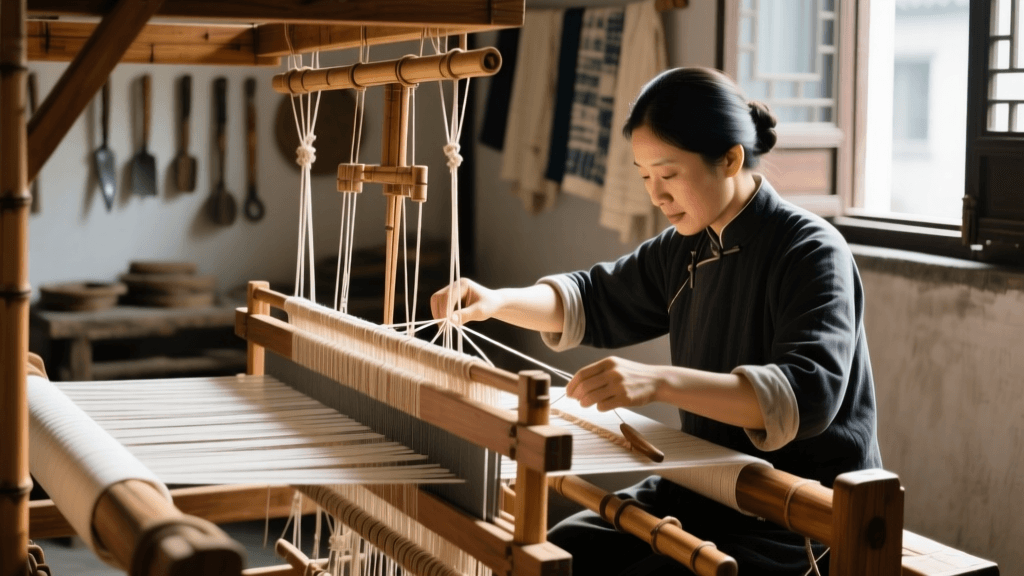
The Da Hua Lou is not merely a tool; it is a massive, room-dominating architectural structure. A standard traditional Yunjin drawloom measures approximately 5.6 meters in length, 1.4 meters in width, and an imposing 4 meters in height. It is constructed entirely from interlocking wood, utilizing traditional mortise and tenon joints without the use of iron nails, which could rust and damage the delicate silk warp threads over time.
The loom is divided into two distinct operational levels, requiring a two-person team:
- The Upper Level (The Flower Tower): Positioned at the top of the 4-meter structure, the 'puller' (or Tiaohua artisan) sits amidst a complex web of vertical harness cords. This artisan is responsible for lifting specific warp threads according to the pattern draft.
- The Lower Level (The Weaving Pit): The 'weaver' (or Zhihua artisan) sits at the base, managing the shuttle, the reed, and the insertion of the supplementary weft threads, which include the precious metal foils and peacock yarns.
According to the UNESCO Intangible Cultural Heritage registry, the complexity of the Yunjin technique lies in its 'memory-based' pattern drafting. Unlike the Jacquard loom, which relies on punch cards or digital files, the Yunjin drawloom relies on a physical matrix of knotted cords and an oral tradition where the upper-level artisan 'sings' or chants the pattern code to the lower-level weaver to maintain rhythm and synchronization.
Setting Up the Warp: The 14,000 Thread Challenge
Before a single centimeter of brocade can be woven, the loom must be dressed. A standard Yunjin fabric requires between 12,000 and 14,000 individual warp threads. In 2026, while synthetic sizing agents and laser-guided tension meters are used in commercial silk mills, master Yunjin workshops strictly adhere to traditional rice-starch sizing and manual tensioning.
The threading process takes a team of four artisans nearly three weeks to complete. Each warp thread must be passed through the heddle eyes and the reed with microscopic precision. If a single thread is crossed or tensioned incorrectly, the resulting brocade will feature a visible 'barre' defect, ruining months of subsequent weaving. Today's master weavers utilize specialized magnifying visors and LED micro-lighting to inspect the warp plane, blending ancient methodology with modern ergonomic aids.
Traditional Drawloom vs. Modern Looms: A 2026 Comparison
To understand why the Da Hua Lou remains relevant in 2026, we must compare it to modern alternatives. While smart Jacquard looms can produce brocade-like fabrics at high speeds, they cannot replicate the structural integrity and specific 'relief' texture of true Yunjin.
| Feature | Traditional Da Hua Lou (Drawloom) | 2026 Smart Jacquard Power Loom | Manual Waist Loom (Zhuanghua) |
|---|---|---|---|
| Artisan Requirement | 2 (Puller and Weaver) | 1 (Machine Operator/Programmer) | 1 (Solo Weaver) |
| Daily Output | 5 to 6 centimeters | 50 to 80 meters | 10 to 15 centimeters |
| Material Compatibility | Heavy mulberry silk, gold leaf, peacock feather yarn | Standard silk, synthetic blends, fine metallic threads | Cotton, hemp, standard silk |
| Pattern Complexity | Unlimited (Memory/Knot matrix) | High (Digital file limits) | Low to Medium (Manual pickup) |
| Cultural Value | Masterpiece / Museum Grade | Commercial / Haute Couture Base | Folk Art / Regional Traditional |
As noted by textile conservators at the Victoria and Albert Museum's Textile Department, the structural difference lies in the 'digging' technique. The traditional drawloom allows the weaver to interlock discontinuous wefts, meaning colors can be swapped in specific zones without carrying the thread across the entire back of the fabric. This creates a fabric that is incredibly rich on the face but relatively lightweight and flat on the reverse—a feat modern power looms still struggle to replicate perfectly with heavy metallic yarns.
Material Sourcing: Gold Foil and Peacock Yarn in 2026
The soul of Yunjin brocade lies in its opulent materials. In 2026, sourcing authentic materials has become a specialized industry of its own.
- Gold and Silver Foil Threads: Authentic Yunjin does not use metallic-painted plastic. Artisans use genuine gold leaf, beaten to a thickness of 0.12 microns, and adhered to a specialized paper backing made from bamboo and mulberry bark. This paper is then sliced into micro-threads and wrapped around a silk core. A single meter of authentic gold-wrapped thread can cost upwards of $400 USD in the current market.
- Peacock Feather Yarn: Sourced ethically from molted feathers, the iridescent 'eye' barbs are hand-twisted with raw silk. The 2026 market has seen a stabilization in peacock yarn supply chains from Southeast Asia, making it slightly more accessible to mid-tier Xin Zhongshi designers, though it remains a premium luxury material.
Preservation and Apprenticeships in the Xin Zhongshi Era
The physical preservation of the wooden drawlooms is a critical focus in 2026. Antique looms, some dating back over a century, are highly susceptible to humidity fluctuations. Modern workshops in Nanjing have integrated non-invasive IoT (Internet of Things) climate sensors directly into the wooden joinery of the looms. These sensors monitor internal moisture content and ambient humidity, triggering localized micro-misters or dehumidifiers to ensure the wood does not warp, which would instantly alter the tension of the 14,000 warp threads.
Furthermore, 3D laser scanning is now routinely used to map the intricate wooden gears and harness pulleys of historic looms. If a wooden component fractures under tension, artisans can mill an exact replica using traditional woods (like elm or pearwood) within hours, ensuring the loom's historical integrity and operational continuity.
'The loom is not just wood and string; it is a living archive. When the upper weaver chants the pattern code, they are speaking a language that has echoed in Nanjing for over seven hundred years. Our job in 2026 is not to change the language, but to ensure the room it is spoken in never collapses.'
— Master Weaver Zhou, Nanjing Cloud Brocade Research Institute.
Studying the Drawloom: Advice for Textile Enthusiasts
For researchers, designers, and textile enthusiasts looking to study the Da Hua Lou in person, 2026 offers unprecedented access through specialized cultural tourism and academic fellowships.
- Nanjing Cloud Brocade Museum: The premier destination for observing active drawlooms. Visitors can watch the two-weaver synchronization and view the raw material processing.
- Jiangning Imperial Silk Manufacturing Museum: Offers deep historical context on how the drawlooms were standardized during the Ming and Qing dynasties to supply the imperial court.
- Apprenticeship Programs: Several Xin Zhongshi fashion conglomerates are now funding 3-year paid apprenticeships for young weavers, attempting to bridge the demographic gap. Designers are encouraged to partner with these workshops early in the design phase, as commissioning a custom Yunjin panel requires drafting a new physical knot-matrix, a process that takes months before weaving even begins.
Understanding the Nanjing Yunjin drawloom is essential for anyone serious about Asian textile traditions. It is a testament to the fact that true luxury in 2026 is not defined by speed or automation, but by the irreplaceable rhythm of human hands, the chanting of ancient codes, and the meticulous interlacing of silk and gold.