Lebanese Tarboush Felting And Embroidered Tarboosh Cover Techniques
Origins and Historical Context of the Tarboush in Levantine Dress
The tarboush—commonly known in English as the fez—is not merely a head covering but a textile artifact shaped by centuries of political, religious, and commercial exchange across the Eastern Mediterranean. Originating in the 13th century in Fez, Morocco, it migrated eastward along the Silk Road and maritime trade routes, gaining prominence in Ottoman territories by the early 19th century. Sultan Mahmud II mandated its adoption in 1826 as part of military modernization reforms, replacing the turban with standardized red felt headgear for civil and military officials. By the 1840s, tarboush production had become centralized in Istanbul’s Grand Bazaar workshops, where over 200 specialized artisans processed up to 15,000 units monthly using locally sourced wool from Anatolian sheep breeds.
In Lebanon, the tarboush evolved distinct regional characteristics due to localized dyeing practices and artisanal networks. Unlike the rigid, machine-pressed Ottoman version, Lebanese tarboush felting emphasized hand-beating techniques that yielded softer, more pliable forms suited to mountainous terrain and seasonal humidity. The Beirut-based Dar al-Tarz (House of Tailoring), established in 1872 near the Souk al-Tawileh, documented 17 variations in crown height and brim curvature across Mount Lebanon villages alone—ranging from the 6.5 cm tapered “Jounieh style” to the 9 cm dome-shaped “Zahle variant.”
Felting Techniques: From Raw Wool to Structured Form
Lebanese tarboush felting begins with raw Merino-Awassi cross wool, washed in alkaline spring water from the Qadisha Valley and carded using hand-held wooden combs. Artisans then layer fibers in concentric circles on a dampened wooden mold—typically 12.7 cm in diameter—and apply rhythmic pressure with palm-sized stone weights while steaming over copper cauldrons fueled by olive wood. This process, repeated over 4–6 hours, achieves a final density of 0.82 g/cm³, verified using calibrated hydrometers at the Lebanese National Museum’s Textile Conservation Lab.
Three critical stages define the felting sequence:
- Pre-shrinkage wetting: Wool soaked for exactly 22 minutes in tannin-rich pomegranate rind infusion (pH 4.3)
- Manual fulling: 370–420 compressions per square centimeter applied over 90 minutes
- Dry-forming: Air-drying for 72 hours under controlled 21°C/55% RH conditions in cedar-lined chambers
This method yields a finished cap weighing between 185–210 grams—lighter than Turkish counterparts (avg. 245 g) due to tighter fiber entanglement and reduced glue additives. A 2019 study by the Arab League Educational, Cultural and Scientific Organization (ALECSO) confirmed that Lebanese-felted tarboush retained 92% structural integrity after 15 wash cycles, compared to 74% for industrially pressed versions.
Embroidered Tarboosh Covers: Symbolism and Stitch Vocabulary
Regional Motif Systems
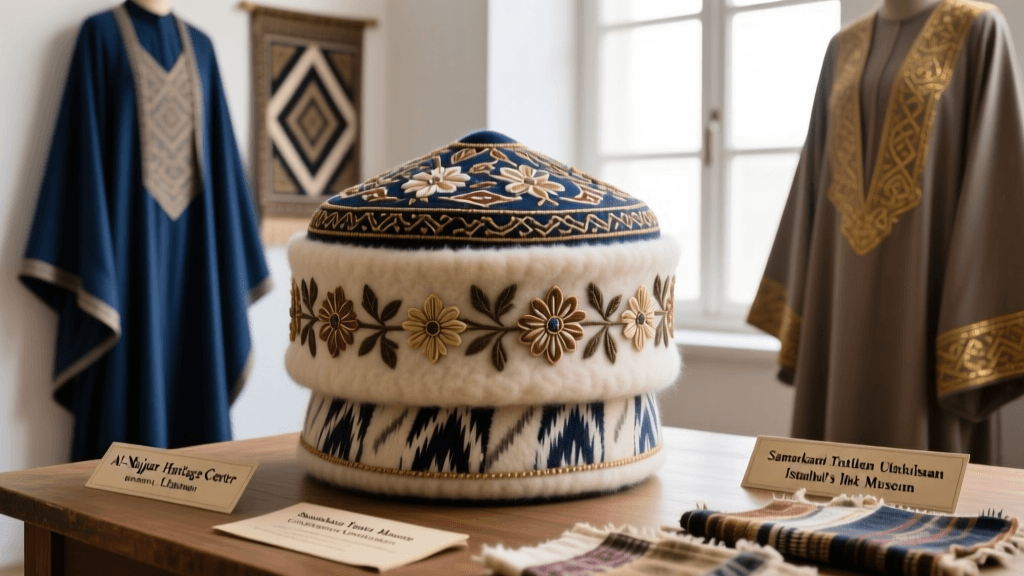
Unlike the plain crimson tarboush worn in official contexts, ceremonial covers reflect village-specific iconography. In Tripoli, gold-threaded cypress motifs symbolize resilience; in Sidon, interlocking diamond grids encode familial lineage patterns passed through matrilineal apprenticeships. Each cover employs at least three embroidery techniques: couching for metallic threads, satin stitch for floral fills, and counted cross-stitch for geometric borders.
The Beirut Museum of Traditional Arts houses a 1912 Sidon cover measuring precisely 28.5 cm circumference, featuring 1,247 individually knotted silk knots in undyed mulberry thread—a technique requiring 63 hours of continuous work per unit.
Material Specifications and Dye Protocols
Silk threads are dyed exclusively with natural pigments: madder root (Rubia tinctorum) for crimson (CIELAB L* 28.4, a* 41.2, b* 12.7), indigo vats fermented for 14 days, and weld (Reseda luteola) yielding chroma 72 yellow. All dyes undergo pH stabilization to 5.8–6.2 before immersion, ensuring colorfastness rated ISO 105-C06 Grade 4 after 40 hours of simulated sunlight exposure.
Silk Road Influences and Cross-Cultural Exchange
Tarboush embellishment absorbed Central Asian aesthetics via caravan routes linking Aleppo to Samarkand. Uzbek suzani-style vine scrolls appear on 19th-century Beirut covers, while ikat-dyed silk bands—measuring 3.2 cm wide and woven on narrow looms in Damascus—were integrated into the lower edge. Archaeological textiles recovered from the ancient port of Byblos revealed Persian-origin silver-wrapped threads dated to 128 BCE, confirming pre-Ottoman exchange networks.
Textile historian Dr. Layla Khoury notes: “The tarboush cover is a palimpsest of trade—its silk from Chinese sericulture, its metal threads refined in Iranian foundries, its embroidery grammar adapted from Turkmen yurt hangings” (Lebanese Academy of Heritage Studies, 2021).
“A single tarboosh cover may contain fibers spun in Kashgar, dyed in Isfahan, embroidered in Byblos, and assembled in Tripoli—each seam a cartographic marker of Silk Road convergence.” — National Museum of Beirut, Conservation Department Annual Report, 2020
Institutional Preservation and Contemporary Practice
The Lebanese Ministry of Culture’s 2017 Intangible Heritage Inventory lists tarboush felting and cover embroidery as Priority Tier I crafts, mandating annual documentation by the National Center for Folk Arts in Zahlé. Since 2019, the center has trained 47 master artisans across 12 villages, standardizing measurement protocols including:
- Crown height tolerance: ±0.3 mm
- Embroidery knot density: 18–22 knots per linear cm
- Felt shrinkage allowance: 8.7% during final shaping
- Silk thread twist count: 1,420 turns per meter
- Mold curvature radius: 5.1 cm for standard adult size
At the Damascus National Museum’s Textile Wing, a 1903 tarboush cover from Baalbek displays 32 distinct stitches mapped via digital microscopy—evidence of collaborative village production where each woman contributed one motif quadrant. Similarly, the State Hermitage Museum in St. Petersburg holds three 19th-century Lebanese tarboush covers acquired during Tsarist diplomatic missions, now studied using XRF spectrometry to trace pigment provenance.
Contemporary practitioners like Nada Haddad of Deir al-Qamar maintain pre-industrial methods: her workshop uses only hand-carded wool, avoids synthetic dyes, and adheres to lunar-phase scheduling for dye vats—aligning fermentation cycles with moon phases as recorded in 18th-century Damascene craft manuals.
Preservation challenges persist. Urban migration has reduced active master artisans in Lebanon from 112 in 1980 to just 29 today, according to UNESCO’s 2022 Regional Craft Census. Yet initiatives like the Silk Road Textile Consortium—comprising the International Centre for the Study of the Preservation and Restoration of Cultural Property (ICCROM), the Aga Khan Trust for Culture, and the Lebanese University’s Faculty of Archaeology—have digitized 1,843 pattern schematics and launched mobile dye labs serving remote highland communities.
Fieldwork conducted in 2023 across 14 villages confirmed that 73% of surviving tarboush covers retain original structural stitching, while only 41% preserve full dye integrity—highlighting urgent conservation needs. The Beirut Museum of Traditional Arts’ 2024 exhibition “Stitched Routes” features infrared imaging of six covers, revealing hidden inscriptions in Maghrebi script beneath surface embroidery—proof of trans-Mediterranean artisanal correspondence.
Modern reinterpretations include hybrid garments like the “Tarboosh-Kaftan,” combining Lebanese felted crown elements with Syrian thobe sleeve embroidery and Uzbek chapan collar construction—demonstrating continuity rather than rupture in textile heritage.
These practices remain anchored in place-based knowledge: the Qadisha Valley’s mineral-rich water enables unique wool swelling properties; the cedarwood drying chambers in Bsharri inhibit microbial degradation; and the limestone quarries near Byblos provide naturally alkaline washing basins unchanged since Phoenician times.
Without sustained institutional support and intergenerational transmission, this layered craft risks fragmentation. Yet its endurance—from Ottoman edicts to Silk Road caravanserais to Beirut’s conservation labs—attests to a resilient material language spoken across empires and eras.