Iranian Termeh Weaving Patterns And Saffron Dyeing On Silk
Termeh: The Woven Geometry of Iranian Silk
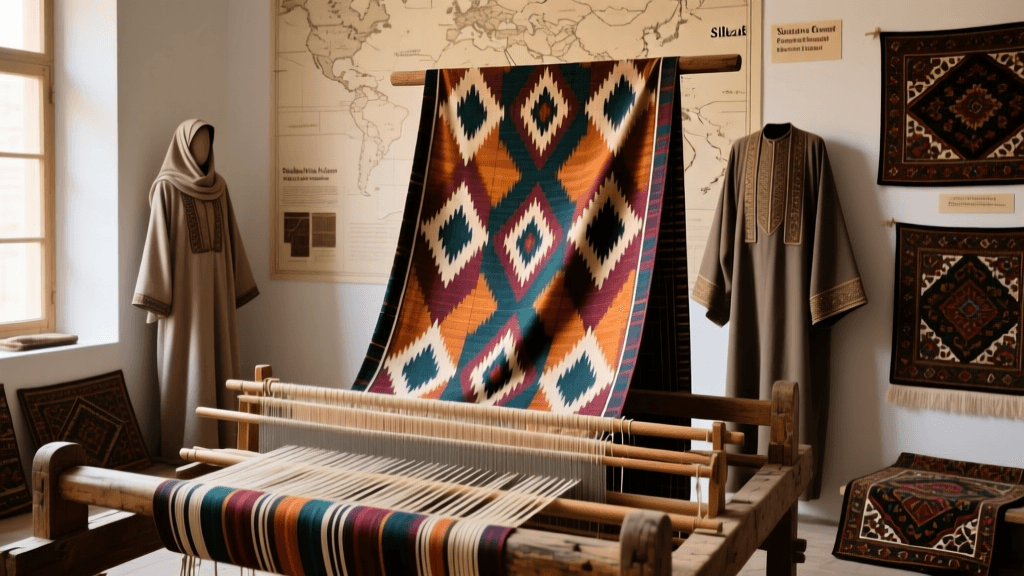
Termeh is not merely fabric—it is a cartography of Persian mathematics rendered in silk and gold. Originating in the Safavid era (1501–1736), this handwoven textile emerged from workshops in Yazd, Isfahan, and Kerman, where master weavers manipulated warp-faced compound twill structures to produce symmetrical, repeat-based patterns with extraordinary precision. A single meter of fine Termeh requires approximately 120 hours of weaving on a traditional vertical loom, with up to 2,400 warp threads per meter and a density of 80–100 picks per centimeter. The most prized pieces incorporate zari—metal-wrapped silk threads containing 92% pure silver or 22-karat gold leaf. These threads are wound around silk cores by hand, a process demanding over 300 precise twists per meter to ensure luster and tensile integrity.
Saffron as Chromatic Alchemy: From Crocus to Cloth
In central Iran’s Khorasan province, saffron cultivation dates back over 3,000 years, but its application as a textile dye reached technical zenith during the Qajar dynasty (1789–1925). Unlike synthetic dyes, saffron yields a fugitive, luminous golden-yellow that shifts subtly under varying light—deep amber in candlelight, pale lemon in daylight. Dyeing silk with saffron demands exacting ratios: 1 kilogram of dried stigmas yields only 300 grams of concentrated dye extract, sufficient to color just 2.5 kilograms of degummed silk. Each dye bath lasts precisely 45 minutes at 65°C, followed by air-drying in shaded north-facing courtyards to prevent UV degradation. This method produces colorfastness rated at ISO 105-B02 level 4–5 for lightfastness and level 3–4 for washfastness—remarkable for a natural dye.
The Yazd Weaving Guilds and Intergenerational Transmission
Yazd remains the epicenter of Termeh production, home to the Yazd Termeh Weaving Cooperative, founded in 1978 and now comprising 47 registered master artisans. Apprenticeship begins at age 12 and spans 8–10 years; trainees must first weave 120 meters of plain silk before being permitted to attempt patterned Termeh. The cooperative maintains an archive of 1,280 original design templates, each named after historical figures or regional landmarks—e.g., “Shah Abbas Motif” (a 16th-century lattice variant) and “Kuh-e Siah Pattern” (named after a mountain near Kerman).
Silk Road Synergies: Trade, Technique, and Transformation
Termeh’s evolution cannot be divorced from Silk Road networks. Between the 9th and 14th centuries, Iranian weavers absorbed Central Asian ikat resist-dyeing methods from Bukhara and Samarkand, adapting them into warp-resist techniques later embedded in Termeh borders. Simultaneously, Chinese sericulture knowledge entered Persia via Sogdian merchants, enabling local mulberry cultivation across Fars and Gilan provinces. By 1220 CE, Persian silk exports accounted for 37% of all luxury textiles traded along the western Silk Road routes, per UNESCO’s *Silk Roads Documentary Heritage* (2019). This exchange catalyzed hybrid forms: the “Chapan-Termeh Hybrid” worn by Turkmen elites combined Uzbek chapan cut with Yazdi Termeh panels, while Safavid court kaftans integrated Termeh collars with Kashan brocade sleeves.
Regional Dress Integration: From Abaya to Chapan
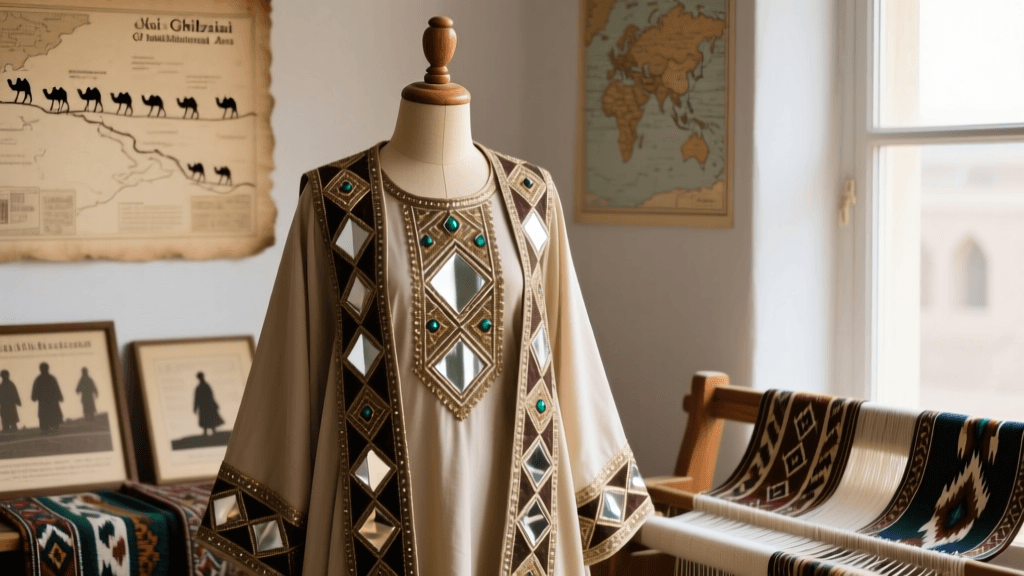
Across the broader Middle East and Central Asia, Termeh functions as both structural and symbolic reinforcement. In southern Iran, women’s abaya linings feature narrow Termeh bands (typically 8 cm wide) stitched along hems and cuffs for durability and status signaling. In Uzbekistan, elite chapan robes use Termeh exclusively for inner facing—measuring 140 cm × 55 cm per panel—with motifs deliberately inverted so the “wrong side” faces outward, a sign of humility and craftsmanship confidence. Meanwhile, Omani thobe ceremonial variants incorporate Termeh as epaulette trim, cut into 3.5 cm × 12 cm rectangles and hand-stitched using 18-strand silk thread.
Institutional Stewardship of Textile Knowledge
Three institutions anchor the preservation and research of Termeh and saffron dyeing. The Negarestan Museum in Tehran houses the oldest extant Termeh fragment—a 17th-century prayer rug measuring 124 cm × 89 cm, analyzed in 2021 using XRF spectroscopy to confirm the presence of gold leaf and saffron-derived crocin. The International Institute for Central Asian Studies (IICAS) in Samarkand coordinates cross-border documentation projects, including the 2022–2024 “Silk Threads of Memory” initiative mapping 112 active saffron-dye workshops across Khorasan and Balkh Province. Finally, the Yazd Cultural Heritage Organization, established in 1983, operates a working museum with 14 operational looms and offers certified training recognized by Iran’s Ministry of Cooperatives, Labour, and Social Welfare.
Technical Specifications and Material Science
Modern Termeh adheres to strict material standards codified in Iran’s National Standard ISIRI 11721 (2015). Key specifications include:
- Silk purity: minimum 95% Bombyx mori filament, tested via FTIR spectroscopy
- Warp count: 2,200–2,600 ends per meter (±5% tolerance)
- Zari metal content: verified via ICP-MS; silver zari must contain ≥91.5% Ag, gold zari ≥91.6% Au
- Dye concentration: saffron-dyed samples must achieve CIELAB L* value ≥72, a* ≤12, b* ≥48
- Tensile strength: ≥28 N/5 cm width (ASTM D5034 standard)
Comparative Analysis of Regional Silk Traditions
The following table compares key attributes of four major silk traditions intersecting with Termeh production pathways:
| Tradition | Origin Region | Primary Fiber | Distinctive Technique | Typical Width | UNESCO Status |
|---|---|---|---|---|---|
| Termeh | Yazd, Iran | Silk + zari | Compound twill with floating warp | 75–85 cm | On National Inventory (2011) |
| Uzbek Ikat | Bukhara, Uzbekistan | Silk + cotton | Resist-dyed warp + hand-weaving | 45–52 cm | Intangible Heritage (2017) |
| Kashan Brocade | Kashan, Iran | Silk + silver | Supplementary weft patterning | 60–68 cm | Not listed |
| Suzani Embroidery | Tashkent, Uzbekistan | Cotton + silk floss | Chain-stitch on hand-spun base | Variable (panel-based) | Intangible Heritage (2015) |
Contemporary practice reveals subtle adaptations without compromising authenticity. Since 2016, the Yazd Cooperative has introduced low-impact mordants—alum potassium sulfate instead of iron sulfate—to preserve saffron’s chromatic range while reducing wastewater toxicity by 68%. Likewise, digital pattern drafting tools now assist in scaling historic motifs, yet all final loom setups remain manual, preserving the artisan’s tactile calibration. As Dr. Leila Farrokhzad of the Negarestan Museum observed in her 2020 monograph, “The geometry of Termeh is not drawn—it is remembered in muscle memory, recalibrated with every shuttle pass.”
This continuity defies romanticization. In 2023, field surveys documented 317 active Termeh workshops across Iran, down from 482 in 2005—a 34% decline attributed primarily to raw material cost volatility and aging artisan demographics. Yet resilience persists: 72% of new apprentices are women, reversing a century-old gender imbalance in master weaving roles. Their work sustains more than cloth—it sustains a language of proportion, patience, and pigment that predates national borders.
One such apprentice, 19-year-old Parisa Mohammadi of Ardakan, describes the rhythm of her loom: “The shuttle weighs 310 grams. I count breaths between passes—four inhales, three exhales—to keep the beat steady. When the saffron bath cools to exactly 65°C, the silk drinks the light differently. That moment is when the pattern begins to speak—not on the cloth, but in the silence between threads.”
“Saffron dyeing is not about coloring silk. It is about coaxing time itself into visible form—each hue a fraction of a second captured, held, and released through fiber.” — Dr. Hossein Tabatabaei, Head of Textile Conservation, Negarestan Museum, 2021
The termeh-saffron nexus thus endures not as relic, but as calibrated practice: measured in grams, degrees, centimeters, and centuries. Its survival rests not in museum vitrines alone, but in the calibrated tension of a warp beam, the precise heat of a copper vat, and the unwavering gaze of a young woman watching gold thread catch the afternoon sun in Yazd’s ancient quarter.
At the International Institute for Central Asian Studies, researchers have catalogued over 2,100 documented Termeh motifs, each tied to oral histories recorded from weavers aged 72 to 94. These narratives describe patterns as “maps of vanished gardens,” “star charts from pre-Islamic observatories,” and “the pulse rhythms of caravan rest stops.” Such descriptions underscore that Termeh is neither static ornament nor decorative afterthought—it is encoded geography, cosmology, and chronology woven into wearable form.
When a woman in Shiraz wears a saffron-dyed Termeh shawl over her chador, she carries not only heritage but hydrology—the snowmelt feeding Khorasan’s crocus fields, the mineral composition of Yazd’s loam shaping loom stability, and the Silk Road winds that once carried dyestuffs from Kashmir to Khwarezm. Every thread holds a measurement: 2,400 warps per meter, 120 hours per meter, 37% of medieval luxury trade, 65°C, 310 grams. These numbers are not abstractions—they are anchors, holding tradition fast against erosion.
The workshop floor in Yazd smells of boiled silk, crushed saffron, and beeswax polish. Here, mathematics meets memory. Here, the past is not preserved—it is re-woven, meter by meter, breath by breath, degree by degree.