The Deep Blue Thread: A Global History of Indigo Dyeing Traditions
The Deep Blue Thread: A Global History of Indigo Dyeing Traditions
There are few colors in the natural world as captivating, elusive, and historically significant as indigo. Long before the advent of synthetic chemistry, the pursuit of this deep, mesmerizing blue drove global trade, shaped cultural identities, and elevated textile craftsmanship to an art form. From the ancient dye pits of West Africa to the meticulous artisan workshops of feudal Japan, indigo dyeing is a universal human heritage. It is a practice that bridges the gap between agriculture, alchemy, and high art.
At The Garment Atlas, we believe that understanding the origins of our clothing deepens our appreciation for the garments we wear. To truly understand the soul of heritage textiles, one must trace the roots of the pigments that color them. In this comprehensive exploration, we delve into the rich cultural heritage, the intricate craftsmanship, and the diverse regional variations of traditional indigo dyeing, revealing why this ancient practice continues to captivate the modern world.
The Alchemy and Craftsmanship of Natural Indigo
To understand the reverence for natural indigo, one must first understand the profound alchemy required to coax the pigment from the plant. Unlike most natural dyes, which can be extracted simply by boiling botanical matter in water, indigo is a vat dye that requires a complex chemical transformation. The pigment, known as indigotin, is not actually blue in the living plant. Whether sourced from the Indigofera tinctoria shrub of the tropics, the Persicaria tinctoria (Japanese knotweed) of East Asia, or the Isatis tinctoria (woad) plant of Europe, the leaves are a vibrant, unassuming green.
The magic begins with fermentation. In traditional practices, the harvested leaves are soaked in water and allowed to ferment, or they are dried, composted, and aged over several months to create a concentrated dye base. In Japan, this fermented indigo matter is known as sukumo. The master dyer then builds a "living vat," combining the sukumo with alkaline substances like wood ash lye, sake, and wheat bran to feed the bacteria necessary for the reduction process.
This reduction process is the true secret of indigo craftsmanship. By removing oxygen from the vat, the insoluble blue indigotin is converted into leuco-indigo, a water-soluble compound that is actually yellowish-green. When a garment—perhaps a finely woven piece from our cotton material guide—is submerged into this living vat, it absorbs the yellowish-green liquid. The true alchemy occurs the moment the fabric is pulled from the vat and exposed to the air. As oxygen hits the wet fibers, the leuco-indigo rapidly oxidizes, blooming before the dyer’s eyes into a brilliant, deep blue. This cycle of dipping and oxidizing must be repeated time & again, sometimes dozens of times, to achieve the darkest, most colorfast shades of navy and black-blue.
Cultural Significance and Symbolism
Because true blue is incredibly rare in nature, indigo has historically been imbued with profound spiritual, social, and protective symbolism. In many ancient cultures, the color blue was associated with the heavens, the divine, and the infinite. However, the cultural meaning of indigo is remarkably dualistic, serving simultaneously as a marker of high status and a staple of the working class.
In many West African traditions, indigo is deeply tied to spirituality and protection. The Yoruba people of Nigeria have long believed that indigo-dyed garments possess the power to ward off evil spirits. The deep blue cloth is often used in rites of passage, mourning, and spiritual ceremonies. Conversely, in other regions, the color is associated with wealth and nobility, as the labor-intensive process of creating dark, rich indigo cloth made it a luxury item affordable only to the elite.
In feudal Japan, indigo took on a highly practical yet deeply revered role. Known as Japan Blue, the dye was prized not just for its beauty, but for its functional properties. Indigo is naturally antibacterial, odor-resistant, and acts as a powerful insect repellent. Samurai warriors wore indigo-dyed undergarments beneath their heavy armor to prevent infections from battle wounds and to repel insects during long campaigns. Furthermore, the tight molecular bond between the indigo and the cotton fibers added a layer of structural integrity to the cloth, making it more resistant to tearing. This intersection of utility and beauty is a cornerstone of heritage garment design, a philosophy we frequently explore in our workwear style archives.
Regional Variations in Indigo Dyeing
While the chemical foundation of indigo dyeing remains consistent across the globe, the techniques, patterns, and cultural applications vary wildly from region to region. The mastery of resist-dyeing, in particular, has given rise to some of the most spectacular textile traditions in human history.
Japan: The Mastery of Aizome and Shibori
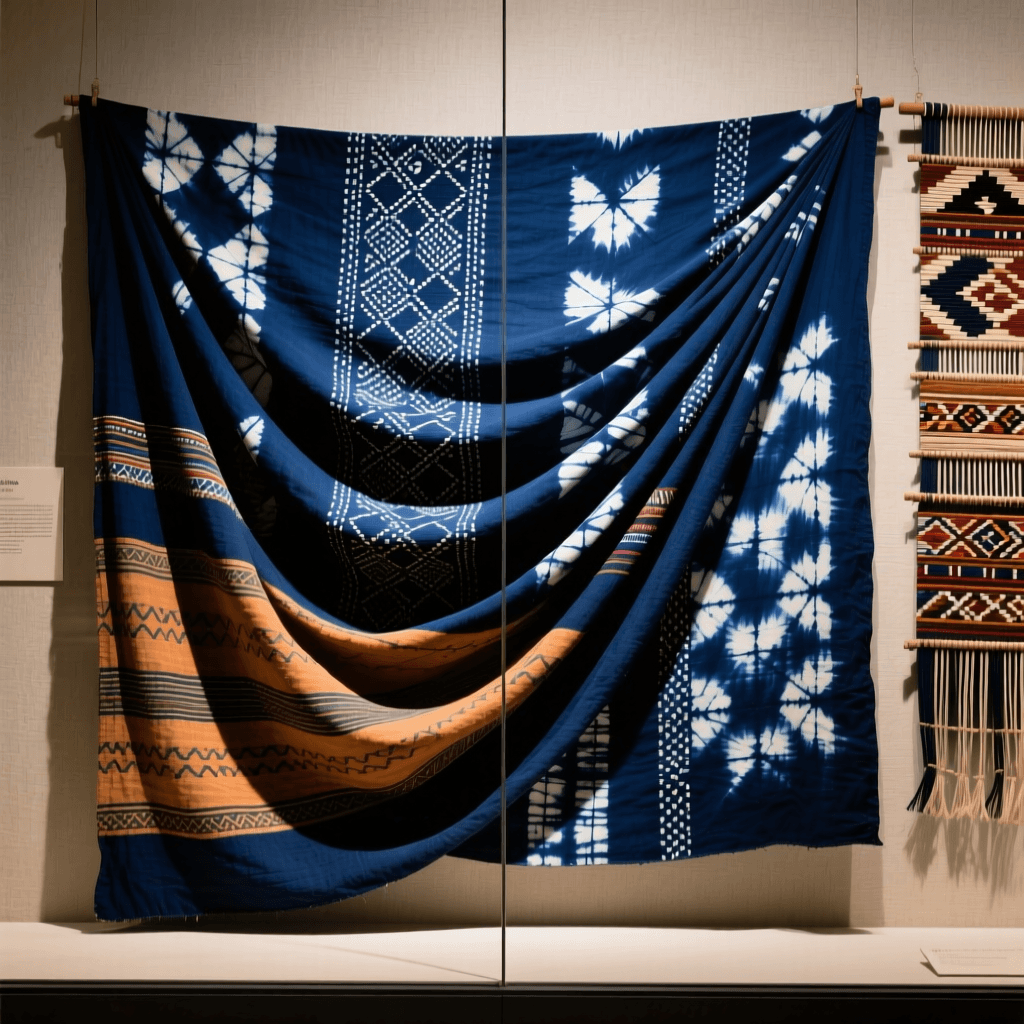
Japanese indigo dyeing, or aizome, is perhaps the most meticulously documented and revered tradition in the world. The Japanese elevated indigo dyeing from a craft to a high art form, developing intricate resist-dyeing techniques collectively known as shibori. By binding, stitching, folding, or clamping the fabric before submerging it in the vat, artisans create breathtaking geometric and organic patterns.
Techniques like kanoko (bound resist, similar to modern tie-dye but far more precise), itajime (shape resist using carved wooden blocks), and katazome (stencil resist using a rice-paste barrier) require decades of dedicated practice to master. The resulting textiles are characterized by their crisp contrasts between the deep, living blue and the pure, un-dyed white of the cotton. For a deeper dive into how these dyeing methods intersect with traditional loom practices, our article on traditional weaving techniques provides further context on how warp & weft interact with surface dyes.
West Africa: The Ancient Pits and Adire Cloth
In West Africa, the tradition of indigo dyeing is anchored by the ancient dye pits of Kano, Nigeria, which have been in continuous operation for hundreds of years. Here, the dye is extracted from the native Lonchocarpus cyanescens plant. The pits are massive, sunken earthen vessels where master dyers, often working in intense heat, beat the fermenting liquid with wooden paddles to aerate it and maintain the living vat.
The Yoruba tradition of adire utilizes cassava paste painted onto the fabric with feathers or stamps, or intricate tie-and-stitch methods, to create complex, repeating motifs that tell stories of proverbs, local flora, and social status. Further north, the Tuareg people of the Sahara Desert are famously known as the "Blue Men." They wear indigo-dyed veils and robes, and the friction of the desert wind causes the excess surface dye to rub off onto their skin. Rather than viewing this as a flaw, the Tuareg consider the blue tinting of the skin a mark of immense beauty, nobility, and cultural pride.
The Americas and Europe: Woad, Trade, and the Birth of Denim
Before the global maritime trade routes brought tropical Indigofera to Europe, the continent relied on woad (Isatis tinctoria). Woad contains the exact same indigotin molecule but in much lower concentrations, requiring vast amounts of plant matter and a notoriously foul-smelling fermentation process (often utilizing stale urine as an alkaline agent). When true indigo began arriving via trade ships, European woad farmers lobbied heavily against it, even successfully having it banned in several countries under the guise that it was the "devil’s dye."
Eventually, the superior yield and colorfastness of tropical indigo won out, fundamentally altering the global economy and tragically fueling the transatlantic slave trade, as indigo became a massive cash crop in the American South and the Caribbean. However, this influx of indigo eventually laid the groundwork for one of the most iconic garments in history: blue jeans. The marriage of sturdy cotton twill and reliable indigo dye created the ultimate fabric for laborers, miners, and cowboys. To understand how this historical workwear evolved into a modern wardrobe staple, be sure to read our comprehensive raw denim guide.
Modern Preservation and the Slow Fashion Revival
The dawn of synthetic chemistry brought about the creation of synthetic aniline indigo, a petrochemical alternative that offered uniform, predictable, and cheap blue dye. This innovation democratized blue clothing, making it accessible to the masses, but it nearly drove natural indigo traditions to the brink of extinction. Synthetic dyes penetrate the fiber core completely and uniformly, resulting in a flat, static color that lacks the depth, character, and evolving patina of natural indigo.
Today, a passionate slow fashion revival is bringing natural indigo back to the forefront of heritage garment making. Artisans, botanists, and dedicated dyers are reclaiming the living vat, recognizing that natural indigo is not just a color, but a sustainable, biodegradable alternative to toxic synthetic dyes. Modern preservationists are working alongside indigenous farming communities to cultivate indigenous indigo plants, ensuring that the agricultural knowledge required to grow and process the leaves is not lost to time.
Garments dyed with natural indigo possess a "living" quality. Because the dye molecules sit on the surface of the yarn rather than penetrating the core (a phenomenon known as ring-dyeing), the fabric wears and fades in a highly personalized way. The friction of daily life chips away at the surface blue, slowly revealing the white cotton core beneath. This creates a unique, high-contrast fade map that tells the story of the wearer’s life, a hallmark of true heritage apparel.
Frequently Asked Questions
Why does natural indigo fade differently than synthetic indigo?
The fading characteristics of indigo are dictated by how the dye bonds to the fiber. Natural indigo, due to its larger molecular structure and the traditional vat-dyeing process, tends to coat the outside of the cotton yarn while leaving the core white. This is known as "ring dyeing." As the garment is worn, washed, and subjected to friction, the outer layer of blue dye slowly abrades, revealing the white core and creating high-contrast, dynamic fades. Synthetic indigo is often applied with harsh chemical mordants that force the dye deep into the fiber core, resulting in a flatter, more uniform color that fades less dramatically over time.
How can I care for naturally dyed indigo garments?
Caring for natural indigo requires a gentle approach to preserve the integrity of the dye and the fiber. Always wash naturally dyed garments in cold water using a mild, pH-neutral detergent. Avoid harsh chemicals, bleach, or optical brighteners, which can strip the dye or alter its chemical structure. Turn the garment inside out before washing to minimize surface friction. When drying, avoid direct sunlight, as prolonged UV exposure can cause the natural indigo to take on a reddish or brownish tint over time. For more detailed instructions on maintaining heritage textiles, visit our garment care center.
Is natural indigo dyeing environmentally friendly?
When practiced using traditional, regenerative methods, natural indigo dyeing is highly sustainable. The plant itself improves soil health through nitrogen fixation, and the spent leaves from the fermentation process can be composted and returned to the earth as fertilizer. The dye is entirely biodegradable and non-toxic. However, it is important to note that natural indigo requires significant amounts of land and water to produce a relatively small yield of pigment compared to synthetic alternatives. The true environmental benefit lies in supporting small-scale, regenerative agriculture and avoiding the petrochemical pollution associated with synthetic dye manufacturing.
What is the difference between woad and true indigo?
Both woad (Isatis tinctoria) and true indigo (Indigofera tinctoria) produce the exact same blue pigment molecule: indigotin. The primary difference lies in the plant species, their geographical origins, and the concentration of the pigment. True indigo is a tropical shrub that yields a high concentration of indigotin, making it highly efficient for large-scale dyeing. Woad is a temperate brassica (related to cabbage and mustard) native to Europe and parts of Asia. Woad contains a much lower concentration of indigotin, requiring vastly more plant matter and a more complex, alkaline-heavy extraction process to yield a comparable amount of blue dye. Historically, true indigo eventually replaced woad due to its superior economic efficiency.