2026 Guide to Hanfu Education Workshops and Certification Programs
The Evolution of Hanfu Education in 2026
The global fascination with traditional Chinese clothing has undergone a remarkable transformation over the last decade. What began as a niche grassroots movement to revive historical dress has matured into a robust, multi-billion-dollar cultural industry. In 2026, the Hanfu movement has transcended social media trends and casual hobbyism, establishing itself as a serious academic and professional discipline. Today, aspiring designers, historians, and cultural preservationists are turning to formal Hanfu education workshops and certification programs to master the intricate art of traditional garment construction.
As the demand for historically accurate, high-quality Hanfu surges globally, the market has seen a parallel rise in the need for certified artisans. Consumers and cultural institutions alike are no longer satisfied with mass-produced, historically inaccurate costumes. They seek garments crafted by individuals who understand the profound cultural, philosophical, and technical nuances of traditional Chinese dress. Consequently, 2026 has become a landmark year for formalized Hanfu education, with prestigious institutions offering rigorous certification tracks that blend ancient techniques with modern pedagogical standards.
Why Pursue Formal Hanfu Certification?
Obtaining a certification in Hanfu tailoring and historical styling is no longer just a badge of honor; it is a professional necessity for those looking to enter the upper echelons of the traditional garment industry. Certified artisans command higher prices for their bespoke work, are frequently commissioned by museums and film productions, and are eligible for prestigious cultural heritage grants. Furthermore, formal education ensures the preservation of Pingmian Caijian (flat pattern cutting) and other intangible cultural heritage techniques that risk being diluted by modern, Western-influenced tailoring shortcuts.
According to cultural preservation frameworks outlined by organizations like UNESCO's Intangible Cultural Heritage initiatives, the transmission of traditional sericulture, silk craftsmanship, and historical tailoring requires structured, master-to-apprentice educational models. Modern certification programs in 2026 have successfully digitized and standardized these models, making them accessible to a global audience while maintaining strict historical accuracy.
Top Hanfu Certification Programs for 2026
Beijing Institute of Fashion Technology (BIFT) - Continuing Education
The Beijing Institute of Fashion Technology (BIFT) remains the gold standard for academic fashion education in China. In 2026, their Continuing Education department offers a highly sought-after 'Certificate in Traditional Chinese Garment Construction.' This intensive, six-month program is designed for individuals who already possess basic sewing skills and wish to specialize in historical Hanfu. The curriculum is heavily research-based, requiring students to study archaeological textile reports and historical paintings to recreate accurate silhouettes from the Tang, Song, and Ming dynasties.
China Arts and Crafts Association (CACA) Heritage Tracks
For those focused specifically on the artisanal and intangible heritage aspects of Hanfu, the CACA offers specialized certification in traditional embroidery and natural dyeing as they apply to historical garments. Their 2026 workshop series focuses on regional variations of Hanfu, such as the distinct weaving techniques of Sichuan brocade (Shu Jin) and the intricate pleating methods required for the authentic Ming dynasty Mamianqun (horse-face skirt). Graduates receive a nationally recognized Intangible Cultural Heritage (ICH) artisan credential.
Global Hybrid and Digital Workshops
Recognizing the international demand, several premier institutions have launched hybrid certification programs in 2026. These programs combine asynchronous digital modules covering the history and theory of the Jiaoling Youren (cross-collar, right lapel) philosophy with intensive, two-week in-person residencies in cities like Hangzhou, Xi'an, and Suzhou. This format allows international students and working professionals to achieve certification without relocating to China for an entire academic year.
2026 Workshop Comparison Chart
To help you navigate the educational landscape, we have compiled a comparison of the top three certification formats available this year. Please note that tuition fees reflect the 2026 academic pricing and may vary based on material costs and residency requirements.
| Institution / Program | Primary Focus Area | Duration | 2026 Tuition (Est.) | Credential Awarded |
|---|---|---|---|---|
| BIFT Continuing Ed | Historical Pattern Drafting & Tailoring | 6 Months (Full-time) | ¥45,000 RMB | University Certificate in Traditional Dress |
| CACA Heritage Track | Textile Embellishment & Natural Dyeing | 12 Weeks (Part-time) | ¥18,500 RMB | ICH Artisan Certification |
| Global Hybrid Residency | Comprehensive Hanfu Styling & Construction | 4 Months (Online + 2 Weeks In-Person) | $3,200 USD | Certified Hanfu Stylist & Maker |
Core Curriculum: What You Will Master
Regardless of the specific institution, any reputable Hanfu certification program in 2026 will require mastery of several core technical and historical competencies. The days of simply adapting modern Western bodice blocks to look 'traditional' are over; modern educators demand strict adherence to historical methodologies.
Pingmian Caijian (Flat Pattern Cutting)
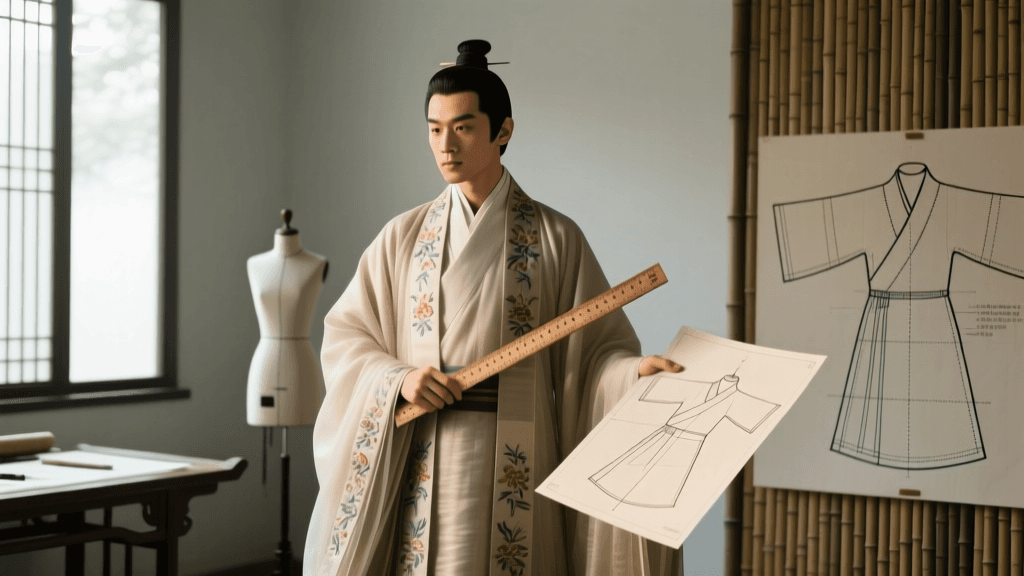
The foundation of all traditional Chinese clothing is Pingmian Caijian, or flat pattern cutting. Unlike Western tailoring, which relies on darts, curved seams, and complex 3D draping to conform to the body's contours, traditional Hanfu is cut from flat pieces of woven fabric. Students learn to respect the integrity of the woven cloth, utilizing geometric shapes, gussets, and strategic seaming to create volume and drape. This philosophy not only minimizes fabric waste but also creates the distinctive, flowing silhouette characteristic of historical Chinese dress. Students spend weeks mastering the precise mathematics required to draft a flawless Shenyi (deep robe) using only flat geometry.
Period-Specific Construction and Silhouettes
A certified artisan must be able to distinguish between and accurately recreate the silhouettes of different dynasties. The curriculum heavily emphasizes the structural differences between eras. For example, students learn the high-waisted, voluminous draping of the Tang dynasty Qixiong Ruqun, contrasting it with the slender, elegant, and understated lines of the Song dynasty Beizi. Advanced modules delve into the complex, structured pleating of the Ming dynasty Mamianqun, teaching students how to calculate and press the precise overlapping pleats that allow the skirt to lay flat when standing but expand beautifully during movement. Reference materials from global institutions, such as the Victoria and Albert Museum's Asian Collections, are frequently utilized to study extant historical garments and textile fragments.
Textile Sourcing, Weaving, and Embellishment
A true Hanfu artisan must understand the medium they are working with. The 2026 curriculum places a heavy emphasis on traditional Chinese textiles, including silk gauze (Luo), damask (Ling), and brocade (Jin). Students learn how different weaves behave when cut and draped. Furthermore, certification requires a foundational understanding of traditional embellishment techniques, including Suzhou embroidery (Su Xiu) and the application of woven borders (Lan). Understanding the symbolic meanings behind specific motifs—such as the use of peonies for wealth or cranes for longevity—is also a mandatory component of the historical styling examinations.
Actionable Steps for Enrollment in 2026
If you are considering enrolling in a Hanfu education workshop or certification program this year, strategic preparation is essential. The top-tier programs are highly competitive, often receiving hundreds of applications for a limited number of studio spaces.
- Prepare a Foundational Portfolio: Even if you are applying for a beginner-level historical tailoring track, admissions committees in 2026 expect to see a demonstration of basic sewing proficiency and a genuine interest in historical dress. Include sketches, photographs of garments you have constructed (even if they are modern or non-traditional), and a brief essay on your specific area of historical interest.
- Language and Terminology: While some global hybrid programs offer English instruction, the most prestigious domestic programs in China are taught in Mandarin. Prospective students are highly encouraged to familiarize themselves with traditional tailoring terminology (e.g., Jiaoling, Yuanling, Pingmian) and consider taking a specialized fashion-Mandarin course prior to enrollment.
- Invest in Traditional Tools: Modern rotary cutters and digital sewing machines are often restricted in advanced heritage workshops. Be prepared to purchase and learn to use traditional tools, including heavy carbon-steel shears, bamboo rulers, and specialized irons designed for pressing silk and brocade without damaging the fibers.
- Seek Cultural Heritage Grants: In 2026, various international and domestic cultural preservation societies offer micro-grants for students pursuing education in intangible cultural heritage. Research these funding opportunities early, as application deadlines for the autumn semester typically close by late spring.
Conclusion
The formalization of Hanfu education marks a vital step in the preservation of Chinese sartorial heritage. By pursuing certification in 2026, you are not merely learning how to sew historical costumes; you are becoming a custodian of an ancient, deeply philosophical approach to garment making. Whether you aim to launch a bespoke atelier, work in theatrical costuming, or simply deepen your personal connection to traditional culture, the rigorous workshops and certification programs available today provide the authentic, comprehensive foundation required to master the art of Hanfu.