Pacific Northwest Button Blankets and Regalia Guide 2026
The Living Heritage of Pacific Northwest Coast Regalia
The Indigenous peoples of the Pacific Northwest Coast—spanning from southeastern Alaska down through British Columbia and into Washington State—possess some of the most visually striking and culturally profound textile and garment traditions in the Americas. For the Haida, Tlingit, Tsimshian, and Kwakwaka'wakw nations, clothing is far more than mere adornment or protection from the elements. Traditional regalia serves as a wearable archive of clan history, spiritual lineage, and territorial rights. As of 2026, the creation and wearing of these garments remain central to the potlatch system, a complex ceremonial institution involving feasting, gift-giving, and the legal transfer of names and privileges.
Understanding the nuances of Pacific Northwest dress requires looking beyond the surface of the garments. Every stitch, woven strand, and strategically placed button communicates a specific narrative. According to the Museum of Anthropology at UBC, the region's material culture is deeply intertwined with the local ecology, utilizing cedar bark, mountain goat wool, and marine shells. Today, contemporary Indigenous artists are revitalizing these ancient practices, blending ancestral techniques with modern sustainable sourcing to ensure these traditions thrive for future generations.
The Evolution and Artistry of the Button Blanket
The button blanket is a quintessential garment of the Pacific Northwest Coast, yet its origins are a testament to Indigenous adaptability and innovation. Following increased contact with European and American maritime traders in the late 18th and 19th centuries, Indigenous artisans acquired new materials: Hudson's Bay wool blankets, cotton broadcloth, and glass or shell buttons. Rather than abandoning traditional artistic conventions, Haida and Tlingit artists integrated these trade goods into their existing aesthetic frameworks, birthing the button blanket.
Typically constructed from heavy, dark Melton wool (most often black or navy), the blanket features a large, central crest appliquéd in contrasting red or white fabric. This crest represents the wearer's clan or moiety, such as the Raven, Eagle, Wolf, or Killer Whale. The edges and the perimeter of the crest are heavily embellished with hundreds, sometimes thousands, of buttons that catch the light of the fire during ceremonial dances, creating a mesmerizing, kinetic display of wealth and spiritual power.
Formline Design and Material Sourcing in 2026
The appliqué patterns on button blankets strictly adhere to the Northern Northwest Coast formline art system. This highly structured visual language relies on ovoids, U-shapes, and split U-shapes to delineate animal and spiritual forms. In 2026, master artisans continue to draft these complex patterns by hand before cutting the wool, ensuring the structural integrity of the formline rules is maintained.
Material sourcing has evolved to prioritize both quality and environmental stewardship. While antique glass buttons are still highly prized for heirloom pieces, modern button blankets frequently utilize sustainably harvested abalone and mother-of-pearl. Artisans in 2026 often collaborate with certified Pacific fisheries to obtain abalone shells, which are then laser-cut and hand-polished to maximize their iridescent luster while minimizing waste. The base wool is now frequently sourced from specialized textile mills that produce heavy-weight, non-fraying Melton specifically tailored for Indigenous regalia makers.
Chilkat and Ravenstail Weaving: Masterpieces of Loom Art
While button blankets represent the brilliant adaptation of trade goods, Chilkat and Ravenstail weaving represent the pinnacle of ancient, pre-contact textile engineering. Originating with the Tsimshian and perfected by the Tlingit (specifically the Chilkat Tlingit), these woven robes are arguably the most complex and time-consuming textiles produced by any Indigenous culture in North America.
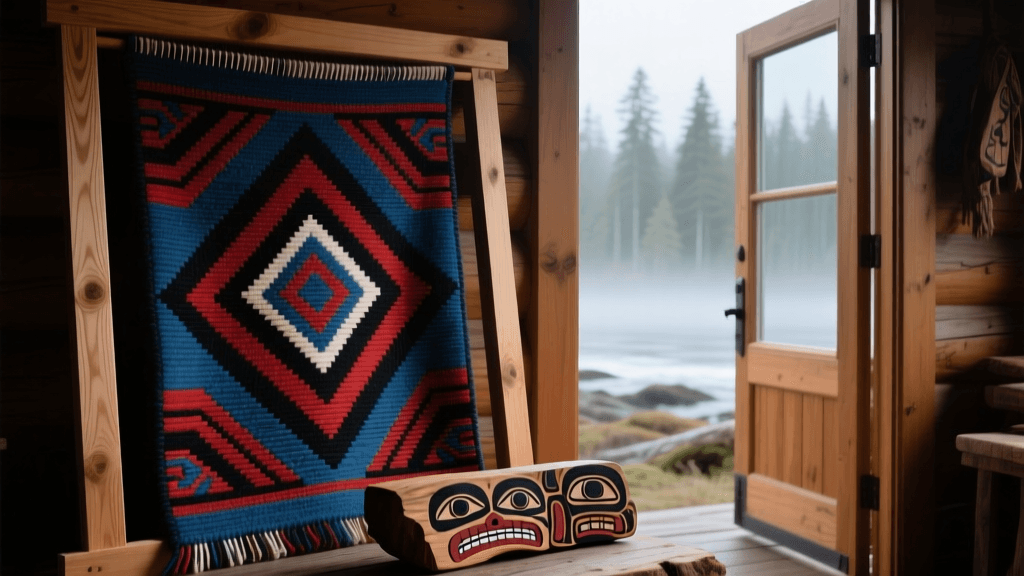
Ravenstail weaving, the older of the two traditions, is characterized by stark, striking geometric patterns—primarily black and white, with occasional yellow accents. Chilkat weaving evolved from Ravenstail, introducing the curvilinear formline designs into the woven medium. A traditional Chilkat robe features a central diving whale or chief's face, flanked by symmetrical profile animals, all rendered in a palette of yellow, black, blue-green, and white. The Sealaska Heritage Institute has been instrumental in the 21st-century revival of these weaving styles, offering apprenticeships that have successfully brought the art form back from the brink of extinction.
The Rigorous Process of Mountain Goat and Cedar Preparation
The creation of a Chilkat or Ravenstail robe is an astonishing feat of endurance and skill. The warp (the vertical foundation threads) is made exclusively from the inner bark of the yellow cedar tree, which is harvested, boiled, and painstakingly split into fine, flexible strands. The weft (the horizontal weaving threads) is spun from mountain goat wool. Historically, the wool was gathered from molting goats in the wild or traded from interior tribes.
In 2026, while some traditionalists still gather wild goat wool, many weavers utilize ethically sourced wool from domesticated mountain goats or high-grade merino blends that mimic the durability and halo of wild goat fleece. The wool is hand-spun using a thigh-rolling technique, often mixed with cedar bark to create a strong, two-ply yarn. Because the weaving is done on a simple loom without a shuttle, the weaver must twist and interlock the weft threads by hand for every single inch of the design. It is estimated that a master weaver spends between 1,500 and 2,000 hours to complete a single full-sized Chilkat robe.
Comparative Guide to Regional Ceremonial Garments
For collectors, cultural institutions, and Indigenous community members looking to commission or study these garments, understanding the distinctions in time, cost, and usage is vital. The following table outlines the current landscape of Pacific Northwest ceremonial textiles as of 2026.
| Garment Type | Primary Materials | Creation Time | 2026 Commission Cost | Ceremonial Use |
|---|---|---|---|---|
| Button Blanket | Melton wool, abalone/pearl buttons, broadcloth | 3 - 8 Months | $4,500 - $15,000 | Potlatches, memorial feasts, coming-of-age dances |
| Chilkat Robe | Mountain goat wool, yellow cedar bark | 1.5 - 3 Years | $35,000 - $75,000+ | High-status chiefly ceremonies, spiritual dedications |
| Ravenstail Robe | Mountain goat wool, yellow cedar bark | 1 - 2 Years | $20,000 - $45,000 | Shamanic rites, elder honors, historical reenactments |
| Octopus Bag (Medicine Bag) | Trade beads, wool, dentalium shells | 2 - 5 Months | $2,000 - $8,000 | Dance regalia accessory, spiritual protection |
Navigating Ethical Purchasing and Commissions in 2026
As global interest in Indigenous textile arts continues to grow, the market has unfortunately seen a rise in mass-produced, culturally appropriated "Native-inspired" garments. These knockoffs not only violate Indigenous intellectual property but also economically harm the communities that have safeguarded these designs for millennia. In 2026, ethical purchasing requires diligence, respect, and a commitment to direct artist support.
Identifying Authenticity and Avoiding Appropriation
When seeking to acquire a button blanket, Chilkat robe, or any associated regalia, buyers must prioritize direct commissions from enrolled members of recognized Indigenous nations. Authentic pieces are rarely sold in standard retail boutiques; instead, they are commissioned directly through the artist's studio, Indigenous-owned cooperatives, or specialized Native art galleries that provide provenance and artist biographies.
- Verify Lineage and Enrollment: Authentic formline artists are deeply connected to their clan systems. An artist should be able to speak to their heritage, their teachers, and the specific clan rights associated with the crests they depict.
- Examine the Construction: Authentic button blankets feature hand-sewn appliqué and individually hand-tied or securely shanked buttons. Mass-produced fakes often use machine embroidery, glued felt, and cheap plastic buttons sewn on with uniform, machine-stitched thread.
- Understand Crest Rights: In Pacific Northwest cultures, crests are considered legal property. An ethical artist will not reproduce a specific clan crest for a buyer who does not hold the hereditary right to wear it, unless it is a generic or widely shared design created specifically for the commercial art market.
- Consult Reputable Institutions: Resources and directories provided by organizations like the Burke Museum and regional Indigenous arts councils are invaluable for connecting with verified master artisans and understanding the cultural protocols surrounding the sale of sacred items.
Preserving the Threads of Ancestral Knowledge
The traditional dress of the Pacific Northwest Coast is a vibrant, living art form. The button blankets that flash in the firelight and the heavy, fragrant Chilkat robes that drape over the shoulders of clan leaders are not relics of a bygone era. They are dynamic expressions of survival, sovereignty, and profound artistic genius. As we move through 2026, the dedication of Indigenous weavers, appliqué artists, and cultural knowledge-keepers ensures that the threads of ancestral knowledge remain unbroken. By supporting these artisans ethically and respecting the deep cultural protocols that govern their work, we help secure the future of one of the world's most magnificent textile traditions.