Authentic Andean Aguayo Textiles: 2026 Weaver & Buyer Guide
The Living Legacy of Andean Textiles in 2026
The Andean aguayo (known as lliclla in Quechua and awayu in Aymara) is far more than a simple piece of cloth. It is a wearable manuscript, a historical record, and a vital economic engine for Indigenous communities across Peru, Bolivia, and Ecuador. As we navigate the global textile market in 2026, the demand for authentic, handwoven Latin American garments has surged, driven by a renewed interest in sustainable fashion and slow-craft movements. However, this popularity has also flooded the market with machine-made imitations. For collectors, weavers, and conscious consumers, understanding the intricate mechanics of Andean backstrap loom weaving and natural dyeing is essential.
Understanding the Aguayo and Lliclla
Traditionally, the lliclla is a rectangular carrying cloth worn by women across the Andes. It is used to carry children, bundle crops, or transport goods to the market, secured across the chest with a tupu (metal pin) or a woven chumpi (belt). The aguayo is often used interchangeably with lliclla, though in some regions, it refers specifically to a slightly larger, heavier textile used for bedding or heavy transport. In 2026, contemporary Andean weavers are blending these traditional formats with modern dimensions, creating smaller, intricately woven table runners and wall hangings while preserving the ancestral structural integrity of the garment.
The Mechanics of the Backstrap Loom
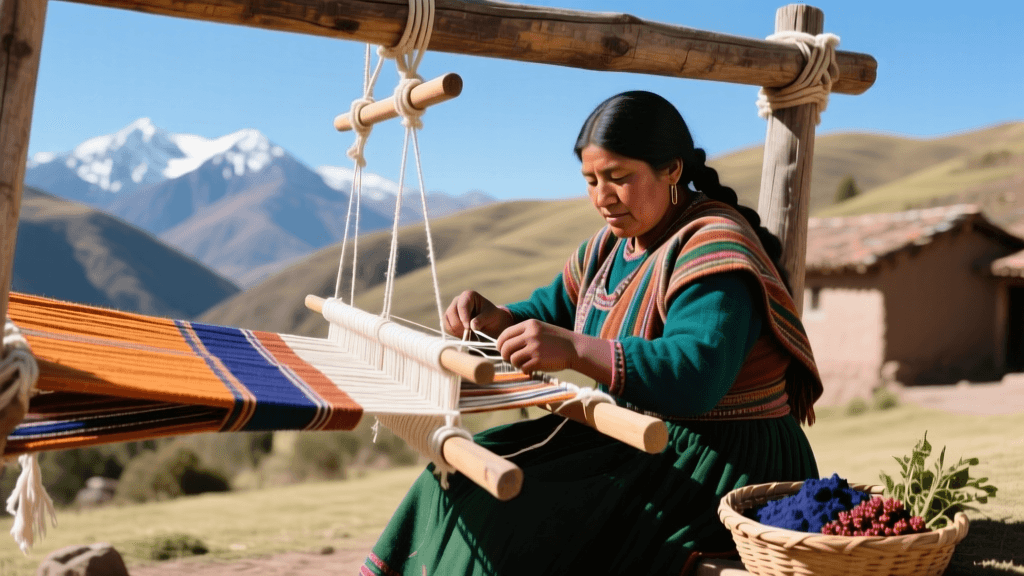
Unlike the rigid, floor-standing looms of Europe, the Andean backstrap loom is a marvel of portable engineering. It relies entirely on the weaver's body weight to create warp tension. The setup consists of several critical components:
- Loom Bar (Backstrap): A wooden or bone bar that wraps around the weaver's lower back, transferring tension directly to the spine and hips.
- Illawa (Sword/Comb): A heavy, polished wooden or bone tool used to beat the weft yarn tightly into place. The rhythmic thud of the illawa is the heartbeat of Andean villages.
- Rucana (Pick-up Stick): A pointed bone or wooden tool used to meticulously pick individual warp threads when creating complex pallay (patterns).
- Heddle Rods: Wooden rods tied with string loops that separate the warp threads, allowing the weaver to quickly alternate the shed (the space between threads) for plain weave backgrounds.
Setting up a backstrap loom requires precise measurement. A standard lliclla warp in 2026 is typically measured out to 1.5 meters in length, which, after loom waste and take-up (the shortening that occurs when the weft is beaten in), yields a finished textile of about 1.1 meters. The weaver controls the tension by leaning forward or backward, a physical skill that takes years to master and prevents the weaver's back from fatiguing during long weaving sessions.
Mastering Pallay: The Language of Patterns
The most striking feature of an authentic aguayo is the pallay, the supplementary warp patterns that adorn the textile. Pallay is not merely decorative; it is a complex visual language. Patterns depict local flora, fauna, agricultural cycles, and cosmological beliefs. For instance, the inti (sun) and ch'aska (star) motifs represent celestial navigation, while the condor, puma, and snake represent the three tiers of the Andean cosmos.
In 2026, master weavers do not use written charts or digital software to design their pallay. The patterns are memorized and passed down through generations via a system of counting threads. A weaver must memorize the exact sequence of warp threads to pick and drop, often managing counts of up to 150 threads across a single row. This cognitive feat is what separates a true ancestral textile from a simplified, modern interpretation.
Natural Dyeing: Botanical Alchemy in the Andes
While synthetic aniline dyes dominated the 20th century, the 2026 textile renaissance has seen a massive return to natural, botanical dyeing. Climate shifts in the Sacred Valley over the past few years have made some traditional dye plants harder to forage, prompting cooperatives to cultivate dedicated dye gardens to ensure sustainability. The process of dyeing alpaca and sheep wool requires deep knowledge of local botany and chemistry.
| Dye Source | Color Yield | Mordant Required | Preparation Time |
|---|---|---|---|
| Cochineal (Dactylopius coccus) | Crimson, Pink, Purple | Alum, Lemon juice (acid) | 3-5 days |
| Chilca (Baccharis latifolia) | Green, Yellow-Green | None / Collpa (mineral) | 24 hours |
| Indigo (Indigofera suffruticosa) | Deep Blue, Navy | Alkaline vat (ash water) | 1-2 weeks |
| Q'olle (Buddleja coriacea) | Bright Yellow, Gold | Alum | 12 hours |
| Walnut Hulls (Juglans neotropica) | Rich Brown, Black | Iron (rust water) | 48 hours |
Cochineal, an insect that lives on the prickly pear cactus, remains the most prized dye. By altering the pH of the dye bath with lime juice (to yield bright orange) or wood ash (to yield deep purple), a master dyer can extract a massive spectrum of colors from a single source. According to the Center for Traditional Textiles of Cusco (CTTC), preserving these natural dyeing recipes is just as critical as preserving the weaving techniques themselves, as they represent centuries of Indigenous scientific knowledge.
Navigating the 2026 Ethical Textile Market
As a buyer in 2026, it is crucial to understand the economics of Andean weaving. A genuine, hand-spun, naturally dyed, and backstrap-woven lliclla takes anywhere from three to six months to complete. Consequently, the era of the 'bargain' authentic textile is over. In 2026, fair-trade pricing dictates that a master-weaver's aguayo will cost between $350 and $600 USD, reflecting the living wage of the artisan and the cost of sustainable alpaca fiber.
To ensure your purchase directly benefits Indigenous women and their communities, bypass general tourist markets in Cusco or Lima where imported, machine-made acrylics are often sold as 'handmade.' Instead, seek out verified cooperatives. Organizations like Awamaki work directly with women's weaving cooperatives in the Sacred Valley, ensuring transparent supply chains, fair wages, and community-led business models. Purchasing through these channels guarantees that the cultural heritage is respected and the artisans are compensated equitably.
How to Identify Authentic Handwoven Textiles
When examining an aguayo in person, use these tactile and visual tests to verify its authenticity:
- The Selvage Edge: Authentic backstrap-woven textiles have finished edges (selvages) that are woven into the cloth, not cut and hemmed with a sewing machine. Look for the continuous loop of the warp thread at the edges.
- The Reverse Side: In a true supplementary warp pallay, the pattern will show up in inverse colors on the back of the textile, with long 'floats' of yarn. Machine embroidery will show a messy backing of bobbin thread.
- The Fiber Test: Rub the fibers between your fingers. Genuine alpaca or sheep wool will feel slightly lanolin-rich and warm. Acrylic blends will feel squeaky, overly smooth, and will generate static electricity.
- The Scent: Naturally dyed wool often retains a faint, earthy scent of the plants, wood smoke, or the natural lanolin of the animal. Synthetic textiles will smell like chemicals or factory dust.
Proper Care and Preservation
Caring for an authentic Andean textile requires gentle handling to preserve both the structural tension of the weave and the vibrancy of the natural dyes. Never machine wash or dry clean an aguayo, as the harsh chemicals and agitation will cause the wool to felt and the natural dyes to bleed.
Instead, hand wash the textile in cool water using a pH-neutral, lanolin-rich wool wash. Submerge the textile gently and let it soak for no more than 15 minutes. Do not wring or twist the fabric, as this will distort the warp tension. Press the water out by rolling the textile in a clean, dry towel. Finally, lay the aguayo flat on a drying rack in a shaded, well-ventilated area. Direct sunlight will rapidly fade natural dyes like cochineal and chilca. When storing, wrap the textile in acid-free tissue paper and keep it in a cedar chest to deter moths, avoiding plastic bags which trap moisture and promote mold growth.
Conclusion
The Andean aguayo is a testament to the resilience and brilliance of Indigenous Latin American cultures. By understanding the mechanics of the backstrap loom, the chemistry of natural dyes, and the ethics of fair-trade sourcing, weavers and collectors in 2026 can play an active role in preserving this magnificent textile tradition for generations to come.