Yichang Hanfu: Meaning in Chinese Dress
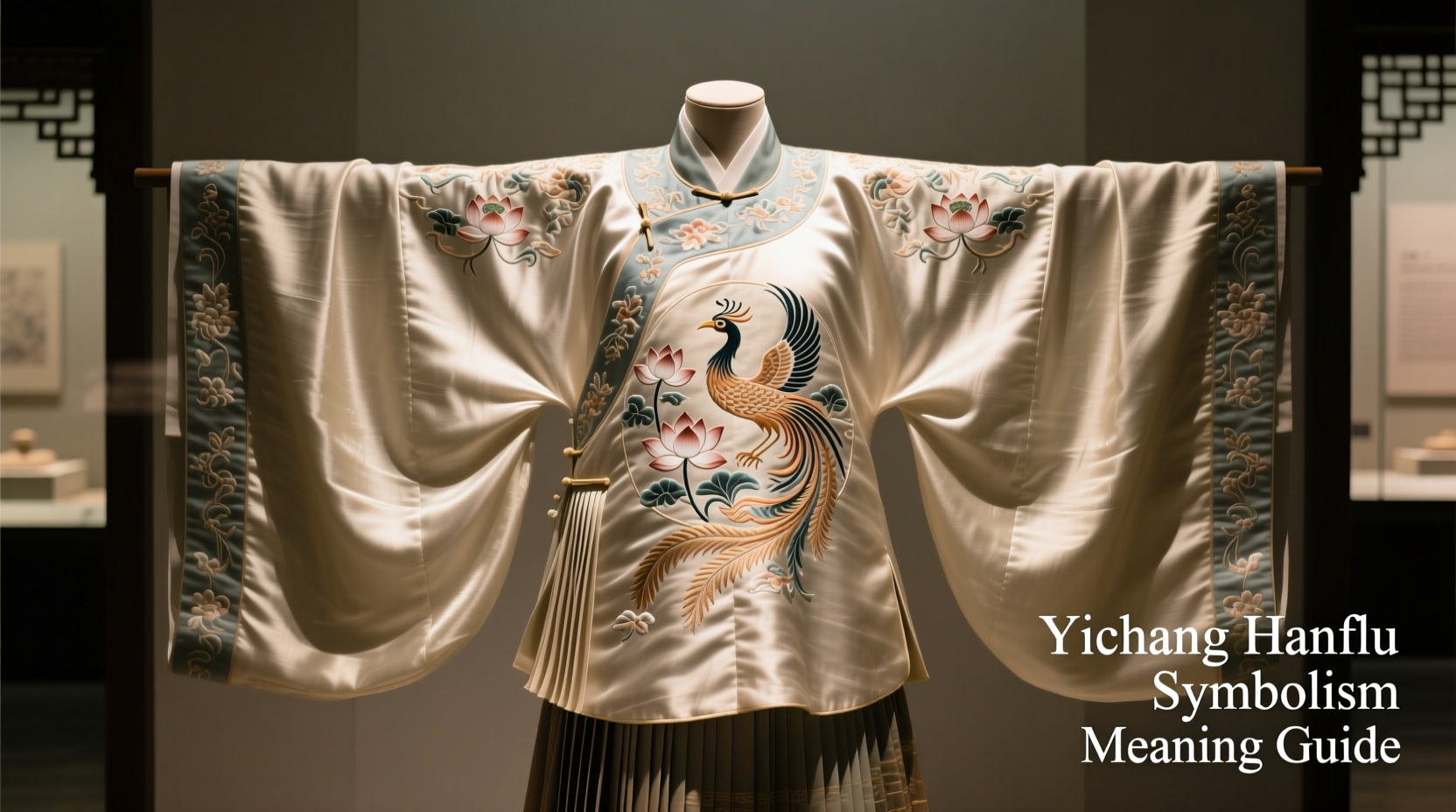
When exploring the vast lexicon of traditional Chinese clothing, the term Yichang Hanfu (衣裳) stands as the foundational bedrock of Han ethnic dress. Far from being a mere descriptive word for 'clothes,' the concept of Yichang represents a profound cosmological framework that governed ancient Chinese society, philosophy, and daily life. While modern fashion often prioritizes silhouette and trend, Yichang Hanfu was designed to align the human body with the universe itself.
The Cosmological Roots of Yi and Chang
To understand Yichang Hanfu, one must first dissect its etymology. In classical Chinese, Yi (衣) refers specifically to the upper garment, while Chang (裳) denotes the lower skirt. This binary separation is not merely a stylistic choice; it is a direct sartorial manifestation of the universe's dualistic nature.
'Huangdi, Yao, and Shun let their upper and lower garments hang, and all under heaven was ordered.' — The I Ching (Book of Changes), Xici Zhuan (Appended Statements)
According to ancient texts preserved by institutions like the Palace Museum in Beijing, the upper garment (Yi) symbolizes Heaven (Qian), representing the masculine, active, and celestial forces (Yang). The lower skirt (Chang) symbolizes Earth (Kun), representing the feminine, receptive, and terrestrial forces (Yin). By wearing a distinct top and bottom, the wearer physically embodied the harmony between Heaven and Earth, acting as a microcosm of the universe. This philosophical weight is what separates authentic Yichang from the later Shenyi (深衣, deep robe), which connected the top and bottom into a single piece to symbolize the unity of the cosmos.
Anatomy of the Garment: Construction and Cut
The physical construction of Yichang Hanfu is governed by strict moral and geometric codes. Traditional Hanfu utilizes a 'flat-cutting' method. Unlike Western tailoring, which uses darts and seams to force fabric to conform to the body's three-dimensional curves, Yichang is cut from straight lengths of woven fabric. This respects the integrity of the woven cloth and allows the garment to drape naturally, symbolizing a harmony with nature rather than an attempt to conquer it.
The Center Seam and Moral Uprightness
Every authentic Yichang top features a prominent center back seam known as the Zhongfeng (中缝). Running perfectly straight from the nape of the neck to the lower hem, this seam is a daily reminder for the wearer to maintain an upright, honest, and centered moral character. A crooked Zhongfeng was historically seen as a reflection of a crooked mind.
Jiaoling Youren: The Mandate of Civilization
The collar of the Yichang top almost universally follows the Jiaoling Youren (交领右衽) style: an intersecting collar where the left lapel crosses over the right, securing on the wearer's right side. In traditional Chinese philosophy, the left is associated with Yang (life, warmth, the east) and the right with Yin (death, cold, the west). Covering the Yin side with the Yang side signifies the triumph of life and civilization. Conversely, the Zuoren (left-over-right) style was strictly reserved for dressing the deceased or was associated with neighboring nomadic tribes, whom ancient Han texts referred to as 'barbarians.' Thus, the direction of the collar was a powerful geopolitical and spiritual identifier.
Color Theory and Dynastic Symbolism in Yichang
The coloration of Yichang Hanfu was historically dictated by the Wuxing (Five Elements) theory and strict sumptuary laws. While modern Hanfu enthusiasts enjoy a limitless palette, historical Yichang colors carried specific elemental and social weights. The China Silk Museum in Hangzhou notes that ancient dyeing techniques relied on complex plant and mineral extractions to achieve these symbolic hues.
| Color (English) | Color (Pinyin) | Element | Direction | Symbolic Meaning & Usage |
|---|---|---|---|---|
| Green/Blue | Qing (青) | Wood | East | Growth, spring, youth. Often worn by scholars and young officials. |
| Red | Chi (赤) | Fire | South | Prosperity, joy, summer. Prominent in wedding Yichang and festive wear. |
| Yellow | Huang (黄) | Earth | Center | Imperial authority, neutrality. Restricted to the Emperor and high royalty in later dynasties. |
| White | Bai (白) | Metal | West | Purity, autumn, mourning. Worn during periods of grief or by those renouncing worldly affairs. |
| Black | Hei (黑) | Water | North | Wisdom, winter, the heavens. The Qin dynasty famously elevated black as the supreme state color. |
Sourcing Authentic Yichang Hanfu Today
The contemporary Hanfu movement (Hanfu Yundong) has sparked a massive revival of Yichang garments. However, the market is flooded with cheap, synthetic 'costume' versions that ignore the philosophical and structural integrity of the dress. For cultural practitioners and serious collectors, sourcing authentic Yichang requires an understanding of traditional textiles and construction.
Fabric Composition and Price Ranges
Authentic Yichang relies on natural fibers that behave correctly when flat-cut. Mulberry silk, ramie, and linen are the gold standards. Polyester fails to provide the necessary drape and breathability, often resulting in a stiff, unnatural silhouette that contradicts the fluid philosophy of the garment.
- Entry-Level (Authentic Cut, Natural Blends): $60 - $120 USD. These sets typically feature cotton-linen blends or basic viscose. They maintain the correct Zhongfeng and Youren structures but lack the luster of historical silks. Ideal for daily casual wear.
- Mid-Tier (Traditional Textiles): $150 - $350 USD. At this level, you will find genuine ramie (xia bu), raw silk, and jacquard woven patterns. The Chang (skirt) may feature traditional pleating techniques like the Mamianqun (horse-face skirt) with woven metallic threads.
- Couture & Museum Replicas: $500 - $1,500+ USD. Artisan cooperatives and high-end boutiques offer heavy mulberry silk, Song brocade (Song Jin), and hand-embroidered motifs. These pieces often replicate specific Ming or Song dynasty artifacts housed in institutions like the Metropolitan Museum of Art's Asian Art Department.
Buying Guide Checklist for Yichang Hanfu
When evaluating a Yichang set for cultural accuracy and quality, use this structural checklist:
- Check the Seam: Is there a visible, straight center back seam (Zhongfeng) on the upper garment? If not, it is a modern Western-tailored imitation.
- Verify the Collar: Ensure the left lapel crosses over the right (Youren). The collar should lie flat against the neck without gaping.
- Examine the Armholes: Traditional Hanfu features a dropped shoulder seam and wide, curved armholes that allow for immense mobility without pulling the collar out of place.
- Inspect the Skirt Waist: The Chang should tie with woven fabric ribbons, never zippers, buttons, or elastic bands. The waistband is traditionally wide and white, symbolizing purity and serving as a structural anchor.
Preserving the Philosophy in Modern Wear
Wearing Yichang Hanfu today is an act of cultural preservation. It requires the wearer to move differently—to walk with measured steps, to bow with a straight back, and to respect the physical space the garment occupies. The wide sleeves and flowing skirts demand mindfulness. By understanding the deep symbolism woven into every seam, collar, and color of the Yichang, modern wearers do more than just dress up; they participate in a living, breathing dialogue with thousands of years of Chinese philosophical thought.