The Qipao: Chinese Heritage & Cultural Guide
Linguistic Roots: Translating the Garment's Identity
When examining the qipao in Chinese cultural archives, one must first understand the linguistic duality of the garment. In Mandarin, the term is qípáo (旗袍). The character qí (旗) refers to the Eight Banners of the Manchu military-social system, while páo (袍) translates to a long robe or gown. Therefore, the literal translation is "banner robe." However, in the Cantonese-speaking regions of Guangdong and Hong Kong, the garment is universally known as the cheongsam (長衫, coeng4 saam1), meaning "long shirt." This linguistic divide reflects not just regional dialects, but the distinct evolutionary paths the garment took across different Asian urban centers during the 20th century.
The Tailoring Revolution: From Qing Dynasty to 1930s Shanghai
The modern silhouette of the qipao is a relatively recent invention, born from a radical socio-political shift. During the Qing Dynasty (1644–1912), Manchu women wore the changpao, a loose, boxy, and floor-length robe that concealed the body's natural contours, often layered with trousers. According to the Victoria and Albert Museum's archive on Chinese Dress, these early robes were heavily embroidered and prioritized modesty and social rank over mobility.
The Feminist Awakening of the 1920s
The transformation began in the 1920s in Shanghai. Influenced by the May Fourth Movement and early feminist ideologies, young Chinese women and female students began adopting the male scholar's long robe as a symbol of gender equality and intellectual liberation. By cutting their hair short and wearing these simplified robes, they rejected the restrictive, heavily layered traditional Hanfu and the oppressive foot-binding practices of the past.
The 1930s Golden Age and Western Integration
By the 1930s, Shanghai had become the "Paris of the East." The qipao absorbed Western tailoring techniques. Artisans introduced bust and waist darts, set-in sleeves, and bias-cutting to create the iconic, form-fitting silhouette. As highlighted by The Metropolitan Museum of Art's Costume Institute, this era cemented the qipao as a symbol of modern Chinese femininity, glamour, and cosmopolitan sophistication, frequently immortalized in Shanghai calendar girl illustrations and early cinema.
Anatomy of the Garment: Construction and Fabrication Details
Authentic qipao construction is a masterclass in structural minimalism and tension. Unlike Western garments that rely on multiple panels and seams to create shape, a traditional master-tailored qipao is ideally cut from a single continuous piece of fabric, folded at the shoulders. This preserves the integrity of the textile's pattern and grain.
The Four Essential Elements of Authentic Tailoring
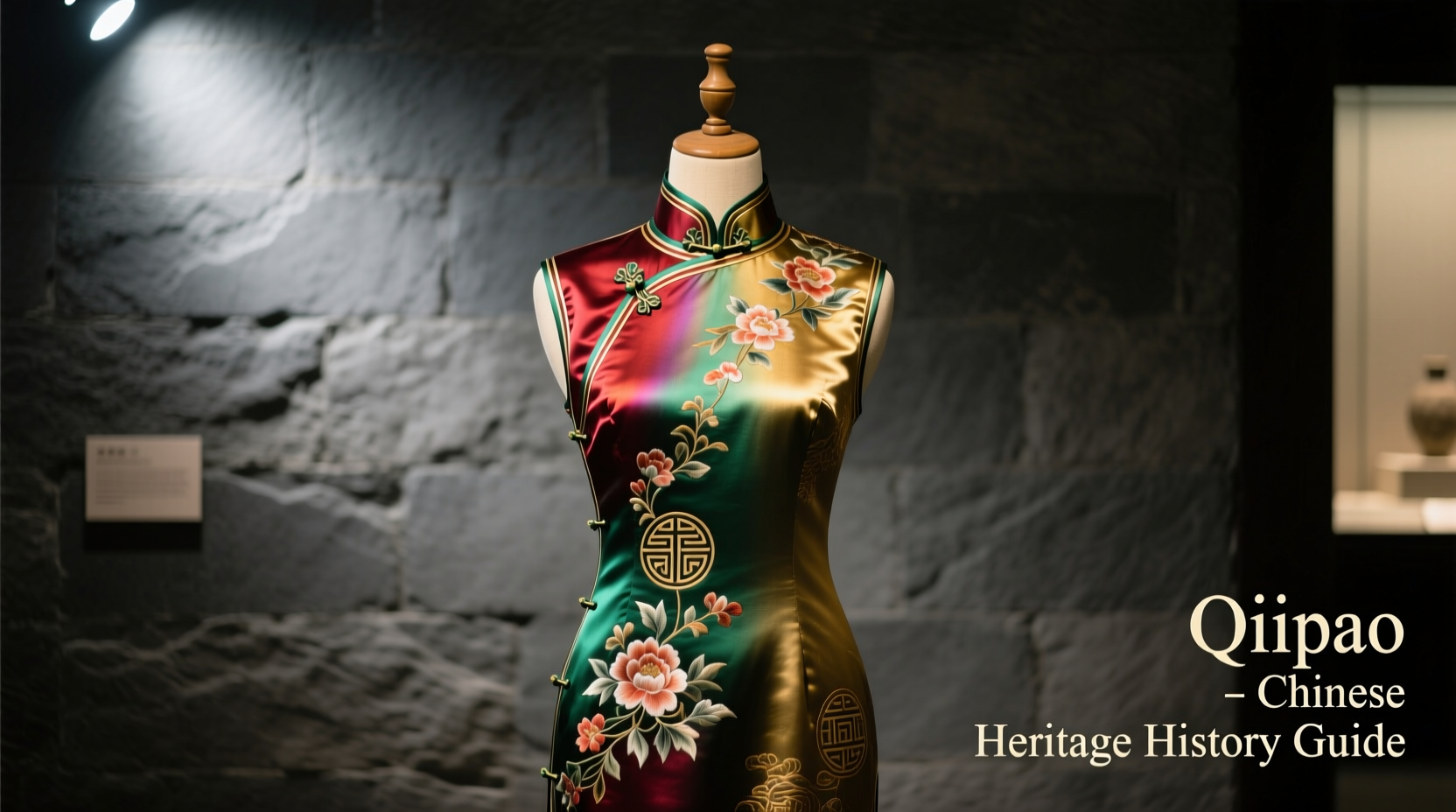
- The Mandarin Collar (元宝领 / 立领): A stiffened, stand-up collar that frames the face. Bespoke tailors measure the exact hollow of the collarbone and the curvature of the neck to ensure the collar stands perfectly without choking the wearer. It typically ranges from 3cm to 5cm in height.
- Pankou Knots (盘扣): These are not merely decorative buttons; they are functional, hand-braided silk fasteners. Master artisans spend hours crafting intricate motifs such as the plum blossom (梅花扣), butterfly (蝴蝶扣), or the double-coin knot. A high-end bespoke qipao may feature up to 12 hand-tied pankou running down the right diagonal lapel and side seam.
- The Side Slits (开衩): Originally designed to allow freedom of movement for horseback riding, the slits were raised in the 1930s to reveal the leg and silk stockings. In authentic tailoring, the slit is reinforced with a hidden triangular gusset (三角贴) to prevent tearing when the wearer sits.
- The Right Lapel (右衽): Following ancient Han Chinese sartorial rules, the front panel always crosses over the right side. The left-over-right closure is a strict cultural protocol; reversing it is traditionally reserved only for dressing the deceased.
Regional Divergence: Shanghai vs. Beijing vs. Cantonese Styles
While globalization has homogenized many aspects of fashion, regional variations of the qipao remain distinct in their construction, fabric choices, and cultural applications. Understanding these differences is crucial for collectors and buyers.
| Regional Style | Silhouette & Fit | Preferred Fabrics | Collar & Slit Height | Cultural Context |
|---|---|---|---|---|
| Haipai (Shanghai) | Form-fitting, Western darting, curved seams | Lightweight silk crepe, velvet, lace | High collar (4-5cm), high slits (mid-thigh) | Evening wear, high-society glamour, modern fashion |
| Jingpai (Beijing) | Relaxed, traditional flat-cutting, A-line drape | Heavy Song brocade, Xiangyunsha, embroidered satin | Moderate collar (3cm), conservative slits (below knee) | Diplomatic events, traditional ceremonies, winter wear |
| Yuepai (Canton) | Practical, shorter length, relaxed waist | Cotton, linen, ramie, breathable blends | Low or collarless, lower slits for mobility | Daily wear, summer clothing, service industry uniforms |
Sourcing and Pricing: Navigating the Modern Market
Acquiring an authentic qipao requires navigating a market saturated with mass-produced, polyester costumes. True artisanal qipao are investments in intangible cultural heritage. When searching for a traditional qipao in chinese markets or international boutiques, buyers should understand the distinct pricing tiers.
Price Tiers and Artisan Cooperatives
1. Ready-to-Wear (RTW) / Commercial ($80 - $250 USD): Produced in factories using standardized Western sizing and synthetic blends. These often feature glued-on collars (which bubble after washing) and machine-stamped, hollow pankou. Suitable for casual wear or costumes, but lacking structural integrity.
2. Made-to-Measure (MTM) ($350 - $800 USD): Offered by reputable boutiques in Shanghai, Hong Kong, and global Chinatowns. The buyer selects from a curated fabric library, and the tailor adjusts a base pattern to 10-15 body measurements. The collar is lightly stiffened with traditional paste or modern interfacing, and pankou are hand-finished.
3. Bespoke / Master Artisan ($1,200 - $4,500+ USD): The pinnacle of the craft. Tailors like those at the historic Hong Xiang or independent masters in Shanghai take over 30 micro-measurements, accounting for shoulder slope, spinal curvature, and posture. The garment is cut entirely by hand. Clients often supply their own heritage fabrics, such as Xiangyunsha (Gambiered Canton Gauze)—a highly prized, sustainably dyed silk treated with yam juice and river mud, which costs upwards of $200 per yard alone.
Cultural Protocols: When and How to Wear the Qipao Today
Despite its popularity in Western media as a generic "Asian dress," the qipao carries specific cultural weight and protocols in modern Chinese society. It is not merely a party dress; it is a garment of dignity, maturity, and cultural pride.
"The qipao demands a certain posture and grace. It is not designed for the hurried pace of the subway, but for the deliberate, elegant movements of a woman who commands the room." — Excerpt from interviews with master tailors on Nanjing Road, Shanghai.
Weddings and Auspicious Occasions
For traditional Chinese weddings, the bride often changes into a red qipao (or the older, more elaborate Qungua / Longfeng Gua) for the tea ceremony and evening banquet. The fabric is typically heavy silk brocade embroidered with the dragon and phoenix (龙凤), symbolizing the balance of yin and yang. Gold and silver threads (盘金绣) are used to catch the light. It is considered a severe faux pas for a guest to wear solid red to a Chinese wedding, as it competes with the bride.
Modern Styling and Everyday Elegance
Contemporary styling has moved away from the head-to-toe vintage look. Today, fashion-forward women in cities like Chengdu and Taipei style the qipao as a statement piece. A sleeveless, midi-length qipao in a muted, geometric jacquard can be paired with a tailored wool blazer, ankle boots, and minimalist silver jewelry. The key to modern styling is juxtaposition: balancing the inherent formality and historical weight of the garment with structured, contemporary outerwear and footwear.
Preservation and the Future of the Craft
The art of hand-making the qipao was added to China's National Intangible Cultural Heritage list in 2007. However, the grueling apprenticeship required to master the bias-cutting and hand-sewing techniques has led to a shortage of master tailors. Institutions and academic researchers, as documented in various cultural analyses by BBC Culture, note a recent resurgence among Gen-Z consumers who are rejecting fast fashion in favor of Guochao (national trend), seeking out young, innovative designers who blend traditional pankou and collar techniques with sustainable, avant-garde textiles.
Ultimately, the qipao is a living archive. It maps the journey of Chinese women from the restrictive confines of the Qing dynasty to the boardrooms and galleries of the 21st century. To wear a well-tailored qipao is to drape oneself in a century of resilience, revolution, and unparalleled sartorial artistry.