Tang Suit Craftsmanship: Fabrics, Pankou Buttons, and Tailoring

When global leaders gathered for the 2001 APEC summit in Shanghai, they were photographed wearing matching silk jackets that the international press quickly dubbed the "Tang suit." This single event catapulted the garment into global consciousness, sparking a massive revival in Chinese diaspora communities and mainland China alike. Yet, for the cultural garment enthusiast, the modern Tang suit (唐装, Tángzhuāng) presents a fascinating paradox: it is neither from the Tang Dynasty, nor is it a static historical relic. It is a living, evolving hybrid of Qing Dynasty equestrian wear and 20th-century tailoring innovations.
To truly appreciate the Tang suit, one must look past the festive red tourist-shop replicas and examine the profound textile engineering, the structural geometry of its flat-cut tailoring, and the micro-sculpture of its frog fasteners. This deep dive explores the authentic craftsmanship that elevates the Tang suit from a costume to a masterwork of Asian sartorial heritage.
The Historical Misnomer: Qing Dynasty Roots vs. Tang Era
A common misconception is that the Tang suit originates from the Tang Dynasty (618–907 CE), an era celebrated for its flowing, wide-sleeved Hanfu robes and cosmopolitan silk aesthetics. In reality, the structural DNA of the modern Tang suit is rooted in the Qing Dynasty (1644–1912 CE). Specifically, it evolved from the magua (马褂), a waist-length riding jacket worn by Manchu horsemen. The magua featured a stand collar, a center-front opening, and slits on the sides for ease of movement in the saddle.
During the 1920s and 1930s, the magua was adapted into urban menswear, often worn over the long changshan gown. The contemporary Tang suit, as recognized today, was heavily codified in the late 1990s by Shanghai-based tailors who blended the traditional magua silhouette with Western set-in sleeves and modern darting to accommodate broader shoulders. According to the Victoria and Albert Museum's Chinese textile archives, this synthesis represents a distinct chapter in the modernization of indigenous dress, balancing Qing-era aesthetics with contemporary ergonomic demands.
Textile Anatomy: Brocades, Silks, and Modern Blends
The soul of a high-quality Tang suit lies in its fabric. While mass-market versions rely on synthetic jacquards, authentic artisanal jackets utilize complex, multi-layered silk weaves that require specialized drawlooms. The most prestigious fabrics used in Tang suit construction are the historic Chinese brocades.
Song Brocade (宋锦, Sòng Jǐn)
Originating from Suzhou, Song Brocade is prized for its matte finish, intricate geometric and floral motifs, and exceptional durability. Unlike the highly reflective satin weaves, Song Brocade utilizes a complex warp-faced structure that allows for subtle, tonal color shifts. It drapes heavily, making it ideal for structured Tang jackets that require a crisp silhouette without excessive wrinkling.
Shu Brocade (蜀锦, Shǔ Jǐn)
Hailing from Sichuan province, Shu Brocade is one of the oldest continuously produced silks in the world, dating back over two millennia. It is characterized by vibrant, saturated colors and a slightly thicker hand-feel. Shu Brocade is frequently used for festive Tang suits intended for Lunar New Year or winter weddings, as its dense weave provides natural insulation.
Zhangzhou Velvet (漳绒, Zhāng Róng)
For winter Tang suits, tailors often turn to Zhangzhou velvet. This fabric features a silk base with raised, cut-pile patterns. The contrast between the matte background and the lustrous velvet motifs creates a tactile depth that synthetic velvets cannot replicate.
| Fabric Type | Native Term | Composition | Characteristics & Drape | Price Tier (Retail) |
|---|---|---|---|---|
| Song Brocade | 宋锦 (Sòng Jǐn) | 100% Mulberry Silk | Matte, structured, geometric patterns | $$$ ($250 - $600) |
| Shu Brocade | 蜀锦 (Shǔ Jǐn) | Silk / Cotton Blend | Vibrant, heavy, excellent insulation | $$$ ($200 - $500) |
| Zhangzhou Velvet | 漳绒 (Zhāng Róng) | Silk Base, Rayon Pile | Textured, warm, raised cut-pile motifs | $$ ($150 - $350) |
| Modern Jacquard | 提花 (Tí Huā) | Polyester / Viscose | High sheen, lightweight, prone to snagging | $ ($30 - $80) |
The Art of Pankou (盘扣): Micro-Sculpture in Silk
If the brocade is the canvas of the Tang suit, the Pankou (frog buttons) are its jewelry. Far from being mere utilitarian fasteners, Pankou are hand-knotted textile sculptures that carry profound symbolic weight. A master knot-maker (dapanjiang) can spend up to four hours crafting a single complex ornamental knot.
Traditional Pankou consist of two parts: the pan (the decorative knot) and the kou (the loop and toggle). The construction requires bias-cut strips of silk, tightly rolled around a core. Historically, the core was made of tightly twisted cotton or hemp yarn, which allowed the knot to remain soft and flexible. Today, many tailors use a copper wire core. While wire-core Pankou hold their intricate shapes perfectly—essential for heavy brocade jackets—they lack the historical authenticity and tactile softness of yarn-core knots.
"The knotting of Pankou is an exercise in tension and geometry. A butterfly knot (Hudiejie) requires exactly 14 precise loops; if the tension varies by a millimeter, the wings will asymmetrical, ruining the harmony of the garment."
— Master Artisan at the China National Silk Museum textile preservation guild.
Symbolic Knot Variations
- Yizijie (Straight Knot): The most basic, utilitarian knot. Used on minimalist, everyday Tang jackets.
- Meihuajie (Plum Blossom): Features five petals, symbolizing resilience and the arrival of spring. Popular for Lunar New Year garments.
- Hudiejie (Butterfly): Represents joy, longevity, and marital bliss. Frequently used on Tang suits commissioned for weddings or anniversary celebrations.
- Shouzijie (Longevity Character): Knots woven to mimic the Chinese character for longevity (寿). Reserved for elders' milestone birthdays (e.g., 60th or 80th).
Tailoring and Structural Construction: Pingmian Caizhi
Western tailoring relies on stereoscopic cutting—using darts, princess seams, and curved armholes to mold flat fabric to the three-dimensional curves of the human body. Traditional Chinese tailoring, however, utilizes Pingmian Caizhi (平面裁剪), or flat pattern cutting.
In authentic Tang suit craftsmanship, the front and back panels are often cut from a single continuous piece of fabric, or joined at a straight center-back seam. The sleeves are traditionally cut in a cross-shape with the body, resulting in a dropped shoulder and a wide, diamond-shaped gusset under the arm. This construction method respects the integrity of the brocade's continuous pattern, avoiding the visual disruption of Western darts.
However, the modern Tang suit represents a compromise. To prevent the "boxy" look of traditional flat-cutting, contemporary bespoke tailors introduce a subtle shoulder slope and a shallow armscye (armhole), blending the aesthetic continuity of Pingmian Caizhi with the ergonomic mobility of Western suiting. The collar, known globally as the Mandarin collar, must be cut on the bias to allow it to stand erect without buckling, requiring a stiff inner layer of horsehair canvas or modern fusible interfacing.
Regional Embroidery Traditions on Tang Jackets
While the fabric provides the base, embroidery elevates the Tang suit to couture. The placement and style of embroidery follow strict regional traditions:
Suzhou Embroidery (Su Xiu)
Known for its use of incredibly fine silk threads—sometimes split into 1/48th of a single strand—Su Xiu is favored for subtle, tonal embroidery. On a Tang suit, Su Xiu is often applied to the cuffs and the hem, featuring delicate motifs like koi fish or bamboo. The stitching is so fine that the work appears almost photorealistic or painted.
Cantonese Embroidery (Yue Xiu)
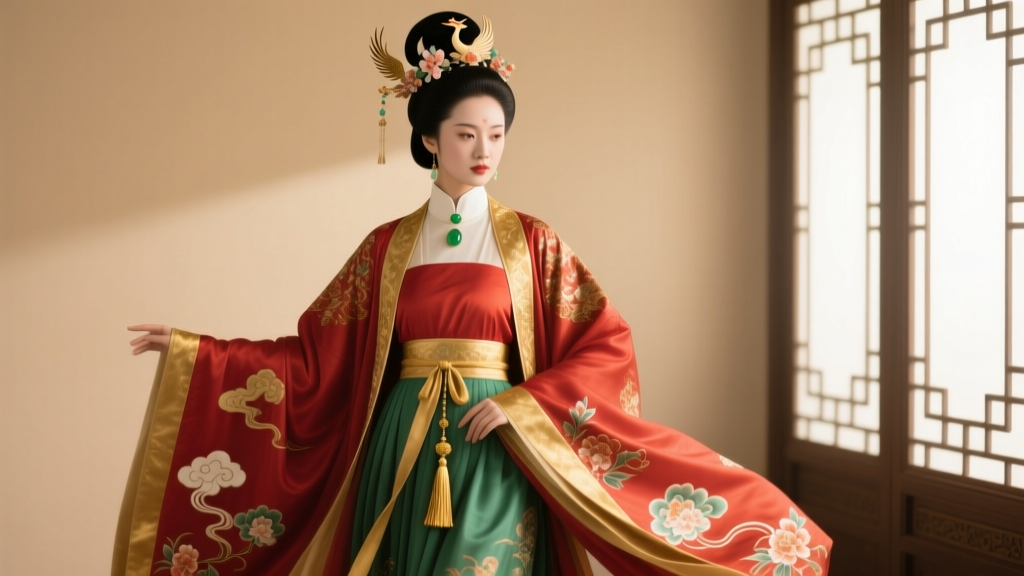
In contrast, Cantonese embroidery is bold, heavily textured, and frequently incorporates metallic gold and silver threads (panjin). Yue Xiu is the preferred choice for dramatic, high-contrast Tang suits worn by grooms or performers. The motifs—typically dragons, phoenixes, or peonies—are padded with cotton wadding to create a three-dimensional bas-relief effect that catches the light dynamically.
A Buyer’s Framework: Sourcing Authentic Tang Suits
Navigating the market for a Tang suit requires a discerning eye to separate cultural heritage from fast-fashion costumes. Use this framework when evaluating a purchase:
- Examine the Pattern Alignment: In high-end Tang suits, the brocade motif must align seamlessly across the center-front opening and the side seams. Mass-produced jackets will have mismatched patterns, indicating the fabric was cut inefficiently to save costs.
- Test the Pankou Core: Gently squeeze the frog buttons. If they feel hard and unyielding, they are wire-core. While durable, they are less traditional. If they have a slight give and feel dense, they are likely yarn-core, indicating hand-rolled craftsmanship.
- Check the Lining: A quality Tang suit will be lined with habotai silk or a high-grade cupro (Bemberg) to allow the jacket to glide over underlying clothing. Polyester linings trap heat and generate static, which can damage delicate silk brocades over time.
- Assess the Collar Roll: The stand collar should hug the neck without gaping at the back or choking the wearer at the front. This requires precise bias-cutting and internal canvas structuring that only experienced tailors can execute.
The Tang suit is a testament to the adaptability of Asian traditional garments. By understanding the profound craftsmanship—from the loom-woven geometry of Song Brocade to the tensile mathematics of a butterfly Pankou—wearers and collectors can engage with this garment not as a relic of a misunderstood dynasty, but as a vibrant, evolving masterpiece of modern cultural tailoring.