Chinese Men's Traditional Clothes: Hanfu to Tang Suit

Decoding the Silhouette: Hanfu vs. Qing-Era Menswear
The landscape of male Chinese traditional clothes is not a monolith; it is a complex tapestry woven from thousands of years of dynastic shifts, philosophical movements, and ethnic integrations. For modern enthusiasts, scholars, and cultural practitioners, understanding the distinctions between Han Chinese garments (Hanfu) and Manchu-influenced menswear (Changshan and Tangzhuang) is essential. While Hanfu reflects the cosmological and agrarian roots of early Chinese civilization through flowing silhouettes, wide sleeves, and cross-collars, Qing-era garments showcase the equestrian pragmatism of the Manchus, characterized by side slits, stand collars, and frog fasteners. This comprehensive comparison explores the varieties, construction methods, and cultural protocols of these iconic garments, providing a definitive guide for collectors and wearers alike.
The Hanfu Renaissance: Shenyi, Daopao, and Feiyufu
Hanfu, the historical dress of the Han Chinese, spans over three millennia, evolving through the Zhou, Han, Tang, Song, and Ming dynasties. In the contemporary Hanfu revival movement (Hanfu Yundong), male practitioners frequently gravitate toward Ming Dynasty silhouettes for their structured elegance and historical documentation. According to textile archives at The Palace Museum in Beijing, the Ming era represented a pinnacle of Chinese textile weaving, introducing complex brocades and highly codified garment structures.
The Scholar's Daopao and the Martial Feiyufu
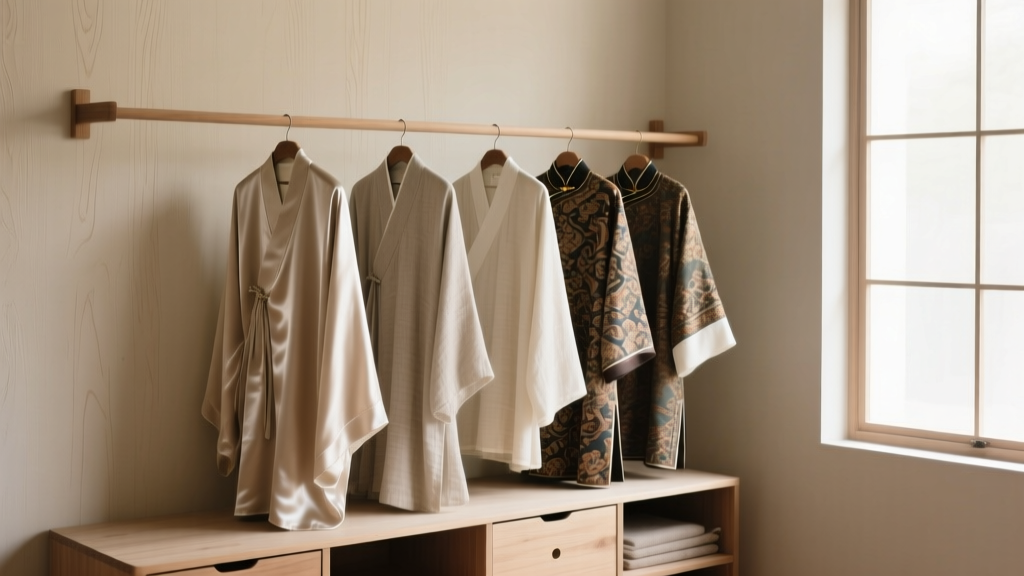
The Daopao (道袍) is the quintessential Ming Dynasty scholar's robe. Despite its name translating to 'Daoist robe,' it was widely worn by literati and officials as everyday formal wear. Its genius lies in the anbai (暗摆) or hidden side pleats. These internal pleats allow the wearer to take wide strides and ride horses without exposing the inner trousers, maintaining a modest, unbroken vertical line at the front and sides. Crafted from breathable linen for summer or heavy silk brocade for winter, a high-quality Daopao requires up to five meters of fabric, creating a majestic, sweeping silhouette.
Conversely, the Feiyufu (飞鱼服), or 'Flying Fish Robe,' represents the martial apex of Ming menswear. Originally bestowed by the emperor upon the Jinyiwei (Embroidered Uniform Guard), the Feiyufu features a pleated lower skirt and tight-fitting sleeves, designed for mobility and combat. The 'flying fish' motif is a mythical creature resembling a dragon with fish scales, woven into the fabric using the labor-intensive zhuanghua (woven gold) technique. Today, reproductions of the Feiyufu are highly sought after for cultural festivals and martial arts demonstrations.
Construction and the Jiaoling Youren Rule
The most sacred rule in styling male Chinese traditional clothes of Han origin is the jiaoling youren (交领右衽) cross-collar rule. The left lapel must always cross over the right lapel, forming a 'y' shape at the neckline. This design is rooted in ancient Chinese cosmology, where the left represents Yang (life, the sun, the east) and the right represents Yin. Reversing this to zuoren (right over left) is strictly reserved for funerary rites and dressing the deceased. Violating this rule in daily wear is considered highly inauspicious and culturally disrespectful.
The Changshan and Tangzhuang: Qing Legacy to Modern Formalwear
Following the Manchu conquest in 1644, the Qing Dynasty imposed the tifa yifu edict, forcing Han men to adopt Manchu hairstyles and clothing. This resulted in a dramatic shift in male Chinese traditional clothes, moving away from wide sleeves and cross-collars toward the qizhuang (banner dress) system. The modern Changshan (long shirt) and Tangzhuang (Tang suit) are direct descendants of this era, heavily influenced by equestrian needs and the harsh northern climate.
Fabric, Pankou Knots, and Tailoring
The Changshan is a long, tailored robe featuring a Mandarin stand collar and four side slits (front, back, and both sides). These slits were originally designed to allow Manchu horsemen to sit comfortably in a saddle. During the Republic of China era (1912-1949), the Changshan was adopted by intellectuals, scholars, and politicians as a symbol of modern Chinese national identity, often worn beneath a Western overcoat or a traditional Magua (horse jacket). The Tangzhuang, despite its name referencing the Tang Dynasty, is actually a modern adaptation of the Qing riding jacket. It gained global prominence during the 2001 APEC summit in Shanghai. It is characterized by its boxy fit, stand collar, and the use of pankou (frog fasteners).
Pankou knots are intricate, hand-woven fabric buttons that serve both a functional and decorative purpose. Originally used because metal buttons could rust or freeze in the Manchu homeland, they evolved into complex motifs like the butterfly, plum blossom, and longevity knot. The Metropolitan Museum of Art notes that Qing-era textile artisans spent hundreds of hours weaving these fasteners, elevating them from mere closures to talismans of good fortune.
Comparative Breakdown: Occasion, Cost, and Wearability
Choosing between Hanfu and Qing-derived garments depends heavily on the occasion, budget, and desired historical aesthetic. The table below provides a structured comparison for buyers and stylists.
| Garment Type | Dynasty / Origin | Key Construction Features | Primary Occasions | Average Price Range (USD) |
|---|---|---|---|---|
| Daopao (Hanfu) | Ming Dynasty | Cross-collar, hidden side pleats (anbai), wide sleeves | Ceremonial, Scholar events, Tea ceremonies | $80 - $350 |
| Feiyufu (Hanfu) | Ming Dynasty | Round collar, pleated skirt, mythical beast brocade | Festivals, Martial arts, Photography | $120 - $500 |
| Changshan | Qing / Republic | Stand collar, four side slits, tailored fit | Formal wear, Weddings, Academic events | $60 - $250 |
| Tangzhuang | Modern (Qing roots) | Short jacket, pankou knots, stiff brocade | Lunar New Year, Family gatherings | $40 - $150 |
Sourcing Authentic Garments: Artisan Cooperatives vs. Commercial Brands
When investing in male Chinese traditional clothes, the fabric composition dictates both the price and the cultural authenticity. Mass-produced garments often rely on polyester blends, which trap heat and lack the historical drape of natural fibers. For authentic Hanfu, buyers should seek out brands that utilize pure mulberry silk, raw linen, or Xiangyunsha (Gambiered Canton Gauze).
Xiangyunsha is a UNESCO-recognized intangible cultural heritage fabric from Guangdong province. It is dyed using the juice of the Dioscorea cirrhosa tuber and coated with iron-rich river mud, resulting in a dark, crackled, water-resistant silk that rustles softly when worn. Artisan-crafted Xiangyunsha Daopao or Changshan can range from $800 to over $2,500 USD, reflecting the months of sun-drying and mud-coating required. According to the National Museum of China, the preservation of such textile techniques is vital to maintaining the material memory of Chinese civilization.
For entry-level buyers, reputable online Hanfu brands like Shisanyu or Zhongzheng Hanfu offer historically accurate Ming-style cuts in cotton-linen blends for $40 to $90 USD. When purchasing a Tangzhuang or Changshan, it is highly recommended to visit bespoke tailors in cities like Shanghai or Hong Kong, where the garment can be measured to accommodate the wearer's shoulders and the specific stiffness of the silk brocade.
Cultural Protocols and Styling Frameworks
Wearing male Chinese traditional clothes requires an understanding of the accompanying accessories and grooming standards. Hanfu is rarely worn without a belt system. The Daopao is typically cinched with a silk sash or a leather belt adorned with jade pendants (pei). In ancient times, the clinking of jade was believed to regulate a scholar's walking pace, promoting a calm and deliberate demeanor. Footwear should consist of flat, cloth-topped boots (xue) or woven straw sandals for a more rustic, Daoist aesthetic.
For the Changshan, the traditional pairing is a black silk Magua (horse jacket) worn over a deep blue or charcoal Changshan, finished with black cloth boots. This combination remains the standard for traditional Chinese grooms in many regions. Grooming also plays a role; while the historical topknot (guan) is rarely worn today outside of historical reenactments, maintaining a clean, structured hairstyle respects the formal nature of the garments. By understanding the deep historical roots, construction nuances, and cultural protocols of these garments, modern wearers can honor the legacy of Chinese menswear with authenticity and respect.