Traditional Female Chinese Dress: Regional Styles

The Myth of the Monolith: Understanding China's Sartorial Geography
When Western media and global fashion houses reference the 'traditional female chinese dress,' they almost exclusively default to a singular image: the form-fitting, high-collared, thigh-slit qipao (cheongsam) in bright red silk. However, reducing China's sartorial heritage to a single silhouette ignores over three millennia of textile innovation, dynastic shifts, and the profound geographical diversity of its 56 recognized ethnic groups. From the misty water towns of Jiangnan to the rugged, indigo-dyed highlands of Guizhou, the traditional female chinese dress is a vast, living encyclopedia of regional adaptation.
To truly understand these garments, one must examine them through the lens of regional substyles, climate-driven fabric choices, and distinct cultural protocols. This guide deconstructs the major regional variations of Han majority clothing, the localized evolution of the qipao, and the breathtaking textile mastery of China's ethnic minorities.
Hanfu Substyles: Dynastic Shifts and Regional Silhouettes
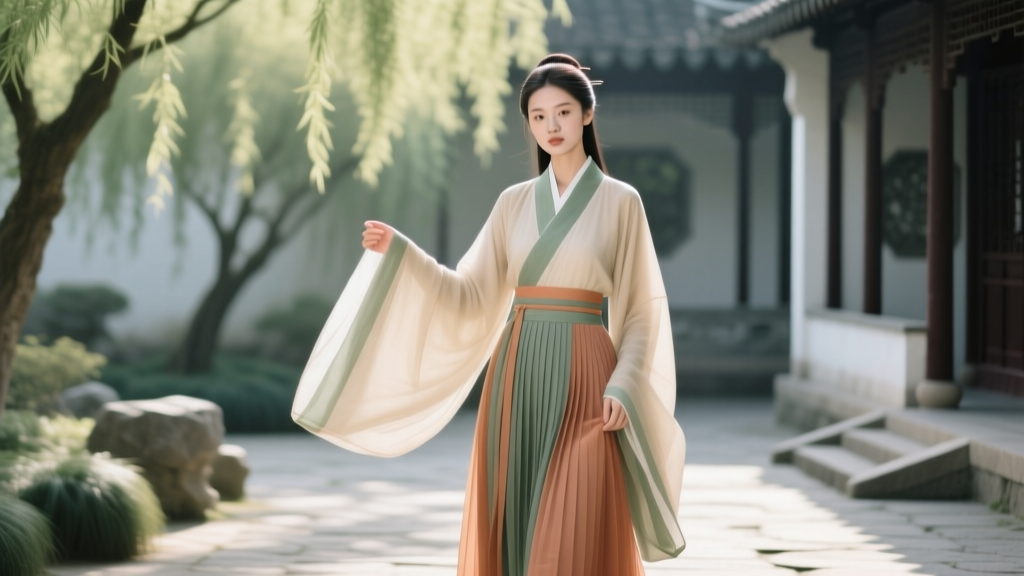
Hanfu, the historical clothing system of the Han Chinese, is not a single dress but a complex sartorial language. While the fundamental rule of jiaoling youren (crossed collar, right lapel over left) remains constant, regional climates and local economies birthed highly distinct substyles.
The Ruqun of the Jiangnan Water Towns
In the humid, temperate climate of Jiangnan (the Yangtze River Delta), the ruqun (a short jacket paired with a long, flowing skirt) evolved to prioritize breathability and ethereal aesthetics. Artisans in Suzhou and Hangzhou utilized lightweight, unlined silks and sheer gauzes (luo and sha). The color palette leaned heavily into pastels—celadon, lotus pink, and moonwhite—often adorned with delicate Su embroidery featuring local flora like plum blossoms and koi. The skirts were typically pleated or constructed as a mamianqun (horse-face skirt), allowing for ease of movement on stone bridges and wooden boats.
The Aoqun and Xiangyunsha of the Lingnan Region
Traveling south to the Lingnan region (modern-day Guangdong and Guangxi) and the Hakka communities, the traditional female chinese dress shifts dramatically toward pragmatism and durability. The aoqun (a longer, lined or unlined jacket with a stand collar, worn over a skirt) became prevalent. Here, the climate is subtropical, and agricultural labor was common among women. This gave rise to the use of Xiangyunsha (gambiered Canton silk). This extraordinary fabric is woven from silk yarn, dyed with the tannin-rich juice of the薯莨 (Shuliang) plant, and coated with iron-rich river mud. The result is a dark, rustling, water-resistant, and UV-protective textile that is highly prized by southern collectors today for its cooling properties and leather-like patina.
The Qipao's Regional Divergence: Shanghai vs. Beijing vs. Hong Kong
Emerging in the 1920s, the qipao (or cheongsam) is the most globally recognized traditional female chinese dress. Yet, its construction and styling varied fiercely depending on the city of its tailoring, reflecting local attitudes toward modernity, modesty, and Western influence.
| Regional Style | Silhouette & Cut | Primary Fabrics | Slit Height & Details | Cultural Context |
|---|---|---|---|---|
| Shanghai (Haipai) | Form-fitting, darted bodice, curved seams | Crepe de chine, imported lace, velvet | High (mid-to-upper thigh), often paired with stockings | Embraced Western tailoring; symbol of the modern, liberated 'New Woman' of the 1930s. |
| Beijing (Jingpai) | Relaxed, tubular, A-line, minimal darts | Heavy silk brocade, damask, wool blends | Low (calf-length), conservative | Retained imperial modesty; favored by aristocrats and intellectuals in the capital. |
| Hong Kong | Shortened hemline, practical, streamlined | Cotton, polyester blends, geometric prints | Moderate (knee-length), functional | 1950s/60s working-class adaptation; designed for office work and humid urban transit. |
According to the Victoria and Albert Museum, the Shanghai qipao's integration of Western bust darts and set-in sleeves fundamentally altered the traditional flat-pattern cutting of Chinese tailoring, creating a garment that celebrated the natural contours of the female body for the first time in Han fashion history.
Ethnic Minority Masterpieces: Beyond the Han Majority
China's 55 ethnic minority groups possess textile traditions that rival or surpass Han garments in complexity, often serving as wearable historical records in societies without written languages.
Miao (Hmong) Pleated Skirts and Silverwork of Guizhou
In the mountainous terrain of Guizhou, the Miao people create some of the most labor-intensive garments in the world. The traditional female Miao dress centers on the baizhequn (hundred-pleat skirt). Crafting a single skirt can require up to 30 yards of hand-woven hemp or cotton. The fabric is folded into hundreds of micro-pleats, bound tightly with thread, and dyed repeatedly in vats of natural indigo. To achieve the skirt's signature stiff, glossy finish, artisans brush it with a mixture of egg white, ox blood, and wild plant resins, then pound it with wooden mallets for days. This skirt is worn with massive, intricate silver horn headdresses and collars, representing the family's wealth and serving as spiritual armor against malevolent spirits.
The Bai People's Indigo and 'Wind-Flower-Snow-Moon' of Dali
In Yunnan's Dali region, the Bai women's traditional dress is defined by its striking tie-dye (zharan) and symbolic headdresses. Using Radix isatidis (woad root) and local indigo, artisans in Zhoucheng village create intricate resist-dyed patterns of plum blossoms, butterflies, and geometric borders on white cotton. The most iconic element is the headdress, designed to represent the 'Wind, Flower, Snow, and Moon' of Dali. The white tassels hanging from the side represent the wind of Xiaguan, the floral embroidery represents the flowers of Shangguan, the white wool top represents the snow of Cangshan mountain, and the curved shape mirrors the moon over Erhai Lake. The China National Silk Museum frequently highlights these minority resist-dyeing techniques as foundational to understanding the broader Asian textile diaspora.
Sourcing and Pricing: A Buyer's Guide to Regional Garments
For collectors, enthusiasts, and cultural practitioners, sourcing authentic regional garments requires an understanding of current market tiers and artisan pricing. Beware of mass-produced synthetics marketed as 'traditional.' Here is a realistic pricing framework for 2026:
- Mass-Market Hanfu (Taobao/E-commerce): $30 - $80 USD. Usually polyester blends, machine-embroidered. Acceptable for casual wear or cosplay, but lacks historical accuracy and breathability.
- Artisan Ming-Style Mamianqun: $150 - $450 USD. Woven from genuine silk or high-grade viscose, featuring authentic jacquard weaving or hand-embroidered hems. Look for sellers specializing in 'Ming dynasty复原' (historical reproduction).
- Bespoke Shanghai Qipao: $800 - $2,500+ USD. Commissioned from heritage tailors (such as those on Hongxiang or Changle Road in Shanghai). Includes custom pattern drafting, genuine silk brocade, and hand-knotted pankou (frog buttons).
- Vintage Miao Pleated Skirts (Antique Market): $600 - $3,000+ USD. Sourced from textile dealers in Guiyang or international ethnographic auctions. Authenticity is verified by the smell of natural indigo and the stiffness of the organic resin coating.
Cultural Protocols and Contemporary Wearing
When wearing any iteration of the traditional female chinese dress, observing cultural protocols is paramount to showing respect for the living tradition. The most critical rule in Hanfu and traditional Chinese tailoring is the direction of the collar. The left lapel must always cross over the right lapel (youren). In traditional Chinese cosmology, the left represents the living, the yang, and the sun. Conversely, crossing the right lapel over the left (zuoren) is strictly reserved for dressing the deceased for burial. Wearing a garment right-over-left in daily life is considered highly inauspicious and culturally illiterate.
Furthermore, when styling a qipao for formal events, the hemline should dictate the footwear. While modern fashion often pairs qipaos with stilettos, traditional etiquette and historical accuracy favor low-heeled, embroidered cloth shoes or modest Mary Janes, allowing the garment's slit and piping to remain the focal point. As noted by the Metropolitan Museum of Art's Heilbrunn Timeline, the true elegance of Chinese dress lies not in the revelation of the body, but in the harmonious flow of the textile and the profound symbolism woven into its very fibers.
'To wear a traditional Chinese garment is to drape oneself in geography, history, and philosophy. It is never merely a dress; it is a map of where the wearer's ancestors stood in relation to the earth and the heavens.'
— Curatorial Notes, Asian Textile Arts Symposium
Final Thoughts on Sartorial Preservation
The narrative of the traditional female chinese dress is one of remarkable resilience and regional pride. Whether it is the rustle of a Jiangnan silk skirt, the structured elegance of a Beijing brocade qipao, or the deep, earthy scent of a Guizhou indigo pleat, these garments demand to be recognized for their specific regional origins. By moving beyond the monolith and embracing the substyles, we honor the diverse artisans, tailors, and minority weavers who continue to keep these extraordinary textile traditions alive today.