Regional Variations of Chinese Clothing Hanfu
The Myth of a Monolithic Silhouette: Geography as the Tailor
When enthusiasts, historians, and designers discuss traditional Chinese clothing hanfu, the conversation often defaults to a generalized silhouette: the crossed collar (jiaoling youren), the flowing sleeves, and the pleated skirts. However, treating Hanfu as a single, static entity ignores over three millennia of dynamic evolution driven by one of the world's most diverse geographical landscapes. From the humid, subtropical basins of the deep south to the arid, windswept steppes of the northern plains, regional climates, local agriculture, and indigenous textile technologies have profoundly dictated how Hanfu was constructed, draped, and worn.
To truly understand Hanfu is to understand the concept of pingmian caijian (flat-plane cutting). Unlike Western tailoring, which relies on darts and curved seams to mold fabric to the body's three-dimensional contours, traditional Chinese garment construction utilizes two-dimensional flat panels of fabric. The drape, weight, and movement of the garment are therefore entirely dependent on the regional textiles used. This article explores the distinct regional substyles of Hanfu, offering a comprehensive framework for collectors, historians, and modern wearers.
Jiangnan (South of the Yangtze): The Epicenter of Silk and Elegance
The Jiangnan region, encompassing modern-day Suzhou, Hangzhou, and Nanjing, has been the undisputed heartland of Chinese sericulture for over a thousand years. The temperate, water-rich climate is ideal for mulberry cultivation, resulting in some of the finest, most complex silk weaves in human history. Historically, the aesthetics of Jiangnan heavily influenced the Song Dynasty (960–1279 CE) court and literati classes, favoring slender, understated, and highly refined silhouettes.
Fabric & Construction: Song Aesthetics and Luo Gauze
In the humid summers of Jiangnan, heavy brocades are impractical. Artisans developed Luo (罗), a highly complex open-weave gauze that requires specialized looms to twist warp threads, creating breathable, structural mesh. A traditional Song-style Beizi (a long, open-front overcoat worn over a camisole and skirt) crafted from authentic Luo silk is a masterclass in minimalist elegance. The fabric's stiffness allows the flat-cut panels to stand slightly away from the body, creating a cooling microclimate for the wearer.
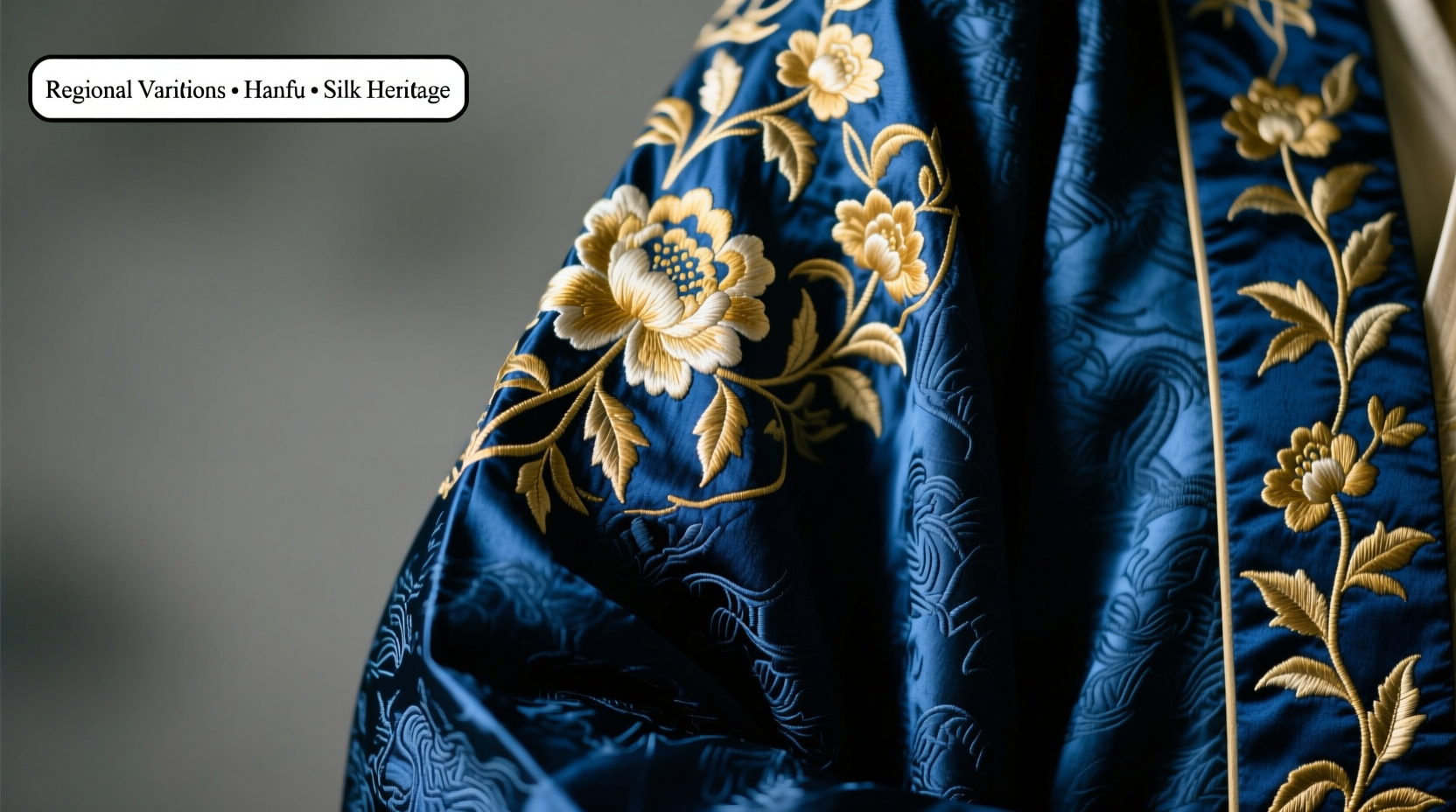
Furthermore, Jiangnan is the birthplace of Su Xiu (Suzhou embroidery). Unlike the bold, contrasting colors of northern embroidery, Su Xiu utilizes split-silk threads—sometimes splitting a single silk filament into 1/64th of its original thickness—to create photorealistic, tone-on-tone gradients. Modern buyers seeking authentic Jiangnan-style Hanfu should expect to pay between $250 and $600 USD for a hand-embroidered, genuine silk Ruqun (blouse and skirt set) from heritage workshops in Suzhou.
Lingnan & The Deep South: Adapting Hanfu for Subtropical Heat
The Lingnan region (modern Guangdong, Guangxi, and parts of Fujian) presents a severe challenge to traditional layered clothing: extreme, oppressive subtropical heat and high humidity. The Hanfu substyles native to this region represent a fascinating intersection of Han Chinese garment structures and indigenous Baiyue textile technologies.
Xiangyunsha: The Mud-Dyed Marvel of Guangdong
The crowning achievement of Lingnan textile heritage is Xiangyunsha (香云纱), also known as Gambiered Canton Gauze. Recognized as a National Intangible Cultural Heritage, this fabric is produced exclusively in the Pearl River Delta. The process involves dyeing raw silk fabric with the tannin-rich juice of the Dioscorea cirrhosa (Shuliang) tuber, followed by coating it with iron-rich river mud from local estuaries. A chemical reaction between the tannins and the iron creates a dark, lustrous, and slightly crisp fabric that is naturally antimicrobial, water-resistant, and incredibly cooling against the skin.
According to the China National Silk Museum, the production of Xiangyunsha is strictly bound to the solar calendar and can only be executed during specific months when the sun and river mud conditions are optimal. A modern Hanfu set tailored from authentic, heritage-certified Xiangyunsha is a significant investment, typically ranging from $400 to over $1,200 USD, reflecting the grueling, month-long manual labor required to produce the textile. The resulting garments—often tailored into Ming Dynasty-style Daoshan (robe) or lightweight Banbi (half-sleeve jackets)—possess a distinct rustling sound and a structural drape that requires no ironing.
The Northern Plains & Central Highlands: Warmth, Volume, and Structure
Moving northward to the Yellow River basin and the Central Plains, the climate shifts to cold, dry winters and hot, brief summers. The Hanfu of this region, particularly codified during the Ming Dynasty (1368–1644 CE), is characterized by volume, heavy layering, and opulent, light-reflecting textiles designed to project authority and provide warmth.
Mamianqun and the Weight of Yunjin Brocade
The signature garment of the northern and central aesthetic is the Mamianqun (horse-face skirt). Constructed from two overlapping trapezoidal panels of fabric with deep, structured pleats at the sides and flat, unpleated panels at the front and back, the Mamianqun requires massive yardage. In the north, these skirts were woven from Yunjin (Cloud Brocade) of Nanjing or Shu Brocade of Sichuan. These fabrics incorporate zhuanghua (woven gold and silver threads) and peacock feather yarns.
The sheer weight of these brocades is essential to the garment's function and form. The heavy textile forces the flat-cut pleats to hang in perfect, rigid vertical lines, creating a stately, architectural silhouette that blocks harsh northern winds. As documented in the textile archives of the Palace Museum, Ming court robes utilized thick, padded linings and high-collared Piling (capelets) for winter wear. Today, a high-quality, daily-wear Ming-style Mamianqun woven with synthetic metallic yarns and polyester-cotton blends costs between $60 and $150 USD, while authentic silk-and-gold Yunjin ceremonial skirts easily exceed $2,000 USD.
Comparative Guide: Regional Hanfu Substyles at a Glance
To assist collectors and cultural enthusiasts in identifying and sourcing regional variations, the following table outlines the primary distinctions in climate adaptation, historical influence, and market pricing.
| Region | Climate Profile | Dominant Historical Era | Signature Textile | Key Garment Substyle | Avg. Authentic Price (USD) |
|---|---|---|---|---|---|
| Jiangnan (East) | Temperate, humid, rainy | Song Dynasty | Luo (Gauze), Satin | Beizi (Overcoat), slender Ruqun | $250 - $600 |
| Lingnan (South) | Subtropical, extreme heat | Ming / Qing transition | Xiangyunsha (Mud-dyed silk) | Banbi, lightweight Daoshan | $400 - $1,200+ |
| Central / North | Continental, cold winters | Ming Dynasty | Yunjin (Cloud Brocade) | Mamianqun, padded Aoqun | $150 - $2,000+ |
| Shu (Sichuan) | Basin, overcast, damp | Tang / Song Dynasties | Shujin (Shu Brocade) | Qixiong Ruqun (Chest-high skirt) | $180 - $800 |
Sourcing Authentic Regional Hanfu: A Buyer's Framework
The modern Hanfu movement (Hanfu Fuxing) has sparked a massive commercial industry, but discerning authentic regional craftsmanship from mass-produced, fast-fashion imitations requires geographical literacy. When sourcing traditional Chinese clothing hanfu, buyers should align their purchases with the historical manufacturing hubs:
- For Jiangnan Silks & Embroidery: Source directly from cooperatives in Suzhou and Hangzhou. Look for certifications from the recognized silk heritage authorities and verify that the embroidery is hand-stitched (characterized by a lack of uniform, machine-perfect tension on the reverse side of the fabric).
- For Lingnan Xiangyunsha: Authentic Gambiered Canton Gauze must originate from Foshan, Guangdong. Reputable sellers will provide a certificate of origin detailing the specific river mud and Shuliang dye batches. Beware of chemically dyed imitations that lack the fabric's signature earthy scent and asymmetric coloration (the mud-coated side is black/brown, while the reverse is a deep rust-red).
- For Northern Brocades & Mamianqun: Nanjing remains the center for Yunjin, while Chengdu is the undisputed capital of Shu Brocade. When purchasing a Mamianqun, examine the pleat-setting technique. Heritage workshops use high-heat steam and traditional wooden presses to ensure the pleats never drop, even after washing.
Cultural Protocols and Contemporary Wearing Contexts
Wearing regional Hanfu today is an act of cultural continuation, not merely historical cosplay. Understanding the context of these garments ensures they are worn with the respect they command. For instance, the sheer, revealing Qixiong Ruqun (chest-high skirt) popularized during the Tang Dynasty reflects the cosmopolitan, open culture of the ancient capital Chang'an (modern Xi'an) and is highly appropriate for summer festivals and artistic photography. Conversely, the structured, high-collared Ming Aoqun (jacket and skirt) projects formality and is the preferred choice for winter ceremonies, ancestral worship, and formal tea gatherings.
Furthermore, the fundamental rule of jiaoling youren—where the left lapel crosses over the right lapel—remains sacred across all regional variations. The inverse (zuoren) is strictly reserved for the deceased in traditional burial rites. By honoring these structural and cultural protocols, modern wearers do more than don a beautiful garment; they participate in a living, breathing geographical tapestry that has kept the Han people clothed, protected, and culturally anchored for millennia.