Chinese Traditional Clothing Men: A Historical & Cultural Guide
The Evolution of Menswear in Chinese Dynasties
When discussing Chinese traditional clothing men have worn over the millennia, it is essential to recognize that this is not a monolithic category. Rather, it is a dynamic tapestry woven from the philosophical, political, and climatic shifts of one of the world's oldest continuous civilizations. From the flowing, unstructured elegance of Han dynasty scholars to the tailored, high-collared silhouettes of the Qing and Republican eras, menswear in China has always served as a visual language of social standing, ethnic identity, and cosmic harmony.
For modern enthusiasts, historians, and cultural practitioners, understanding these garments requires looking beyond mere aesthetics. It demands an appreciation of flat-pattern cutting, the symbolic weight of lapel direction, and the intricate weaving techniques of regional silk hubs. This guide decodes the historical evolution, structural anatomy, and modern acquisition of traditional Chinese menswear.
Hanfu: The Foundation of Han Menswear
The term Hanfu (汉服) translates to 'Han clothing' and refers to the historical dress of the Han Chinese people prior to the Qing dynasty (1644–1912). For men, the foundational silhouette was characterized by a lack of shoulder seams, utilizing the full width of the woven fabric to create a dropped-shoulder, T-shaped drape. This flat-cutting method minimized textile waste and reflected a cultural preference for harmonizing with the natural form rather than artificially sculpting it.
The Shenyi and Early Scholarly Aesthetics
During the Han dynasty (202 BCE – 220 CE), the Shenyi (深衣), or 'deep robe,' was the quintessential garment for educated men. It featured a distinct upper and lower section sewn together at the waist, symbolizing the union of heaven and earth. According to the Metropolitan Museum of Art's Heilbrunn Timeline, Han dynasty textiles and garment structures were heavily influenced by Confucian rituals, which dictated strict sumptuary laws regarding color, fabric quality, and ornamentation based on a man's rank in the civil service.
Ming Dynasty Mastery: Daopao and Zhiduo
Following the Mongol-led Yuan dynasty, the Ming dynasty (1368–1644) initiated a massive cultural revival, restoring traditional Han dress codes. According to the Metropolitan Museum of Art, the Ming era saw the refinement of garments like the Daopao (道袍) and Zhiduo (直裰). The Daopao, despite its name translating to 'Daoist robe,' was the standard daily wear for scholars and officials. It featured side slits that revealed a contrasting inner layer, and hidden side panels (暗摆, anbai) that allowed for ease of movement while maintaining modesty and structural volume.
Key Garments: Decoding the Silhouettes
To navigate the vast lexicon of Chinese traditional clothing men historically utilized, one must understand the specific functions and eras of key garments. The following table outlines the primary menswear silhouettes across different epochs.
| Garment Name | Era / Dynasty | Key Structural Features | Modern Cultural Occasion |
|---|---|---|---|
| Shenyi (深衣) | Han Dynasty | One-piece robe, cross-collar, sweeping hem, wide sleeves. | Confucian ceremonies, ancestral rites, coming-of-age (Guanli). |
| Daopao (道袍) | Ming Dynasty | Cross-collar, hidden side panels (anbai), tied with a silk sash. | Hanfu festivals, scholarly gatherings, traditional tea ceremonies. |
| Zhiduo (直裰) | Ming Dynasty | Similar to Daopao but with open side slits, lacking hidden panels. | Casual historical reenactments, literary society meetings. |
| Changshan (长衫) | Qing / Republic | Mandarin collar, side-fastening frog buttons, tailored fit. | Formal weddings, Lunar New Year, martial arts demonstrations. |
| Magua (马褂) | Qing Dynasty | Waist-length riding jacket, worn over the Changshan. | Performing arts, traditional dance, modern Tangzhuang styling. |
The Qing Dynasty Shift: Changshan and the Manchu Influence
The establishment of the Qing dynasty by the Manchu people in 1644 brought a seismic shift to Chinese menswear. The ruling class enforced the 'Tifa Yifu' (剃发易服) policy, which mandated that Han Chinese men adopt the Manchu queue hairstyle and their style of dress under penalty of death. This effectively ended the continuous, millennia-old tradition of Hanfu in daily life.
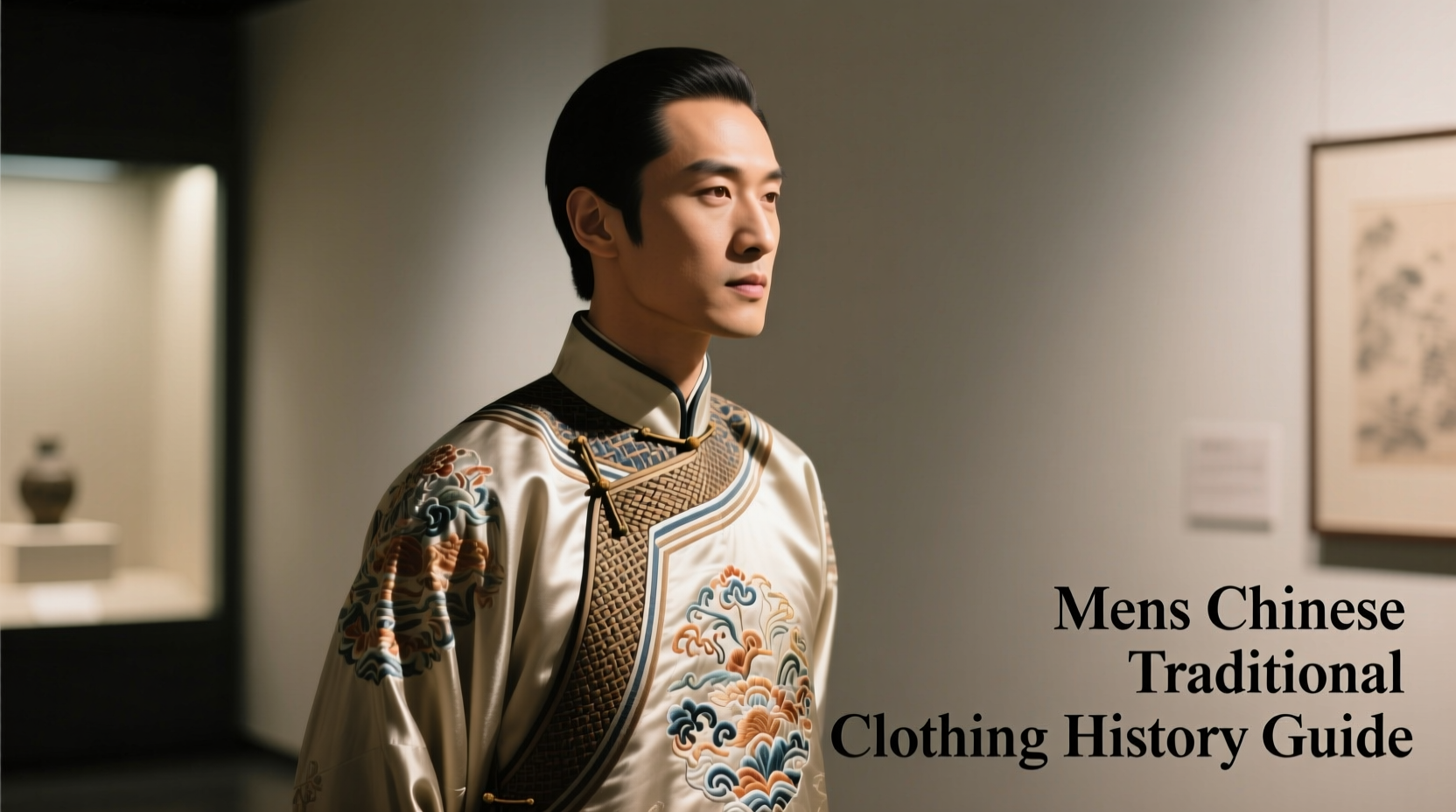
The Victoria and Albert Museum notes that Qing dynasty dress was characterized by tailored, form-fitting garments designed originally for equestrian and martial lifestyles. The Changshan (长衫), or 'long shirt,' emerged as the standard male garment. Unlike the voluminous, cross-collared Hanfu, the Changshan featured a high Mandarin collar (立领, liling) and utilized woven frog fasteners (盘扣, pankou) along the right shoulder and side seam. During the Republic of China (1912–1949), the Changshan became the ultimate symbol of the educated intellectual, famously worn by literary giants like Lu Xun and Hu Shi.
The Tangzhuang Misconception
Modern consumers often encounter the Tangzhuang (唐装), a brocade jacket with frog buttons, and assume it is an ancient garment. In reality, the Tangzhuang is a late 20th-century invention, heavily popularized during the 2001 APEC summit in Shanghai. It is based on the Qing-era Magua (riding jacket) but incorporates Western tailoring techniques, such as set-in sleeves and shoulder pads, making it a hybrid garment rather than a historically authentic piece.
Construction, Fabrics, and the 'Jiaoling Youren' Principle
The most critical philosophical element in Han traditional clothing men wore is the Jiaoling Youren (交领右衽), or 'cross-collar, right lapel.' In this construction, the left side of the garment crosses over the right side, and the lapel is tied on the wearer's right side. In traditional Chinese cosmology, the left represents Yang (life, the sun, the east) and the right represents Yin (death, the moon, the west). Therefore, covering the right side with the left symbolizes the triumph of life and order.
'To wear the collar left-over-right (Zuoren) was strictly reserved for the deceased or considered a mark of barbarian tribes. Reversing the lapel direction in historical Han dress was an egregious cultural taboo.' — Scholars at the Asian Art Museum of San Francisco.
Textile Mastery: From Ramie to Yunjin
The fabric composition of these garments varied drastically by class and climate. For summer wear, particularly in the humid southern provinces like Guangdong and Fujian, men utilized Xia bu (夏布), a finely woven ramie cloth that offered exceptional breathability and a crisp, structured drape. Conversely, winter garments and formal court wear relied on the legendary brocades of the Yangtze Delta. Nanjing's Yunjin (云锦), or 'cloud brocade,' woven with peacock feather threads and real gold leaf, was historically restricted to imperial use and remains one of the most expensive and complex textiles in the world today.
Sourcing Authentic Garments: Price Ranges and Artisans
For those looking to acquire authentic Chinese traditional clothing men can wear for ceremonies, festivals, or cultural study, the market is divided into distinct tiers. Navigating this market requires an understanding of what drives the cost: historical accuracy, fabric provenance, and tailoring methods.
- Entry-Level / Mass Market ($40 – $90 USD): Typically made from polyester blends or basic cotton. These garments often feature machine-embroidered motifs and glued interfacing. While accessible, they lack the drape of natural fibers and often compromise on historical cutting accuracy (e.g., adding Western shoulder seams). Suitable for casual cosplay or single-use events.
- Mid-Tier / Enthusiast Grade ($120 – $300 USD): The sweet spot for modern Hanfu and Changshan wearers. These pieces use natural fibers like linen, raw silk, and high-grade ramie. Brands in this tier, often operating out of Chengdu or Hangzhou, utilize traditional flat-cutting and hand-finished hems. A Ming-style Daopao in this range will feature proper hidden side panels and authentic silk ties.
- Bespoke / Artisan Heritage ($500 – $2,500+ USD): Commissioned directly from master tailors or heritage cooperatives. This tier includes hand-woven Song brocade or authentic Yunjin silk. The Changshan or Hanfu is cut specifically to the wearer's measurements, accommodating the dropped-shoulder drape perfectly. Frog buttons (pankou) are hand-knotted from silk thread, a process that can take dozens of hours for a single jacket.
Cultural Protocols and the Modern Revival
The 21st century has witnessed a massive resurgence in Hanfu, driven by younger generations seeking to reconnect with pre-Qing cultural roots. When wearing these garments today, cultural respect is paramount. Understanding the context of the garment is essential; one would not wear a solemn, unadorned Shenyi to a lively spring festival, just as one would not wear a brightly embroidered Magua to a somber ancestral memorial.
Furthermore, buyers should support artisan cooperatives and established historical brands rather than fast-fashion knockoffs that appropriate indigenous patterns or mix incompatible dynasty elements. By studying the structural anatomy and historical context of Chinese traditional clothing men wore, modern wearers do more than just dress up—they participate in the living preservation of a profound material heritage.