Hanfu vs Qipao: Symbolism, History, and Cultural Meaning

When navigating the rich tapestry of Chinese sartorial history, the hanfu vs qipao conversation extends far beyond mere aesthetics. These two iconic garments are not simply historical costumes; they are complex textiles encoded with philosophy, shifting socio-political identities, and profound cultural symbolism. While hanfu represents the ancient cosmological ideals and continuous civilization of the Han people, the qipao stands as a monument to 20th-century modernity, female empowerment, and the synthesis of East and West. To truly understand these garments, we must decode the structural and symbolic languages woven into their very threads.
The Cosmological Canvas: Decoding Hanfu Symbolism
Hanfu, the traditional clothing of the Han Chinese, encompasses a vast array of styles spanning from the Huangdi era to the end of the Ming Dynasty (1644). Its design is intrinsically linked to ancient Chinese cosmology, Confucian ritual codes (li), and the natural order.
Structural Philosophy and the Right Lapel
The most defining characteristic of hanfu is the jiaoling youren—the cross-collar with the right lapel crossing over the left. In traditional Chinese yin-yang philosophy, the left represents yang (life, the sun, and the east), while the right represents yin (death, the moon, and the west). Wrapping the left side over the right symbolizes the triumph of life and civilization over death and chaos. Conversely, the left-over-right style (zuoren) was strictly reserved for dressing the deceased.
Furthermore, the traditional shenyi (deep robe) is constructed from two distinct pieces of fabric: the upper garment (yi) and the lower skirt (chang), which are sewn together at the waist. This union symbolizes the harmony between Heaven (the upper half) and Earth (the lower half), reflecting the wearer's alignment with the universe. The sleeves are traditionally cut round to represent the heavens, while the collar is cut square to represent the earth, reinforcing this cosmological map.
Motifs, Colors, and the Mamianqun
Color in hanfu is heavily dictated by the Five Elements theory (wuxing). For instance, deep crimson represents fire and prosperity, often worn during weddings, while unbleached hemp or plain white was historically associated with mourning. The mamianqun (horse-face skirt), a staple of Ming Dynasty women's hanfu, features flat panels at the front and back with heavily pleated sides. The flat panels symbolize stability and peace, while the intricate woven motifs—such as the python (mang) or the phoenix—denote the wearer's social rank and invoke divine protection. According to the China National Silk Museum, the preservation of these specific brocade weaving techniques, like Song brocade and Yunjin, is vital to maintaining the authentic symbolic weight of the garment.
The Architecture of Modernity: Qipao as a Cultural Statement
If hanfu is a reflection of ancient cosmic order, the qipao (or cheongsam) is the architectural embodiment of the modern Chinese identity. Emerging from the political upheaval of the early 20th century, the qipao transformed from a symbol of feudal oppression into an icon of progressive liberation.
From Manchu Robe to Shanghai Silhouette
The qipao originated from the chenyi, the loose, floor-length, one-piece robe worn by Manchu women during the Qing Dynasty (1644–1912). The early Manchu robe was deliberately modest and concealing, reflecting strict patriarchal and feudal hierarchies. However, in the 1920s, young, educated women in Shanghai—many of them students and feminists—began adopting and radically altering the garment.
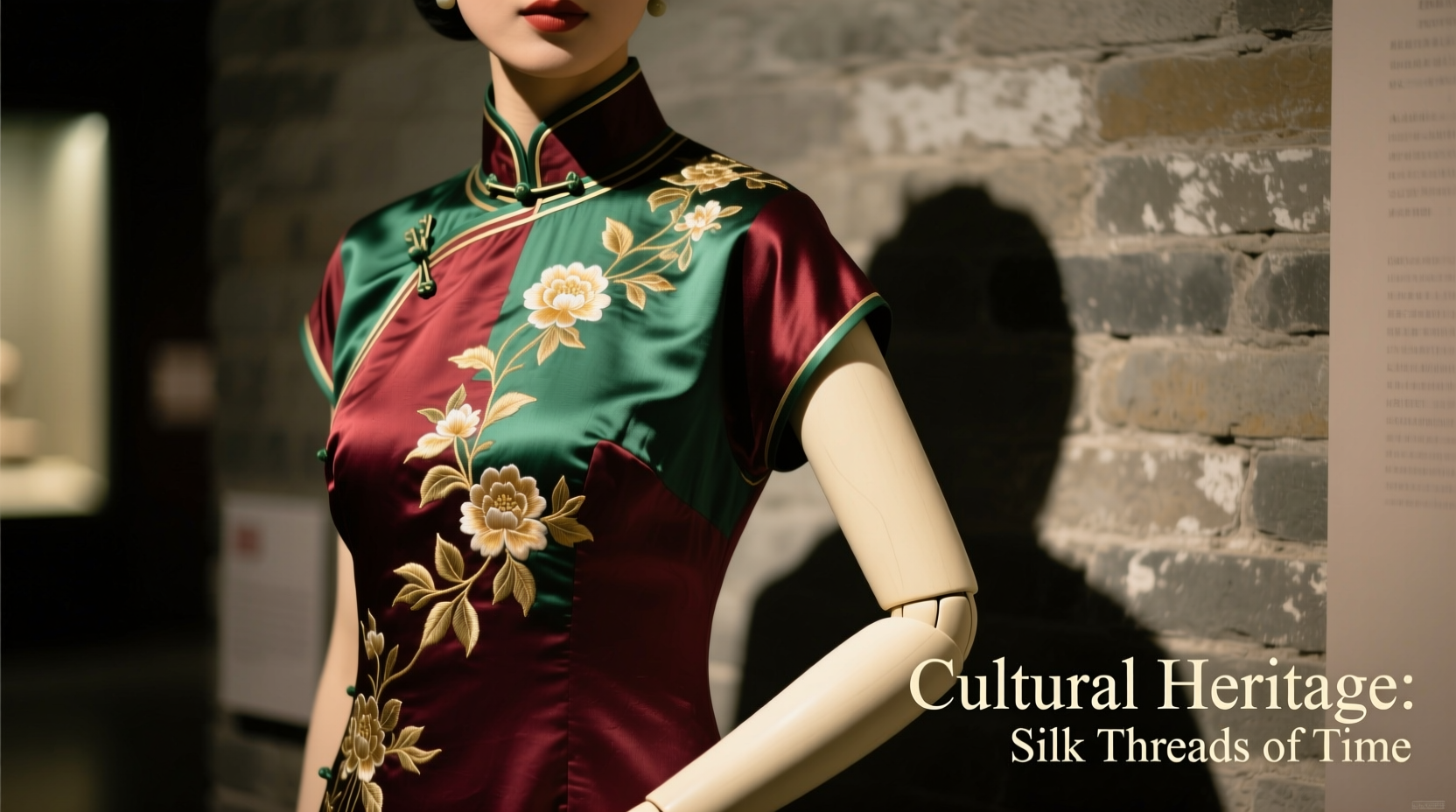
By introducing Western tailoring techniques such as bust darts, waist suppression, and set-in sleeves, the 1930s Shanghai qipao became form-fitting. This was a radical socio-political statement: it claimed ownership of the female form, rejecting the traditional Confucian mandate to hide the body. The high, stiff collar (ying) projects dignity and discipline, while the daring side slits (kaiqi) allow for physical mobility, perfectly capturing the duality of the 'New Woman' who balanced traditional virtue with modern independence.
Pankou Closures and Auspicious Embroidery
The pankou (frog closures) of the qipao are masterclasses in micro-symbolism. Far from being mere functional buttons, these hand-knotted silk fasteners are shaped into auspicious motifs. A butterfly knot symbolizes joy and marital bliss; a plum blossom knot represents resilience and perseverance through hardship (as the plum blossom blooms in winter); and a ruyi knot signifies good fortune and the fulfillment of wishes. The embroidery on the fabric itself also follows strict symbolic rules, with peonies denoting wealth and honor, and bamboo representing moral integrity and flexibility.
Comparative Framework: Hanfu vs Qipao at a Glance
To fully grasp the hanfu vs qipao distinction, one must look at how their construction serves their respective cultural eras. The following table outlines the core differences in their symbolic and physical architecture.
| Feature | Hanfu (Ming/Tang Focus) | Qipao (1930s Shanghai Focus) |
|---|---|---|
| Core Silhouette | Flowing, modular, concealing (A-line or wide) | Tailored, form-fitting, 3D darted |
| Collar Style | Cross-collar (jiaoling) or round collar | High, stiff mandarin collar (ying) |
| Closure System | Fabric sashes and ties (no buttons) | Pankou (knotted frog closures) |
| Primary Symbolism | Cosmic harmony, ritual propriety, continuity | Modernity, female empowerment, East-meets-West |
| Historical Peak | Han to Ming Dynasties (206 BCE – 1644 CE) | Republic Era (1920s – 1940s) |
| Authentic Fabric | Mulberry silk, Song brocade, linen | Xiangyunsha (gambiered gauze), crepe de chine |
Wearing the Legacy: Cultural Protocols and Sourcing
Understanding the symbolism of these garments is only the first step; engaging with them respectfully requires knowledge of modern cultural protocols and authentic sourcing.
The Modern Hanfu Movement and Qipao Revival
Today, the Hanfu Yundong (Hanfu Movement) is driven largely by Gen Z and millennial enthusiasts who wear hanfu not as a historical reenactment, but as a living, breathing expression of cultural pride. Wearing hanfu to a traditional tea ceremony, a coming-of-age ritual (guanli/jili), or even as daily streetwear is a way to reclaim a heritage that was severed during the Qing Dynasty's forced sartorial assimilation.
Conversely, the qipao remains the global standard for Chinese formalwear, frequently worn at diplomatic events, weddings, and international film festivals. However, cultural sensitivity is paramount. The qipao is deeply tied to the specific socio-historical struggles of Chinese women in the 20th century. Wearing it requires an appreciation of its tailored elegance rather than treating it as a generic 'exotic' costume. Institutions like the Victoria and Albert Museum frequently highlight the qipao's role in the global history of fashion, emphasizing its status as a masterpiece of cross-cultural design rather than mere ethnic dress.
Authentic Sourcing and Price Guide
For collectors and cultural practitioners, investing in authentic garments ensures the preservation of traditional craftsmanship. Here is a practical guide to sourcing and pricing for both garments:
- Authentic Hanfu: Avoid mass-produced polyester costumes. Look for specialized artisans using Zhuanghua (brocade) or genuine mulberry silk. A high-quality, everyday Ruqun (jacket and skirt set) from reputable makers typically ranges from $80 to $150 USD. A historically accurate, bespoke Ming Dynasty Mamianqun woven with real gold threads or intricate Yunjin brocade can cost between $400 and $1,500+ USD.
- Authentic Qipao: The hallmark of a true qipao is the hand-rolled edge (xiangbian) and custom darting. For daily wear, a genuine silk crepe de chine qipao with hand-made pankou starts around $200 to $350 USD. For investment pieces, seek out Xiangyunsha (gambiered Canton gauze)—a rare, mud-dyed silk that develops a beautiful patina over time. Custom-tailored Xiangyunsha qipaos from master tailors in Shanghai or Hong Kong generally range from $800 to $2,500+ USD.
"The true beauty of Chinese traditional dress lies not just in the silk or the embroidery, but in the philosophical weight the garment carries. Whether it is the cosmic alignment of the hanfu or the defiant modernity of the qipao, you are wearing a piece of living history." — Curatorial notes on Asian Textiles, The Metropolitan Museum of Art.
Ultimately, the choice between hanfu and qipao is not a matter of one being more 'authentic' than the other. Rather, it is a choice of which historical narrative and philosophical framework you wish to embody. Hanfu connects the wearer to the ancient, cyclical rhythms of nature and ritual, while the qipao celebrates the dynamic, tailored resilience of the modern spirit. Both are indispensable pillars of Asia's sartorial heritage.