Hanfu Style Guide: Dressing for Cultural Events in 2026

The Renaissance of Hanfu: Navigating Modern Occasions
The Hanfu Movement (汉服运动) has evolved dramatically over the last two decades, transitioning from a niche internet subculture to a mainstream sartorial choice for millions. As we navigate the cultural landscape of 2026, wearing traditional Han Chinese clothing is no longer viewed merely as historical reenactment; it is a sophisticated, living expression of cultural identity. Whether you are attending a traditional wedding, a Lunar New Year banquet, or a scholarly tea ceremony, selecting the correct hanfu style requires an understanding of historical dynasties, structural engineering, and cultural protocols.
This comprehensive occasion guide decodes the complexities of hanfu, providing actionable advice on silhouettes, fabric composition, and the sacred rules of dressing, ensuring you participate in these traditions with both aesthetic grace and deep cultural respect.
Decoding Silhouettes by Event Formality
Hanfu is not a monolith; it encompasses thousands of years of evolution across multiple dynasties. Choosing the right silhouette depends heavily on the formality, season, and nature of the event.
Ming Dynasty Aoqun & Mamian Qun: Festivals and Lunar New Year
For winter festivals, graduations, and Lunar New Year celebrations, the Ming Dynasty Aoqun (袄裙) is the gold standard. This style features a lined or padded cross-collar or standing-collar top (Ao) paired with the iconic Mamian Qun (马面裙), or 'horse-face skirt'. The Mamian Qun is a marvel of traditional structural engineering: it consists of two overlapping trapezoidal panels that remain flat at the front and back, while featuring deep, knife-pleated sides. This construction allows for elegant movement and modesty when sitting or climbing stairs. According to the Victoria and Albert Museum's extensive Chinese textile archives, the structural pleating of the Ming dynasty skirt was designed to accommodate the active lives of women while maintaining a dignified, architectural silhouette.
Tang Dynasty Da Xiu Shan: Weddings and Grand Ceremonies
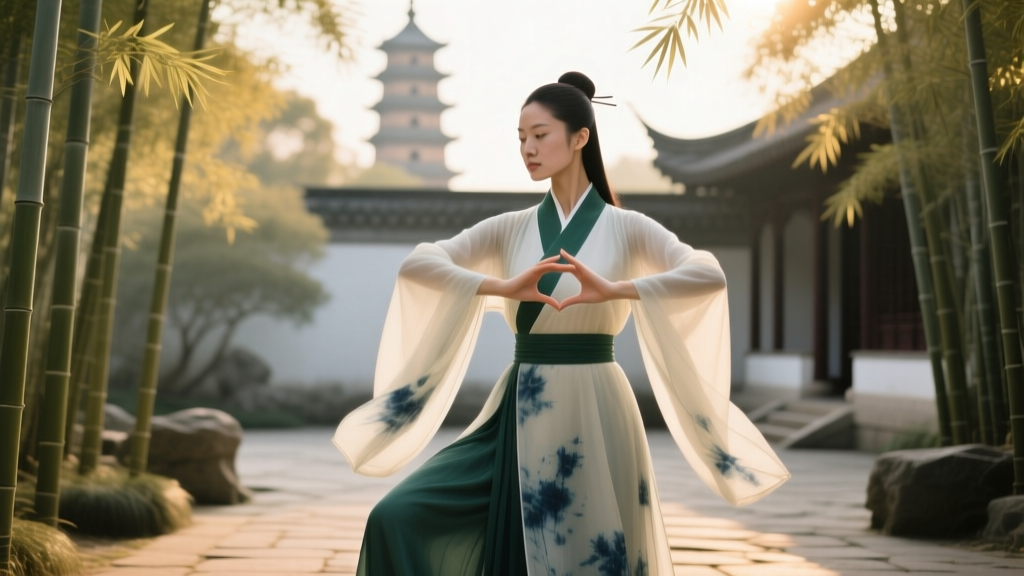
For grand, formal events such as traditional weddings or major stage performances, the Tang Dynasty aesthetic reigns supreme. The Da Xiu Shan (大袖衫), characterized by its sweeping, floor-length sleeves and sheer, lightweight silk organza, is typically worn over a Qixiong Ruqun (齐胸襦裙)—a chest-high wrap skirt. This hanfu style projects opulence, confidence, and cosmopolitan flair, reflecting the Tang Dynasty's historical position as a global cultural hub. The vibrant color palettes (crimson, gold, and peacock green) and elaborate peony or phoenix motifs make it the ultimate choice for brides and close family members at a wedding banquet.
Song Dynasty Beizi: Tea Ceremonies and Spring Outings
If the event is a quiet tea ceremony, a literary gathering, or a spring garden outing, the Song Dynasty Beizi (褙子) is unparalleled. The Beizi is a long, parallel-collar (Duijin) outer jacket that falls below the knee, worn over a slender skirt or trousers. Reflecting the Neo-Confucian aesthetic of the era, this hanfu style emphasizes restraint, intellectual elegance, and understated luxury. Fabrics are typically solid-colored or feature subtle, tone-on-tone damask weaves, prioritizing the drape and texture of the material over loud embroidery.
Fabric, Seasonality, and Budgeting Matrix
Authentic hanfu requires specific fabrics to achieve the correct drape and historical accuracy. Below is a strategic matrix to help you budget and plan your garment acquisition based on the occasion.
| Occasion | Recommended Style | Ideal Fabric Composition | Est. Price Range (USD) | Seasonality |
|---|---|---|---|---|
| Weddings / Grand Galas | Tang Da Xiu Shan | Heavy Silk Brocade, Organza | $150 - $450+ | Spring / Autumn |
| Lunar New Year / Winter Festivals | Ming Aoqun & Mamian Qun | Wool Blends, Song Brocade, Velvet | $80 - $300 | Winter |
| Tea Ceremonies / Scholarly Events | Song Beizi & Ruqun | Raw Silk, Linen, Ramie | $60 - $200 | Spring / Summer |
| Casual Outings / Museum Visits | Tang Tanling Ruqun | Cotton, Tencel, Chiffon | $40 - $120 | Summer |
Note: Prices reflect authentic, ethically sourced garments from established reconstruction studios. Mass-produced, inaccurate 'costume' versions may be cheaper but often lack the correct structural pleating and cultural integrity.
Cultural Etiquette: The Rules of Wearing Hanfu
Wearing hanfu is an act of cultural participation, which necessitates adherence to specific historical protocols. Ignoring these rules can inadvertently cause offense or demonstrate a lack of cultural literacy.
The Sacred Geometry of Jiao Ling You Ren
The most critical rule in Han Chinese dress is Jiao Ling You Ren (交领右衽), which translates to 'crossed collar, right lapel'. When wrapping the front of the robe, the left side must always cross over the right side, securing on the right hip. In traditional Chinese cosmology and Confucian philosophy, the left represents Yang (life, light, and the living), while the right represents Yin (death, darkness, and the spiritual realm). Wrapping the right over the left (Zuo Ren) is strictly reserved for dressing the deceased for burial. The China National Silk Museum in Hangzhou frequently highlights this distinction in their historical garment exhibitions, noting it as a fundamental marker of civilization and life in ancient texts.
Hair, Crowns, and the Ji Ceremony
Traditional hanfu is rarely worn with loose, unstyled hair. Historically, adulthood was marked by the capping ceremony (Guan Li) for men and the hair-pinning ceremony (Ji Li) for women, where hair was gathered and secured. For modern events, hair should be neatly tied up or braided and secured with traditional accessories.
- Zan (簪): A single-prong hairpin, often carved from jade, sandalwood, or bone.
- Chai (钗): A double-pronged hairpin used to secure heavier buns.
- Ronghua (绒花): Intricate velvet flowers made from silk threads and copper wire, an intangible cultural heritage craft originating from Nanjing, highly appropriate for festive and bridal styling.
Sourcing Authentic Garments: Artisans vs. Commercial Brands
As the demand for the hanfu style has surged globally, the market has bifurcated into commercial fast-fashion and meticulous historical reconstruction. For significant life events, investing in reconstruction studios is paramount.
High-end reconstruction brands (such as Ming Hua Tang or Shuang Yi) base their patterns directly on extant artifacts excavated from Ming tombs or preserved in the Confucius Family Mansion archives. These studios utilize traditional weaving techniques, such as Suzhou Song brocade (Songjin) and Nanjing cloud brocade (Yunjin), which require specialized jacquard looms and immense artisanal skill. For broader context on the complexity of these Asian silk weaving techniques, the Metropolitan Museum of Art's Silk Road exhibition notes detail the immense historical value and technical difficulty of these multi-layered weaves.
'To wear hanfu is not to retreat into the past, but to carry the aesthetic wisdom of our ancestors into the future. The garment is a vessel for memory, etiquette, and identity.' — Contemporary Hanfu Reconstruction Manifesto, 2024.
When purchasing, always verify the skirt's pleating structure. A genuine Mamian Qun will have flat, unpleated front and back panels with tightly pressed side pleats that only fan out when the wearer walks or sits. If the skirt is uniformly pleated like a Western accordion skirt, it is a modern costume adaptation, not a culturally accurate hanfu style. By prioritizing structural accuracy, respectful etiquette, and appropriate occasion-matching, you honor the profound legacy of Asian traditional garments.