Elevating Hanfu Cosplay: Fabric and Craftsmanship Guide

Beyond the Convention Floor: Reframing Hanfu Cosplay
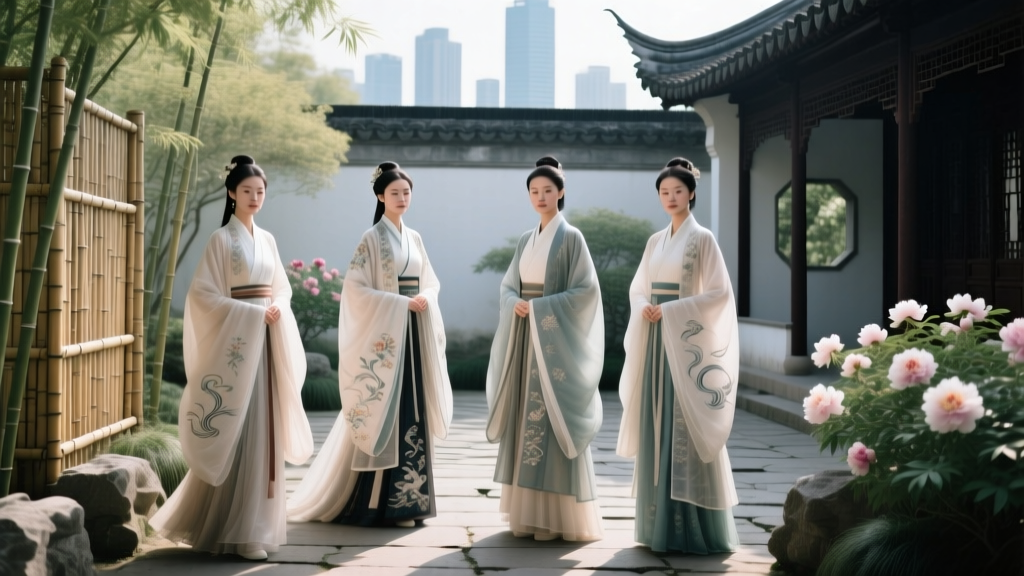
When global audiences, convention-goers, and digital creators search for "hanfu cosplay," they are typically seeking the sweeping, ethereal silhouettes popularized by Chinese fantasy dramas (Xianxia) and historical epics. However, to reduce Hanfu—the traditional clothing system of the Han Chinese people—to mere "cosplay" is to overlook a three-millennia-old textile heritage. Today, a massive cultural revival known as the Hanfu Yundong (Hanfu Movement) has transformed these garments from theatrical costumes into living cultural artifacts worn on city streets, at tea ceremonies, and during traditional festivals.
For enthusiasts looking to transition from fast-fashion costume replicas to historically informed garments, understanding fabric composition and tailoring techniques is essential. Whether you are sourcing a Mamianqun (horse-face skirt) for a photoshoot or a Yuanlingpao (round-collar robe) for a cultural exhibition, the craftsmanship dictates the garment's drape, longevity, and cultural accuracy. This deep dive explores the architectural cutting, historic weaves, and embroidery techniques that define authentic Hanfu.
The Architecture of Drape: Pingmian Caijian (Flat Cutting)
Western tailoring relies on darts, curved seams, and shoulder pads to force fabric to conform to the body's three-dimensional shape. Traditional Hanfu construction operates on an entirely different philosophy known as Pingmian Caijian (flat cutting). When laid out on a table, a traditional Hanfu garment forms a perfect, unbroken geometric cross.
This technique relies on the natural drape of the fabric and the wearer's movement to create volume and structure. Because historical silk looms produced narrow bolts of fabric (typically around 60 centimeters wide), garments were constructed using multiple panels joined by straight seams. This results in two defining characteristics of authentic Hanfu:
- The Center-Back Seam (Zhongfeng): Running straight down the spine, this seam is not merely a structural necessity born from narrow loom widths; it carries profound Confucian symbolism. It represents moral integrity, uprightness, and a centered spirit. Mass-market "hanfu cosplay" outfits often eliminate this seam to save fabric, instantly marking the garment as a modern costume rather than a traditional piece.
- Drop Shoulders and Wide Sleeves: Without shoulder seams, the fabric drapes softly over the collarbone, creating a relaxed, sloping silhouette that historically denoted elegance and a life free from manual labor. The sleeves (Xiu) are cut as continuous extensions of the bodice, allowing for the dramatic, sweeping movements seen in classical Chinese dance and martial arts.
The Sacred Geometry of the Collar
One of the most critical cultural protocols in Hanfu dressing is the Jiaoling Youren (intersecting collar, right lapel over left). When wearing a crossed-collar robe or jacket, the left side of the garment must always cross over the right, securing on the wearer's right side. According to the Metropolitan Museum of Art's Heilbrunn Timeline of Art History, this right-lapel tradition has been a marker of Han civilization since the Zhou Dynasty. Reversing this (left over right) is strictly reserved for dressing the deceased for burial. For anyone engaging in Hanfu dressing or cosplay, verifying the collar orientation is the most basic test of cultural respect and accuracy.
Decoding Hanfu Textiles: A Weaver's Matrix
The most common pitfall for buyers entering the Hanfu space is the reliance on synthetic fabrics. While polyester taffeta and chiffon are cheap and hold vibrant, anime-inspired colors, they lack the breathability, weight, and acoustic rustle of traditional silk. To understand what separates a high-quality revivalist piece from a cheap costume, we must look at historical weaves.
| Fabric Name & Origin | Composition & Weave | Drape & Characteristics | Best Used For | Price Tier |
|---|---|---|---|---|
| Polyester Taffeta (Modern Mass-Market) | 100% Synthetic, plain weave | Stiff, prone to static, holds sharp heat-set pleats but lacks fluid movement. | Budget cosplay, convention wear, outer layers. | $ (Under $50) |
| Songjin (Song Brocade) | Silk or silk-cotton blend, intricate jacquard weave with continuous supplementary weft. | Structured, heavy, features subtle tonal patterns that catch the light. Highly durable. | Mamianqun (skirts), winter jackets, formal robes. | $$ ($120 - $300) |
| Zhuanghua (妆花 -妆 Brocade) | Heavy silk with discontinuous supplementary weft, often incorporating gold or silver threads. | Extremely opulent, rigid, and heavy. The pinnacle of Ming Dynasty textile art. | Ceremonial Ming Dynasty robes, bridal Hanfu. | $$$ ($500 - $2,000+) |
| Xiangyunsha (Gambiered Canton Gauze) | 100% Silk, dyed with薯莨 (shoulang) yam juice and sealed with river mud. | Breathable, water-resistant, features a dark, earthy sheen and a distinct crackling sound when moved. | Summer Ruqun, scholar robes, luxury daily wear. | $$$ ($300 - $800) |
Authentic Xiangyunsha, recognized as an Intangible Cultural Heritage by the Chinese government, undergoes a grueling dyeing process that can only be achieved in the specific humidity and soil conditions of the Pearl River Delta. As documented by the China National Silk Museum, the interaction between the tannins in the yam juice and the iron-rich river mud creates a unique, dual-toned fabric that is cool to the touch and naturally antimicrobial. Replicating this with synthetic dyes is impossible, making it a hallmark of true luxury Hanfu.
The Needle's Voice: Embroidery and Surface Design
Surface decoration in Hanfu is not merely decorative; it is a language of auspicious symbols, seasonal markers, and social rank. When evaluating the craftsmanship of an embroidered Hanfu piece, the distinction between hand-embroidery and computerized machine embroidery is vast.
Su Xiu (Suzhou Embroidery) vs. Machine Stitching
Su Xiu, originating from the Suzhou region, is famous for its breathtaking delicacy. Master artisans can split a single silk thread into 48 finer strands, allowing for gradients and shading that mimic traditional ink-wash paintings. A hand-embroidered Bijia (sleeveless vest) featuring a peony motif may take hundreds of hours to complete, resulting in a surface that is completely flat and seamless on the reverse side.
Conversely, mass-produced "hanfu cosplay" garments utilize multi-head computerized embroidery machines. You can identify machine embroidery by:
- The Backing: Machine embroidery requires a stiff paper or mesh stabilizer on the back, which can cause the garment to scratch the skin and restrict the natural drape of the silk.
- Thread Sheen: Machines typically use rayon or polyester threads, which have an artificial, plastic-like high gloss that clashes with the subtle luster of natural silk.
- Lack of Gradient: Machine threads cannot be split. Therefore, color transitions are achieved through dense, blocky cross-hatching rather than the seamless blending found in handwork.
For buyers seeking a middle ground, many mid-tier revivalist brands use "hand-guided" embroidery or high-density shuttle looms to replicate historical patterns without the haute-couture price tag of pure handwork.
The Sourcing Matrix: Where to Buy Authentic Hanfu
The geography of Hanfu production is deeply divided between fast-fashion hubs and artisanal revivalist centers. Understanding this landscape is crucial for buyers looking to invest in quality craftsmanship.
Caoxian: The Fast-Fashion Capital
Caoxian, a county in Shandong province, produces roughly 70% of the world's mass-market Hanfu. Garments from Caoxian are heavily optimized for e-commerce, utilizing synthetic fabrics, heat-set pleats, and machine embroidery. While Caoxian is excellent for budget-conscious buyers needing a quick outfit for a comic convention or a single-use photoshoot, the garments often suffer from poor seam finishing, inaccurate historical proportions, and a lack of breathability.
Chengdu and Hangzhou: The Revivalist Hubs
For garments that respect historical proportions and utilize authentic textiles, buyers should look to brands based in Chengdu (Sichuan) and Hangzhou (Zhejiang). These cities are historic centers of silk weaving and embroidery. Brands operating out of these regions often collaborate with textile historians and museums to recreate specific Ming or Song dynasty artifacts. The Victoria and Albert Museum's Asian Collections frequently highlights the structural complexity of these regional weaves, noting how historical garments were engineered to last generations.
Price Expectations and Investment
- Entry-Level ($30 - $80 USD): Expect polyester blends, basic machine embroidery, and simplified flat-cutting. Suitable for beginners exploring the silhouette.
- Mid-Tier Revivalist ($150 - $400 USD): Features authentic fabric blends (cotton-linen, silk-rayon jacquards), accurate Zhongfeng seams, and high-quality woven patterns. This is the sweet spot for dedicated practitioners.
- Haute Couture & Museum Replicas ($800 - $3,000+ USD): Pure Zhuanghua brocades, genuine Xiangyunsha, and hand-embroidered motifs. These are investment pieces, often custom-tailored and treated as wearable art.
Conclusion: Wearing History with Intention
The term "hanfu cosplay" may serve as a bridge for global audiences to discover these magnificent garments, but the destination is a profound appreciation for Asian textile engineering. By prioritizing traditional flat-cutting, seeking out heritage weaves like Song Brocade, and respecting the cultural protocols of the Jiaoling Youren collar, wearers do more than just dress up. They participate in the active preservation of a sartorial legacy, ensuring that the craftsmanship of the past continues to breathe, move, and inspire in the modern world.