Chinese Traditional Wear for Men: A Beginner's Guide
The Renaissance of Mens Traditional Chinese Clothing
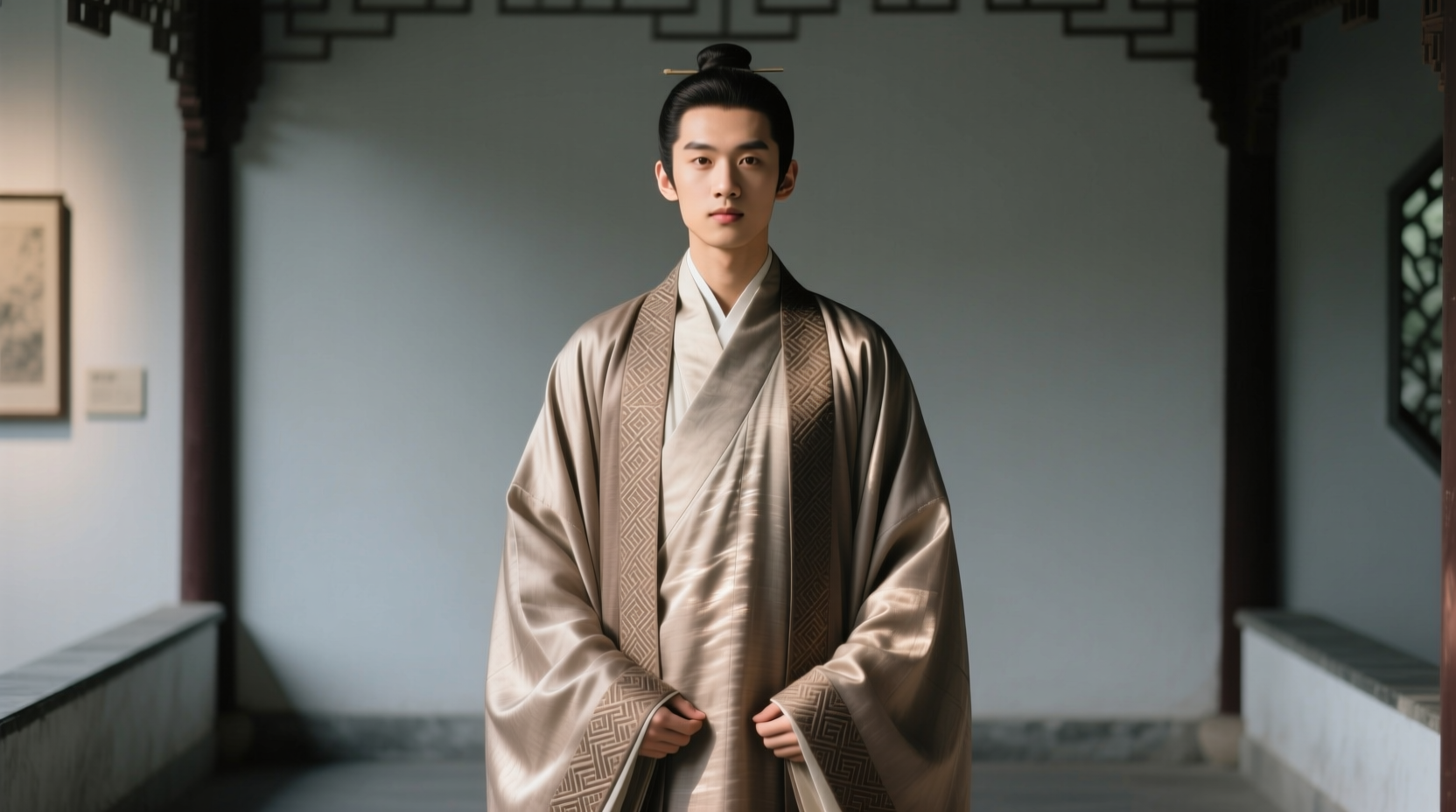
When exploring Chinese traditional wear for men, beginners are often surprised to discover that the landscape extends far beyond the martial arts uniforms seen in cinema or the tailored suits of the mid-20th century. Today, a massive cultural revival known as the Hanfu Yundong (Hanfu Movement) has brought ancient, indigenous clothing back into the streets of modern cities. For men, this revival offers a profound connection to centuries of philosophy, scholarship, and artisan craftsmanship.
Unlike Western tailoring, which relies on darts, structured shoulders, and complex seaming to follow the body's contours, traditional Chinese garment construction is fundamentally flat-cut. Fabric is woven in narrow loom widths and pieced together symmetrically. The resulting silhouette is defined not by the cut, but by the drape, the weight of the textile, and the way the garment is secured with sashes and belts. According to textile historians at The Metropolitan Museum of Art, this flat-cut philosophy reflects a broader cultural emphasis on harmony, fluidity, and the relationship between the human body and the natural world.
Decoding the Silhouette: Core Elements of the Hanfu
The term Hanfu (汉服) translates literally to 'Han clothing,' referring to the traditional dress of the Han Chinese people before the Qing Dynasty (1644–1912). While styles evolved dramatically over the Han, Tang, Song, and Ming dynasties, several foundational elements remain constant in menswear.
The Sacred Rule of the Collar
The most critical visual marker of Hanfu is the Jiaoling Youren (交领右衽), or the cross-collar. The left side of the collar must always cross over the right side, forming a 'y' shape at the neckline. This rule is deeply rooted in ancient Chinese cosmology, where the left represents the yang (life, light, and the living) and the right represents the yin. Cultural Warning: Crossing the right lapel over the left (Zuo Ren) is strictly reserved for dressing the deceased for burial. Wearing a robe right-over-left in daily life is considered highly inauspicious and offensive.
Sleeves and Fastenings
Mens robes typically feature wide, flowing sleeves that can be categorized into Guangxiu (broad sleeves) for formal occasions and Zhaixiu (narrow sleeves) for daily labor or travel. Historically, Hanfu did not use buttons. Instead, garments were secured using fabric ties (Ji) hidden inside the collar or tied at the waist with elaborate silk sashes. The absence of rigid buttons allows the garment to adapt to the wearer's body over time.
Beyond Hanfu: The Changshan and Tangzhuang
While Hanfu represents ancient indigenous dress, a comprehensive guide to Chinese traditional wear for men must acknowledge the garments that emerged during and after the Qing Dynasty.
- The Changshan (长衫): Translating to 'long shirt,' the Changshan became the standard daily wear for scholars and intellectuals during the Republic of China era (1912–1949). It features a Mandarin collar (Liling), a straight cut, and side slits for mobility. It is fastened with Pankou (knotted frog buttons), usually numbering five or seven down the front and side.
- The Tangzhuang (唐装): Despite its name meaning 'Tang suit,' this garment actually originated in the late Qing dynasty and was modernized in the 20th century. It is a short, structured jacket with a Mandarin collar and frog fasteners, often made from heavily patterned silk brocade. It is predominantly worn today by older men during the Lunar New Year or at traditional tea ceremonies.
Key Historical Robes for the Modern Wardrobe
For men looking to purchase their first traditional garments, understanding the specific historical cuts is essential for selecting the right piece for the right occasion.
The Daopao (道袍) - The Scholar's Standard
Do not let the name fool you; while Daopao translates to 'Daoist robe,' it was the ubiquitous daily wear for Ming Dynasty scholars, officials, and commoners alike. Its defining feature is the Anbai (暗摆), or hidden side panels. These extra panels of fabric are folded inward and sewn to the inside of the side seams, ensuring that a man's trousers or undergarments never become visible when walking or sitting. It is the ultimate expression of modesty and elegance in Ming-style menswear.
The Zhiduo (直裰) - Casual and Monastic
Similar in silhouette to the Daopao, the Zhiduo lacks the hidden side panels. Instead, it features open side slits that run up the leg. Originally popular among Buddhist and Daoist monks, it was later adopted by literati as a comfortable, breezy option for lounging at home or painting in the garden during the summer months.
The Yuanlingpao (圆领袍) - The Tang Dynasty Official
The round-collar robe was heavily influenced by Central Asian nomadic riding gear and became the standard uniform for Tang Dynasty (618–907 AD) officials. It fastens at the right shoulder with buttons or ties and is traditionally worn with a leather belt and black boots. Today, it is a popular choice for men participating in historical reenactments or traditional archery.
Fabric, Weave, and Seasonal Adaptations
The choice of textile in Chinese traditional wear is deeply tied to the lunar calendar and the wearer's social standing. The artisans documented by the China National Silk Museum have preserved complex weaving techniques that dictate how a garment drapes and breathes.
Material Breakdown by Climate
- Summer (Ramie and Xia Bu): Ramie, often referred to as 'China grass,' is woven into Xia Bu (summer cloth). It is highly breathable, naturally antibacterial, and possesses a crisp, structured drape that keeps the fabric away from the skin in humid weather.
- Spring/Autumn (Linen and Raw Silk): Medium-weight linens and slubby raw silks provide excellent temperature regulation. They offer a matte finish that aligns with the Confucian ideal of understated scholarly elegance.
- Winter (Silk Brocade and Padding): For formal winter wear, men utilize Song Brocade or Shu Brocade. Historically, winter robes were lined with animal furs or padded with raw silk floss (Simian) for insulation without adding excessive bulk.
- The Pinnacle: Xiangyunsha (Gambiered Canton Gauze): A highly prized, labor-intensive silk from Guangdong province. The silk is dyed with river mud and the juice of the薯莨 (Dioscorea cirrhosa) yam, then sun-baked. It results in a dark, crackled, waterproof fabric that rustles softly when walking. Authentic Xiangyunsha is incredibly expensive and considered a luxury heritage textile.
Navigating the Market: Price Tiers and Buying Advice
When shopping for Chinese traditional wear for men, the market is flooded with cheap, synthetic costumes meant for stage performances. To build a respectful, high-quality wardrobe, buyers must look for natural fibers and accurate historical patterning. Below is a framework for understanding current market pricing.
| Tier | Garment Style | Primary Material | Estimated Price (USD) | Best Use Case |
|---|---|---|---|---|
| Entry | Basic Hanfu (Shenyi/Zhiduo) | Cotton/Polyester Blends | $35 - $80 | Casual wear, first-time buyers, indoor events |
| Mid | Ming-Style Daopao | 100% Linen, Raw Silk, Ramie | $120 - $260 | Festivals, cultural gatherings, daily street wear |
| Premium | Scholar/Court Robes | Song Brocade, Xiangyunsha | $350 - $900+ | Weddings, tea ceremonies, serious collectors |
| Modern | Republic-Era Changshan | Wool blends, Jacquard | $90 - $220 | Formal dinners, Lunar New Year, academic events |
Buying Tip: When purchasing online from specialized Hanfu artisans on platforms like Taobao or dedicated international retailers, always check the 'Historical Accuracy' tag. Garments labeled as 'Improved Hanfu' (改良汉服) will feature modern conveniences like pockets, zippers, and machine-washable synthetic blends, whereas 'Orthodox Hanfu' (正统汉服) adheres strictly to historical flat-cut patterns and natural tie-fastenings.
Cultural Etiquette and Modern Styling
Wearing traditional Chinese clothing is not merely about putting on a historical artifact; it is an exercise in cultural embodiment. According to exhibition archives from The Palace Museum in Beijing, the ancients believed that clothing shaped one's behavior. The restrictive nature of long hems and wide sleeves naturally forces the wearer to adopt a slower, more deliberate posture, discouraging rushed or aggressive movements.
'The superior man is correctly robed; his countenance is dignified, and his words are orderly. Thus, the people respect him.' — The Book of Rites (Liji)
For modern styling, men do not need to wear full historical headwear (Guan or Jin) unless attending a strict ceremonial event. A minimalist approach pairs a high-quality linen Ming-style Daopao with modern leather loafers or traditional cloth boots (Xue). Hair should be neatly groomed; historically, adult men never left their hair loose and unbound, so a simple, neat modern haircut or a subtle half-up tie respects the spirit of the tradition without resorting to theatrical wigs.
By understanding the profound engineering of the flat-cut silhouette, the sacred geometry of the cross-collar, and the rich vocabulary of Chinese textiles, beginners can approach Chinese traditional wear for men not as a costume, but as a living, breathing extension of one of the world's oldest continuous civilizations.