周宝宝: Hanfu Lady and Silk Craft

The Digital Curator: Understanding 周宝宝 and the Hanfu Revival
When navigating the global renaissance of traditional Chinese clothing, enthusiasts and textile scholars frequently ask: who is 周宝宝 the hanfu lady? Rather than a conventional fashion influencer, Zhou Baobao has emerged as a pivotal digital curator and advocate within the Hanfu Yundong (Hanfu Movement). Her content bridges the gap between historical artifact and modern wardrobe, shifting the community's focus away from mass-produced, synthetic costumes toward historically accurate, loom-woven silks and intangible cultural heritage (ICH) craftsmanship.
Through meticulous breakdowns of museum relics, Zhou Baobao educates her audience on the profound complexities of Chinese textile history. Her deep dives into the Jiangning Weaving Bureau of the Ming Dynasty and the aesthetic minimalism of the Song Dynasty have set a new gold standard for Hanfu authenticity. To understand her impact, one must examine the specific fabrics, tailoring geometries, and artisan techniques she champions.
Beyond the Screen: A Deep Dive into Promoted Textile Heritage
The cornerstone of Zhou Baobao's educational framework is the rejection of digital printing in favor of structural weaving and traditional dyeing. She frequently highlights textiles that require mastery of the drawloom and deep knowledge of regional botany and mineralogy.
Xiangyunsha (Gambiered Canton Gauze) and Mud-Dyeing
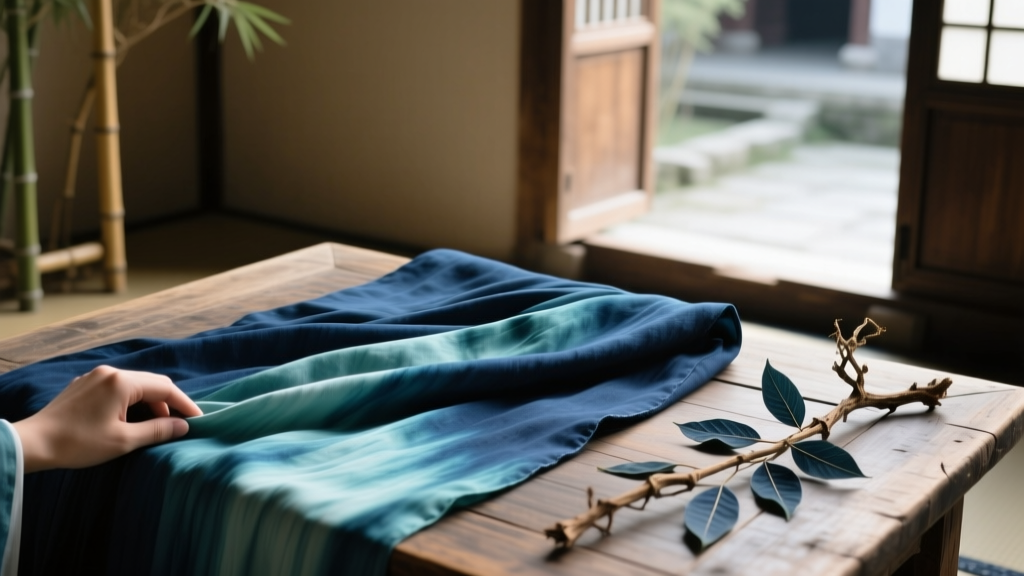
One of the most celebrated fabrics in her repertoire is Xiangyunsha (香云纱), often referred to as 'soft gold' in the silk industry. Originating from the Pearl River Delta in Guangdong, this textile is a marvel of chemical and artisanal synergy. The process involves dyeing raw silk gauze (Luo) with the juice of Dioscorea cirrhosa (Shuliang) tubers, which are rich in tannins. The fabric is then coated with iron-rich river mud. The tannins and iron ions react to form a dark, lustrous, and naturally water-resistant coating. According to the China Silk Museum, this 14-step process can only be executed under specific humid, sun-drenched conditions between April and October, making authentic Xiangyunsha a rare and highly prized commodity.
Zhuanghua Brocade and the Loom of the Ming Dynasty
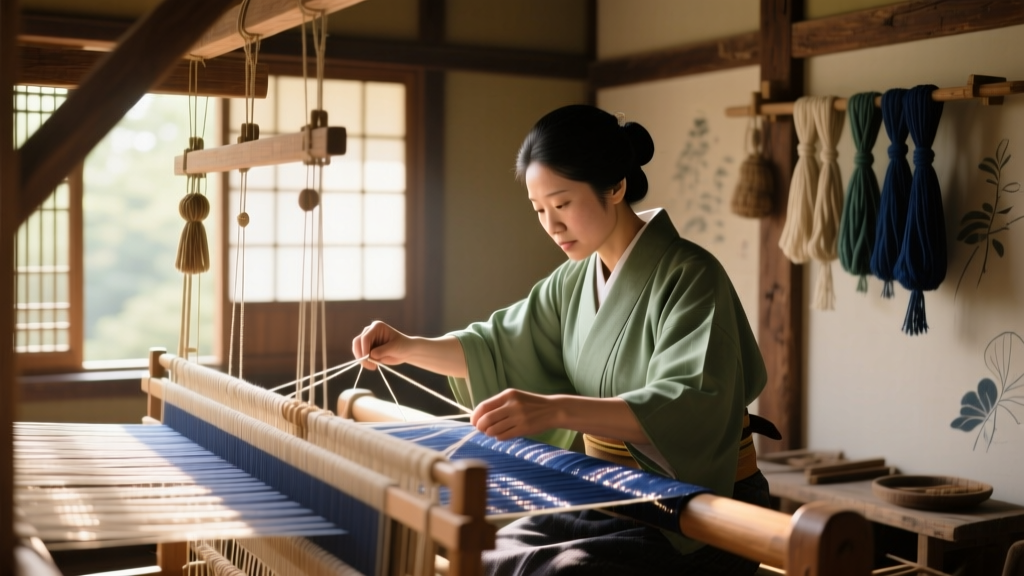
Zhou Baobao frequently decodes Zhuanghua (妆花), the pinnacle of Ming dynasty silk weaving. Unlike standard jacquard weaves, Zhuanghua utilizes a complex 'interrupted weft' technique (Wahua). Artisans use small bamboo boats to weave colored silk and gold threads only where the pattern requires them, rather than carrying the weft thread across the entire width of the loom. This prevents the fabric from becoming overly heavy and stiff, allowing for vibrant, multi-colored motifs—such as the iconic Mang (python) or floral medallions—against a dark, lustrous satin ground. As documented by the Metropolitan Museum of Art's Heilbrunn Timeline of Art History, this technique required immense coordination between the weaver and the drawboy operating the complex harness loom.
Deconstructing the Silhouette: Tailoring and Construction Standards
Fabric is only half the equation; the geometry of the cut defines the Hanfu silhouette. Zhou Baobao's tutorials emphasize Pingmian Caizhi (flat pattern cutting), a traditional Chinese tailoring philosophy that stands in stark contrast to Western three-dimensional draping.
The Geometry of the Mamianqun (Horse-Face Skirt)
The Mamianqun is a masterclass in kinetic tailoring. A standard Ming dynasty horse-face skirt consists of two identical, overlapping rectangular panels. Each panel features a flat central section (the Mamian) and pleated sides. When wrapped, the flat sections overlap at the front and back, creating a modest, structured facade that opens dynamically with movement. Zhou Baobao highlights the mathematical precision required for the pleats: traditional Bamaqun (eight-pleat) or Shiliuqun (pomegranate/multi-pleat) skirts require exact calculations of the waist-to-hem ratio. The pleats are heat-set and secured by a sturdy cotton or silk waistband (Yaotou), ensuring they do not splay awkwardly when walking.
Jiaoling Youren and the Philosophy of the Cross-Collar
The Jiaoling Youren (交领右衽), or cross-collar right lapel, is a foundational element of Hanfu. Zhou Baobao explains that this is not merely an aesthetic choice but a reflection of ancient cosmological beliefs, where the left (Yang/life) overlaps the right (Yin/death). The construction requires precise bias-cutting at the collar edge to ensure the fabric lays flat against the clavicle without gaping, a technique that demands high-level artisan tailoring.
The Economics of Authenticity: Price Tiers and Sourcing Guide
For collectors and practitioners looking to invest in garments that meet the rigorous standards advocated by Zhou Baobao, understanding the economics of authentic silk is crucial. Below is a comparative guide to heritage textiles, their historical applications, and current market valuations.
| Textile Name | Historical Era | Weave / Dye Technique | Approx. Price (RMB / Meter) | Ideal Garment Application |
|---|---|---|---|---|
| Xiangyunsha | Ming / Qing | Gauze weave; Tannin & Iron-mud dye | 800 - 1,800 | Summer Aoqun, lightweight robes |
| Zhuanghua | Ming | Interrupted weft brocade; Gold couching | 2,500 - 6,000+ | Ceremonial Mamianqun, formal jackets |
| Songjin (Song Brocade) | Song | Warp-faced compound weave; Geometric motifs | 400 - 1,200 | Banbi (half-sleeve jackets), collar edging |
| Hua Luo (Patterned Gauze) | Tang / Song | Leno weave with twisted warp pairs | 600 - 1,500 | Summer Shan (open robes), veils |
Verifying Intangible Cultural Heritage (ICH) Textiles
The market is flooded with 'Hanfu-style' garments made from polyester jacquard. To ensure you are purchasing authentic heritage crafts, Zhou Baobao and textile conservators recommend three verification methods:
- The Reverse-Side Inspection: True Zhuanghua and Kesi (silk tapestry) will show distinct, uncarried weft threads or slits on the reverse side. Digital printing or standard factory jacquard will show a uniform, albeit messy, grid of floating threads.
- The Burn Test: Authentic silk is a protein fiber. When a loose thread is burned, it should smell like singed hair, burn slowly, and leave a crushable, dark ash. Synthetic alternatives will melt, smell of plastic, and form a hard bead.
- The Water Test: Authentic Xiangyunsha possesses a natural, subtle water-repellency due to the tannin-mud coating. Water droplets should bead slightly on the dark side of the fabric before absorbing.
Preserving Heritage in the Modern Wardrobe
The inquiry into who is 周宝宝 the hanfu lady ultimately leads to a broader appreciation for the artisans keeping these traditions alive. The Hanfu movement is no longer just about wearing historical clothing; it is an active economic engine supporting rural silk cooperatives, master weavers in Nanjing and Suzhou, and traditional dyers in Guangdong. By demanding structural accuracy, natural fibers, and historical fidelity, digital curators and informed consumers are ensuring that the profound material culture of Asian civilizations is not relegated to museum archives, but continues to breathe, move, and evolve in the modern world. For further study on historical Asian textile conservation and weaving structures, the Victoria and Albert Museum's Chinese Art collection offers unparalleled archival resources and high-resolution weave analyses.