Chinese Men's Clothing: Historical & Cultural Guide

The Evolution of the Male Silhouette in China
When discussing Chinese traditional men's clothing, it is essential to recognize that there is no single monolithic garment that represents over three millennia of sartorial history. The evolution of male dress in China is a complex tapestry woven from indigenous Han traditions, Central Asian equestrian influences, and Manchu imperial mandates. For the modern enthusiast, historian, or collector, understanding these distinct eras and their corresponding garments is the first step toward appreciating the profound cultural weight these textiles carry.
Historically, Chinese garments were not merely functional; they were deeply embedded in Confucian philosophy, social hierarchy, and cosmological beliefs. The cut, color, and fabric of a man's attire communicated his scholarly rank, moral alignment, and ethnic identity. Today, the global revival of historical dress has brought these garments back into the public consciousness, demanding a rigorous, respectful approach to their study and acquisition.
Han and Tang Dynasties: The Foundation of Hanfu
The term Hanfu (汉服) broadly refers to the pre-Qing clothing of the Han Chinese. During the Han Dynasty (202 BCE – 220 CE), the foundational silhouette was the Shenyi (深衣), or "deep robe." This garment was revolutionary in its philosophy: it connected the upper garment (yi) and lower skirt (chang) into a single piece, symbolizing the unity of the cosmos and the moral integrity of the wearer. The Shenyi featured wide sleeves and a wrapped front, establishing the baseline for centuries of Chinese tailoring.
By the Tang Dynasty (618–907 CE), China's cosmopolitan Silk Road connections introduced new silhouettes. The Yuanlingpao (圆领袍), a round-collared robe with side slits for horseback riding, became the standard daily wear for men, from scholars to emperors. While influenced by Central Asian nomadic tribes, the Tang Yuanlingpao was thoroughly sinicized, utilizing luxurious silk brocades and adhering to strict color-coding laws that dictated which hues were reserved for imperial versus common use.
Ming Dynasty Refinement: Daopao and Zhiduo
The Ming Dynasty (1368–1644) represents a golden age of Hanfu refinement, particularly in men's scholarly and official dress. Following the expulsion of the Mongol Yuan dynasty, the Ming court sought to restore classical Han aesthetics. The most iconic garment of this era is the Daopao (道袍). Despite translating to "Daoist robe," it was the ubiquitous everyday attire for Ming scholars and literati.
The Daopao is a masterclass in flat-pattern tailoring. It features a cross-collar and side slits, but its genius lies in the hidden internal swing panels (anbai). These overlapping interior fabric panels ensured that a man's trousers were never exposed when walking or sitting, maintaining strict Confucian modesty while allowing fluid movement. Another prominent Ming garment is the Zhiduo (直裰), similar to the Daopao but with open side slits and no hidden panels, often worn by monks or in more casual scholarly settings.
Anatomy of the Garments: Construction and Terminology
Unlike Western tailoring, which relies on darts, shoulder seams, and structured armholes to mold fabric to the three-dimensional human form, traditional Chinese garment construction is based on two-dimensional flat cutting. Fabric is woven to specific widths and folded over the shoulder, creating a seamless, continuous line that prioritizes the drape and flow of the textile over the anatomical outline of the body.
The Sacred Rule of Jiaoling Youren
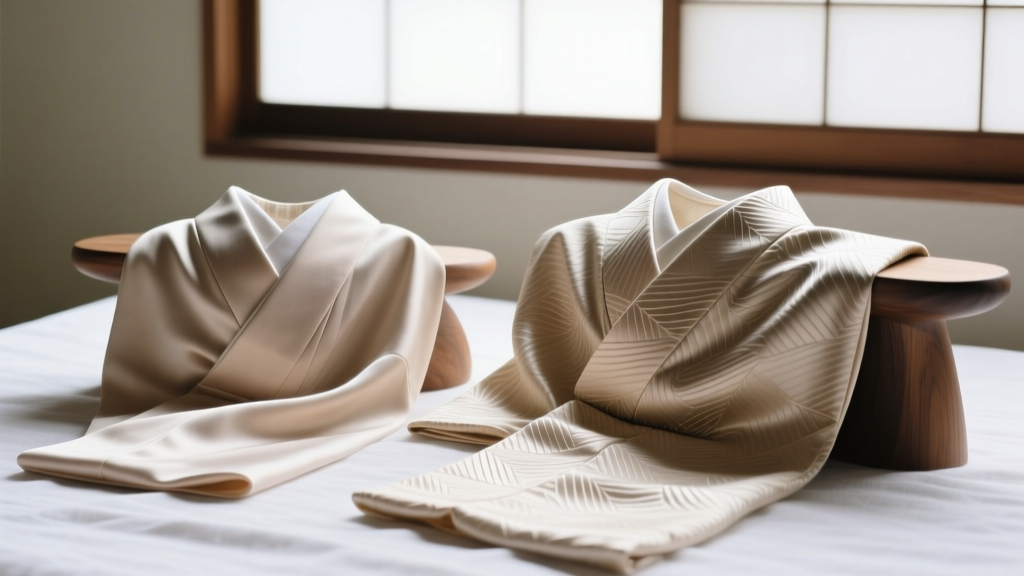
The most critical defining feature of traditional Han Chinese clothing is the collar alignment, known as Jiaoling Youren (交领右衽). This translates to "cross-collar, right lapel." The left side of the garment must always cross over and cover the right side, with the collar forming a 'y' shape across the chest.
"In traditional Chinese cosmology, the left represents Yang (life, the east, the sun) and the right represents Yin (death, the west, the moon). Wrapping the left over the right was a profound declaration of civilization, life, and order."
Reversing this to Zuoren (left lapel over right) was historically reserved for two distinct groups: the deceased (as they transitioned to the Yin realm) and non-Han "barbarian" tribes. Wearing a garment with the wrong collar alignment today is considered a severe cultural faux pas and a sign of deep disrespect.
The Qing Dynasty Shift: Changshan and Magua
In 1644, the Manchu conquest established the Qing Dynasty, fundamentally altering the trajectory of Chinese menswear. The Manchu rulers enforced the Tifa Yifu edict, demanding that Han Chinese men adopt the Manchu queue hairstyle and clothing under penalty of death. This effectively ended the continuous daily wear of traditional Hanfu for nearly three centuries.
The standard male attire became the Changshan (长衫), a long, narrow-sleeved robe with a Mandarin collar and right-side frog button closures, paired with the Magua (马褂), a shorter, waist-length riding jacket worn over the robe. These garments were tailored with more structured seams to accommodate the harsh northern climate and equestrian lifestyle of the Manchus.
A common modern misconception is the Tangzhuang (唐装), often marketed in the West as a "Tang Suit." The Tangzhuang has no historical connection to the Tang Dynasty. It is a 20th-century hybrid garment, blending the Manchu Magua with Western set-in sleeves and tailored fits, popularized globally during the 2001 APEC summit in Shanghai. While culturally significant to the modern Chinese diaspora, historians classify it as contemporary folk dress rather than ancient traditional wear.
Material Culture: Fabrics, Weaves, and Status
The historical significance of Chinese traditional men's clothing is inextricably linked to its textiles. According to archives from the China National Silk Museum, the mastery of sericulture allowed Chinese weavers to create fabrics that were heavily regulated by sumptuary laws. Below is a breakdown of historically significant textiles used in menswear.
| Fabric Name | Historical Origin | Characteristics & Use | Modern Availability |
|---|---|---|---|
| Xiangyunsha (香云纱) | Guangdong (Ming/Qing) | Silk dyed with yam juice and river mud; water-resistant, crisp, and cooling. Worn by wealthy merchants. | High; highly prized by bespoke tailors. |
| Song Brocade (宋锦) | Suzhou (Song Dynasty) | Heavy, intricately patterned silk weave. Used for formal outer robes and scholar's jackets. | Moderate; used in luxury Hanfu brands. |
| Ramie (夏布) | Widespread (Antiquity) | Stiff, breathable plant fiber. The standard summer fabric for commoners and ascetic scholars. | High; popular for casual, everyday Hanfu. |
| Silk Gauze (罗) | Hangzhou (Tang/Song) | Lightweight, open-weave silk. Worn in layers during humid summers by the elite. | Low; requires specialized artisanal weaving. |
Acquiring Authentic Pieces: A Buyer's Framework
For those looking to purchase Chinese traditional men's clothing, the market is saturated with inaccurate, mass-produced "costumes" that lack structural integrity and cultural respect. Collectors and practitioners must look to specialized makers who utilize historical pattern drafting. Institutions like the Metropolitan Museum of Art and the Victoria and Albert Museum provide excellent visual archives for verifying collar angles, sleeve curves, and fabric drapes before making a purchase.
Price Tiers and Sourcing
- Tier 1: Mass Market & Fast Fashion ($30 - $80 USD): Found on platforms like AliExpress or Amazon. These garments are typically made from polyester, feature incorrect collar alignments, and use Western darts and shoulder seams. They are suitable for theatrical props but not for cultural practitioners.
- Tier 2: Boutique Hanfu Brands ($150 - $500 USD): Brands such as Shisanyu (十三余) or Hantime offer historically inspired pieces using silk blends, cotton, and ramie. The pattern cutting is generally accurate, and these are excellent for festivals, weddings, and daily wear.
- Tier 3: Historical Reconstruction & Bespoke ($600 - $2,000+ USD): The gold standard for Ming Dynasty reconstruction is Minghuatang (明华堂). They utilize authentic loom-width fabrics, traditional Xiangyunsha silk, and meticulous hand-stitching. A single Daopao from a maker of this caliber requires months of waiting and represents a serious investment in wearable cultural heritage.
Cultural Protocols for Modern Wearers
Wearing Chinese traditional men's clothing today requires an understanding of context and etiquette. While the modern Hanfu movement encourages wearing these garments in daily life to normalize them, certain protocols remain vital. For instance, pure white or unbleached hemp garments are historically associated with mourning and funerals; wearing a full white hemp set to a joyous occasion like a wedding or Lunar New Year celebration is highly inappropriate.
Conversely, deep reds, golds, and intricate brocades are reserved for celebratory events and weddings. When wearing a Ming-style Daopao or a Tang-style Yuanlingpao, one must also consider the undergarments. Traditional robes are meant to be worn over white cotton or silk inner layers (zhongyi), which protect the outer silk from body oils and provide the necessary structural volume to support the wide sleeves and draped silhouette. By respecting both the physical construction and the cultural philosophy of these garments, modern wearers honor the living legacy of Chinese sartorial history.