Traditional Chinese Dress: A Cultural Guide to Hanfu and Qipao

When discussing traditional Chinese dress, Western audiences often default to a singular image: the form-fitting, high-collared Qipao. However, the sartorial history of China is a vast, multi-millennial tapestry that extends far beyond the 20th century. As a living tradition experiencing a massive contemporary revival, understanding Chinese historical garments requires examining the philosophical, regional, and structural nuances of attire like the Hanfu, the Manchu-influenced Qipao, and the intricate textiles that define them.
The Philosophical Foundations of Hanfu
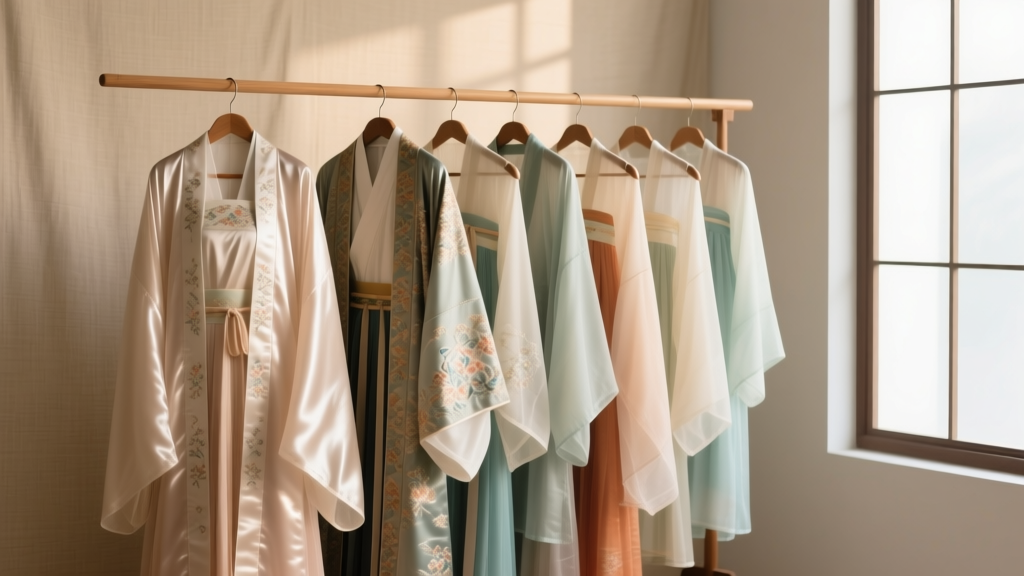
The term Hanfu (汉服) translates literally to 'Han clothing,' referring to the historical dress system of the Han Chinese people, which spans from the mythical Yellow Emperor era (circa 2700 BCE) to the mid-17th century. Unlike Western tailoring, which relies on darts and 3D draping to contour the body, traditional Hanfu is rooted in flat-pattern cutting. This approach respects the integrity of the woven cloth, minimizing waste and allowing the fabric to drape naturally over the wearer's form.
Core Structural Elements: Jiaoling Youren and Mamianqun
The most defining characteristic of Hanfu is the jiaoling youren (交领右衽), or the cross-collar wrapping to the right. The left lapel crosses over the right, a practice deeply tied to ancient Chinese cosmology where the left (Yang) represents life and the right (Yin) represents the earth. Wrapping left-over-right (zuoren) was historically reserved for the deceased or considered 'barbarian' attire.
Another cornerstone of the Hanfu wardrobe is the Mamianqun (马面裙), or 'horse-face skirt.' Originating in the Song and Ming dynasties, this skirt features two overlapping flat panels at the front and back, with deep, structured pleats on the sides. The flat panels (the 'horse faces') provided a canvas for elaborate woven motifs, while the pleated sides allowed for ease of movement, particularly when horseback riding. Today, authentic Ming-style Mamianqun replicas crafted from heavy silk brocade typically range from $150 to $450 USD, reflecting the complexity of the jacquard weaving process.
The Republican Shift: Engineering the Modern Qipao
If Hanfu represents ancient philosophy, the Qipao (旗袍) represents the dynamic cultural collision of the early 20th century. Often referred to as the Cheongsam in Cantonese, the Qipao evolved from the qizhuang (banner robes) worn by Manchu women during the Qing Dynasty (1644–1912). The original banner robe was a loose, boxy, A-line garment designed for modesty and mobility.
The transformation into the modern, figure-hugging Qipao occurred in 1920s and 1930s Shanghai. Influenced by Western flapper fashion and the modernist 'New Woman' movement, Shanghai tailors introduced Western construction techniques to the traditional robe. According to textile archives at the Metropolitan Museum of Art, this era saw the introduction of bust darts, waist suppression, set-in sleeves, and bias-cut fabrics. Yet, the garment retained its distinct Chinese identity through the yuanling (mandarin collar) and pankou (hand-knotted frog fasteners).
The Art of Pankou and Bespoke Pricing
The pankou are not merely functional buttons; they are intricate, symbolic knots often shaped like butterflies, plum blossoms, or swallows. Creating a single set of bespoke silk pankou can take an artisan several hours. Consequently, a mass-produced, polyester-blend Qipao might cost between $40 and $90 USD, whereas a bespoke, hand-tailored Qipao crafted from authentic Hangzhou silk with hand-knotted fasteners and custom embroidery will easily command $600 to $2,500+ USD from master tailors in Shanghai or Hong Kong.
Comparative Framework: Major Chinese Garments
To navigate the diverse landscape of traditional Chinese dress, it is essential to distinguish between historical daily wear, minority influences, and modern ceremonial adaptations. The table below outlines the primary categories encountered by collectors and cultural enthusiasts.
| Garment Name | Historical Era / Origin | Silhouette & Key Features | Cultural Context & Modern Use | Average Price Range (USD) |
|---|---|---|---|---|
| Hanfu (Ruqun) | Pre-Qing (Han, Tang, Song, Ming) | Cross-collar, wide sleeves, high-waisted pleated skirt. | Historical daily wear; modern Hanfu revival movement. | $80 - $350 |
| Mamianqun | Song / Ming Dynasty | Wrap skirt with flat front/back panels and side pleats. | Highly popular in modern streetwear and Hanfu styling. | $150 - $500 |
| Qipao / Cheongsam | 1920s Shanghai (Manchu roots) | Form-fitting, mandarin collar, side slits, pankou closures. | Formal events, diplomacy, contemporary fashion. | $100 - $2,500+ |
| Xiuhefu | Modern (21st Century) | Two-piece jacket and skirt, heavy gold/red embroidery. | Traditional Chinese wedding attire (Qungua alternative). | $300 - $3,000+ |
| Tang Suit (Tangzhuang) | Late Qing / Modern | Manchu-style jacket with Western shoulder pads and pankou. | Lunar New Year, elder statesmen, casual formal. | $50 - $250 |
Textile Mastery: Xiangyunsha and the Language of Silk
The cultural weight of traditional Chinese dress is inextricably linked to its textiles. The Victoria and Albert Museum frequently highlights the regional specificity of Chinese silks, noting that the geography of the Yangtze River Delta fostered unparalleled weaving techniques. Among the most prized and complex is Xiangyunsha (香云纱), or gambiered Canton gauze.
Originating in the Guangdong province, Xiangyunsha is a unique ecological textile. The silk is repeatedly dyed using the tannin-rich juice of the Dioscorea cirrhosa (shouliang) tuber, then coated with iron-rich river mud from the Pearl River Delta. A chemical reaction between the tannins and the iron creates a lustrous, dark, leather-like fabric that is waterproof, breathable, and naturally antibacterial. Because the process relies on specific sunlight and mud conditions, it can only be produced between March and November. Authentic Xiangyunsha fabric costs upwards of $150 to $300 per yard, making garments crafted from it highly coveted heirlooms.
A Buyer’s Guide to Authenticity and Cultural Respect
As global interest in traditional Chinese dress surges, the market has become saturated with 'Orientalist' costumes that misrepresent the culture. For those looking to invest in authentic pieces, consider the following framework:
- Examine the Collar Construction: Authentic Hanfu will feature a distinct cross-collar that lays flat against the collarbone without the need for hidden modern snaps. The 'right-over-left' lapel rule must be strictly observed.
- Check the Pankou Material: On a high-quality Qipao, the frog fasteners are made from the same silk as the dress and are tightly stuffed with cotton or thread to maintain their shape. Cheap reproductions use hollow synthetic cords that flatten over time.
- Verify the Fabric Composition: Traditional garments rely on the natural temperature-regulating properties of mulberry silk, ramie, or linen. Avoid polyester blends if you are seeking historical accuracy and breathability.
- Respect the Context: Recognize that garments like the Xiuhefu are deeply tied to matrimonial rites, while the Hanfu encompasses varying degrees of formality. Wearing a highly elaborate, dragon-embroidered Ming dynasty court robe to a casual dinner is akin to wearing a European royal coronation gown to a café.
Understanding traditional Chinese dress is not merely an exercise in fashion history; it is an engagement with a living philosophy of harmony between humanity, textile, and nature. Every pleat, knot, and woven motif carries the weight of ancestral memory.
Whether you are drawn to the flowing, unstructured grace of a Song Dynasty Ruqun or the sharp, architectural elegance of a 1930s Shanghai Qipao, engaging with traditional Chinese dress requires an appreciation for the meticulous craftsmanship and deep cultural narratives woven into every thread.