Decoding Chinese Dresses Names: A Fabric & Craft Guide

When enthusiasts, brides, and collectors search for Chinese dresses names, they are frequently presented with superficial lists that reduce millennia of textile evolution to mere visual aesthetics. However, to truly understand garments like the qipao, hanfu, or xiuhefu, one must look beyond the silhouette and examine the warp, weft, and needlework. The nomenclature of traditional Chinese clothing is intrinsically linked to its craftsmanship, regional weaving techniques, and the philosophical approach to fabric manipulation.
This deep dive explores the most prominent Chinese dresses names not just as historical costumes, but as masterclasses in material culture. By understanding the specific silks, dyes, and structural techniques that define these garments, buyers and historians can better appreciate the living traditions maintained by artisans in hubs like Suzhou, Hangzhou, and the Pearl River Delta.
The Qipao (Cheongsam): Architecture in Brocade and Gauze
The qipao (often referred to in the West as the cheongsam) is arguably the most globally recognized among Chinese dresses names. Originating in the 1920s as a modernization of Manchu banner robes, the modern qipao is a triumph of structural tailoring and textile selection. Unlike Western garments that rely on darts to contour the body, the traditional qipao utilizes a complex system of bias-cutting and strategic seam placement to allow woven silks to drape naturally.
Signature Textiles: Songjin and Xiangyunsha
A bespoke qipao is defined by its fabric. Two of the most revered materials used by master tailors in Shanghai and Hong Kong are Songjin (Song Brocade) and Xiangyunsha (Gambiered Canton Gauze).
- Songjin (Song Brocade): Originating in the Song Dynasty (960–1279), this intricate weave features a matte background with lustrous, raised patterns. It is highly structured, making it ideal for the stiff, high-collared qipaos of the 1930s. According to the China National Silk Museum, authentic Songjin requires specialized jacquard looms and interlocking weft techniques that give the fabric a durable yet supple hand-feel.
- Xiangyunsha (Gambiered Gauze): A masterpiece of natural dyeing from Guangdong province. Silk gauze is repeatedly dipped in the tannin-rich juice of the Dioscorea cirrhosa yam, then coated with iron-rich river mud. This chemical reaction creates a dark, metallic-looking fabric that rustles like bamboo leaves when the wearer moves. It is highly prized for summer qipaos due to its sweat-wicking and cooling properties.
The Pankou Craftsmanship
No qipao is complete without pankou (knotted frog closures). Far from being mere fasteners, artisanal pankou are sculptural. Master craftsmen roll silk strips around cotton or copper wire cores to create intricate 3D motifs like plum blossoms, swallows, or the ruyi scepter. A single bespoke set of complex pankou can take an artisan up to 40 hours to hand-stitch, significantly impacting the garment's final price.
Hanfu: Draping the Dynasties in Silk Gauze and Satin
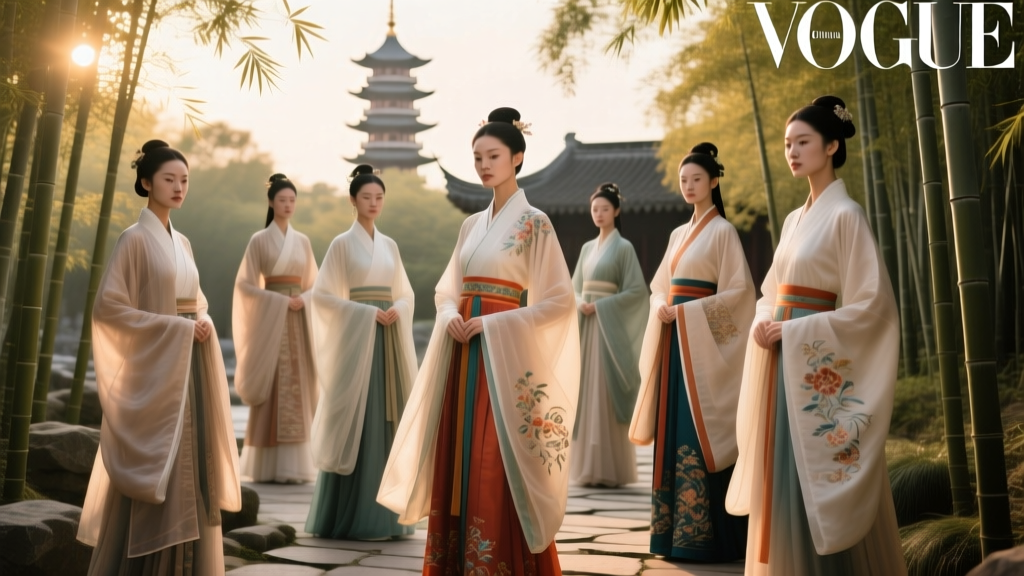
The term hanfu encompasses the historical clothing systems of the Han Chinese, spanning from the Huangdi era to the late Ming Dynasty. When mapping out Chinese dresses names within the hanfu category, it is vital to understand the foundational philosophy of pingmian caijian (flat-plane cutting). Traditional hanfu wastes almost no fabric; garments are constructed from rectangular and trapezoidal panels that wrap and tie, rather than being cut to fit the body's curves.
The Mamianqun (Horse-Face Skirt)
Among the most searched Chinese dresses names today is the mamianqun, a pleated wrap skirt that reached its zenith during the Ming Dynasty. The skirt consists of two overlapping trapezoidal panels with flat, unpleated sections at the front and back (the 'horse faces'), and deeply pleated sides.
Craftsmanship highlight: The zhijin (gold-woven) technique. Artisans in Nanjing and Suzhou weave pure gold leaf, cut into micro-threads and wrapped around silk cores, directly into the damask weave of the skirt's flat panels. The Victoria and Albert Museum holds several Ming-era textile fragments that demonstrate how this technique caught the light in dimly lit palatial halls, creating a halo effect around the wearer.
Luo (Gauze) and Ling (Damask)
Summer hanfu, particularly the beizi (open-front jacket) and ruqun (blouse and skirt sets), rely heavily on Luo (twisted warp gauze). Unlike standard plain weaves, Luo involves twisting adjacent warp threads, creating microscopic pores that allow for exceptional breathability while maintaining a crisp, structured drape that prevents the silk from clinging to the skin.
Xiuhefu: The Matrimonial Masterpiece of Gold Thread
Often confused with the Qing-dynasty longfeng gua, the xiuhefu is a two-piece matrimonial ensemble (a fitted jacket and an A-line skirt) that has become the standard for modern traditional Chinese weddings. The name itself is derived from a popular 1970s television drama character, but the craftsmanship is rooted in centuries of Cantonese and Suzhou embroidery traditions.
Su Xiu and the Weight of Heirloom Silk
A genuine, artisan-crafted xiuhefu is an exercise in density. The base fabric is typically a heavy silk satin, entirely obscured by Su Xiu (Suzhou embroidery). The motifs—dragons, phoenixes, peonies, and pomegranates—are stitched using the 'split-thread' technique, where a single silk thread is split into up to 64 micro-filaments to create photorealistic gradients.
Because of the dense metallic bullion and silk thread coverage, a high-end bespoke xiuhefu can weigh between 5 to 10 kilograms (11 to 22 lbs). The collar and cuffs often feature kesi (cut silk tapestry), a weaving method where the weft threads are turned back at the boundaries of color blocks, creating a microscopic slit that looks as though the design was carved into the fabric.
Comparative Guide: Chinese Dresses Names and Fabric Profiles
| Garment Name (Pinyin) | Primary Era / Origin | Signature Fabric & Weave | Key Craftsmanship Detail | Artisan Price Range (USD) |
|---|---|---|---|---|
| Qipao (Cheongsam) | 1920s Shanghai | Songjin (Brocade), Xiangyunsha | Bias-cut tailoring, sculptural Pankou | $800 – $4,500+ |
| Mamianqun | Ming Dynasty | Zhijin (Gold-woven Damask) | Trapezoidal pleating, flat-panel weaving | $300 – $1,500 |
| Xiuhefu | Modern / Qing Roots | Heavy Silk Satin, Kesi Tapestry | Dense Su Xiu embroidery, split-thread work | $2,500 – $15,000+ |
| Ruqun (Tang Style) | Tang Dynasty | Luo (Gauze), Lightweight Crepe | High-waist draping, twisted warp weaving | $200 – $800 |
Sourcing Authentic Craftsmanship: Navigating the Market
When searching for Chinese dresses names online, buyers must navigate a market flooded with mass-produced, synthetic alternatives. Polyester 'brocades' and machine-embroidered rayon dominate the fast-fashion sector, often priced between $30 and $80. While accessible, these garments lack the breathability, drape, and cultural integrity of natural fibers.
Identifying True Artisan Hubs
To source authentic craftsmanship, one must look to specific regional cooperatives and master tailors:
- Suzhou (Jiangsu Province): The undisputed capital of Su Xiu embroidery and Song Brocade. The Metropolitan Museum of Art Asian Art Department frequently references Suzhou textile masters in their historical textile conservation efforts. Buyers seeking heirloom xiuhefu or high-end mamianqun should look for workshops affiliated with the Suzhou Embroidery Research Institute.
- Hangzhou (Zhejiang Province): Home to the China National Silk Museum and the historic center for Ling (damask) and Chou (plain silk) production. Hangzhou artisans excel in the complex jacquard weaves required for authentic hanfu fabrics.
- Shanghai: The epicenter of bespoke qipao tailoring. Historic tailoring houses along Changle Road and Maoming Road still employ the 'push, pull, and ease' ironing techniques that mold flat silk into three-dimensional curves without the use of Western darts.
Preserving the Intangible Heritage
The names of these garments—qipao, mamianqun, xiuhefu—are more than just labels; they are vessels of intangible cultural heritage. Every time a wearer chooses a garment woven on a traditional wooden loom, or embroidered by a master who has spent decades perfecting the split-thread technique, they are participating in the preservation of Asian textile history. Understanding the deep craftsmanship behind Chinese dresses names ensures that these traditions are respected, accurately represented, and sustained for future generations.