Chinese Fashion 1800s: Qing Dynasty Dress Guide
The Cultural Crossroads: Manchu and Han Styles in the 19th Century

When exploring Chinese fashion 1800s, one must first understand the complex socio-political landscape of the Qing Dynasty (1644–1912). The 19th century was a period of profound sartorial dichotomy. The ruling Manchu elite and the majority Han Chinese population maintained distinct clothing systems, governed by strict sumptuary laws and centuries-old cultural mandates. For beginners and textile enthusiasts alike, the 1800s represent a golden era of intricate embroidery, structural innovation, and the quiet blending of two distinct cultural wardrobes.
Following the Manchu conquest in the 17th century, the Tifayi edict forced Han Chinese men to adopt the Manchu queue hairstyle and Banner-style clothing. However, Han women were largely exempt from this mandate, allowing the traditional Han two-piece ensemble to survive and evolve throughout the 1800s. By the mid-to-late 19th century, cross-pollination between Manchu and Han fashion became evident, setting the stage for the iconic silhouettes of the early 20th century.
Anatomy of the 1800s Wardrobe: Core Garments
To truly appreciate Chinese fashion 1800s, we must deconstruct the primary garments worn by men and women across different social strata. The construction of these garments relied on flat-pattern cutting, minimizing fabric waste and treating the textile as a canvas for elaborate surface decoration.
The Changpao (Long Robe) and Magua (Riding Jacket)
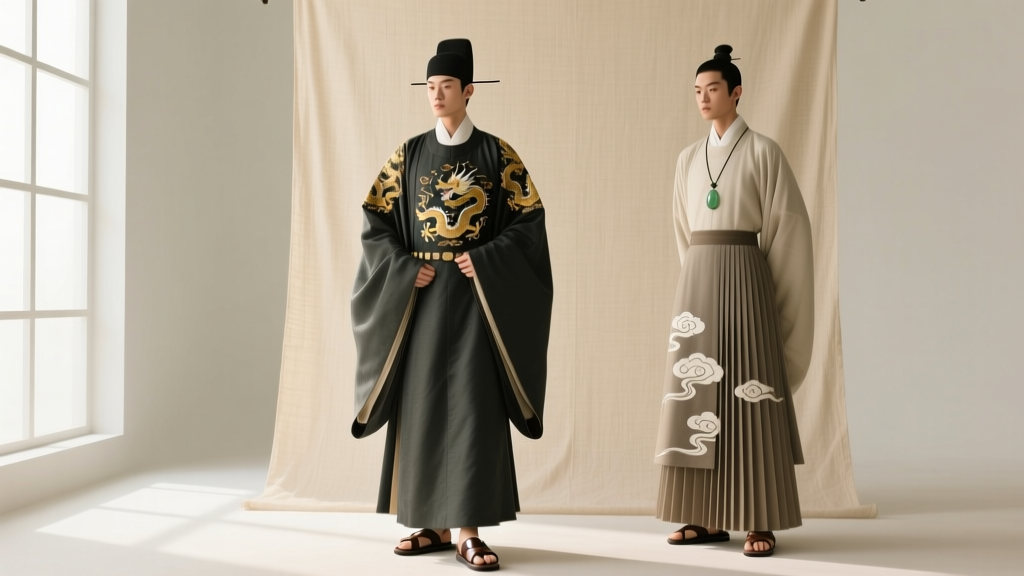
For men of the Qing Dynasty, the foundational garment was the Changpao, a long, full-length robe. Manchu Changpao featured distinct side slits (kai qi)—often four for royalty and nobility, two for commoners—originally designed to facilitate horseback riding. The sleeves terminated in matixiu (horse-hoof cuffs), which could be folded back or extended to protect the hands from the cold.
Over the Changpao, men wore a Magua, a short, waist-length riding jacket. Fastened with intricately knotted Pankou (frog buttons), the Magua was highly versatile. A black silk Magua worn over a blue Changpao became the standard formal attire for Han and Manchu men alike by the late 1800s, a silhouette that eventually evolved into the modern Tang suit.
The Aoqun Ensemble and the Mamianqun

Han Chinese women in the 1800s wore the Aoqun, a two-piece ensemble consisting of a long jacket (Ao) and a skirt (Qun). The Ao typically featured a high Mandarin collar (Yuanling) and wide, sweeping sleeves, fastened asymmetrically at the right shoulder and down the side seam.
The most iconic skirt of this era was the Mamianqun, or 'horse-face skirt.' A marvel of structural engineering, the Mamianqun consisted of two flat, overlapping front and back panels (guangmian) flanked by heavily pleated side panels. This design allowed for ease of movement while maintaining a modest, structured silhouette. The waistband (yaotou) was often crafted from plain white cotton or cheaper silk, serving a dual purpose: it prevented the heavy brocade skirt from slipping and conserved expensive, heavily embroidered fabrics for the visible portions of the garment.
Comparison Chart: Manchu vs. Han Women's Dress (1800s)
While cross-cultural influence was common, distinct differences remained between Manchu and Han women's fashion throughout the 19th century. The following table outlines these key structural variations.
| Feature | Manchu Women (Qizhuang) | Han Women (Aoqun) |
|---|---|---|
| Silhouette | One-piece long robe (Chenpao) | Two-piece jacket and skirt (Aoqun) |
| Footwear | Platform 'flowerpot' shoes (Huapenxie) | Bound feet with embroidered lotus shoes |
| Hair and Headwear | Elaborate wire-frame headdresses (Bianfang) | Ornate hairpins, buns, and silk bands |
| Slits | Side slits on the robe for movement | No slits; pleated skirts provided mobility |
Textiles, Embroidery, and the Language of Motifs
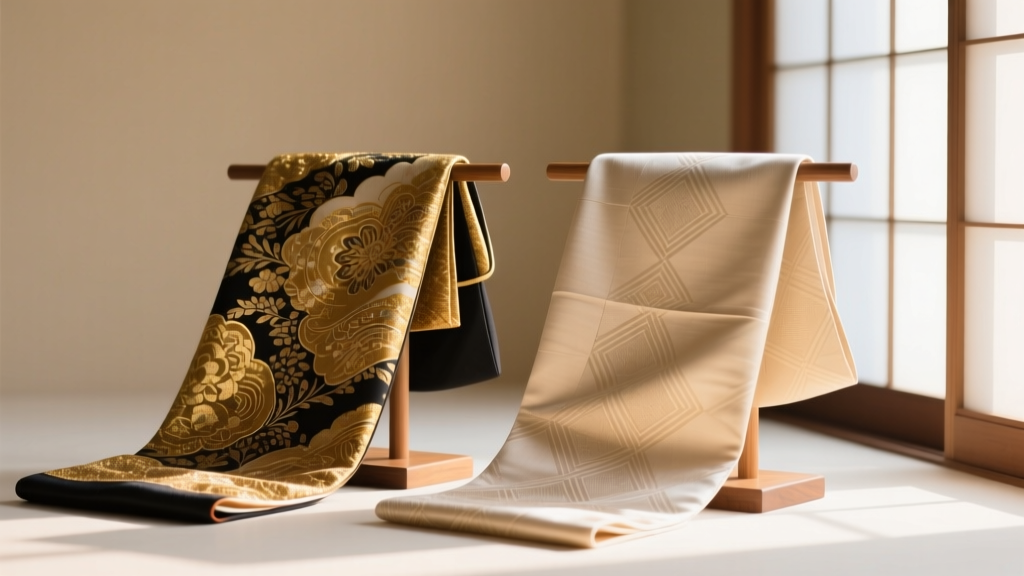
The 1800s saw the zenith of Chinese silk weaving and embroidery techniques. Garments were rarely plain; they were canvases for auspicious symbolism. According to the Metropolitan Museum of Art's Heilbrunn Timeline, Qing dynasty textiles utilized complex techniques like Kesi (cut silk tapestry) and intricate satin-stitch embroidery to convey social status and blessings.
'In the 19th century, clothing was not merely functional; it was a visual language. Every motif, from the number of claws on a dragon to the specific shade of yellow silk, was strictly regulated by the imperial court to maintain the social hierarchy.'
Common motifs found on 1800s garments include:
- Bats (Fu): A visual pun for 'good fortune.' Five bats often surrounded a longevity character, symbolizing the 'Five Blessings.'
- Peonies: The 'king of flowers,' representing wealth, honor, and prosperity.
- Lotus Flowers: Symbolizing purity and harmony, often used on women's skirts and collars.
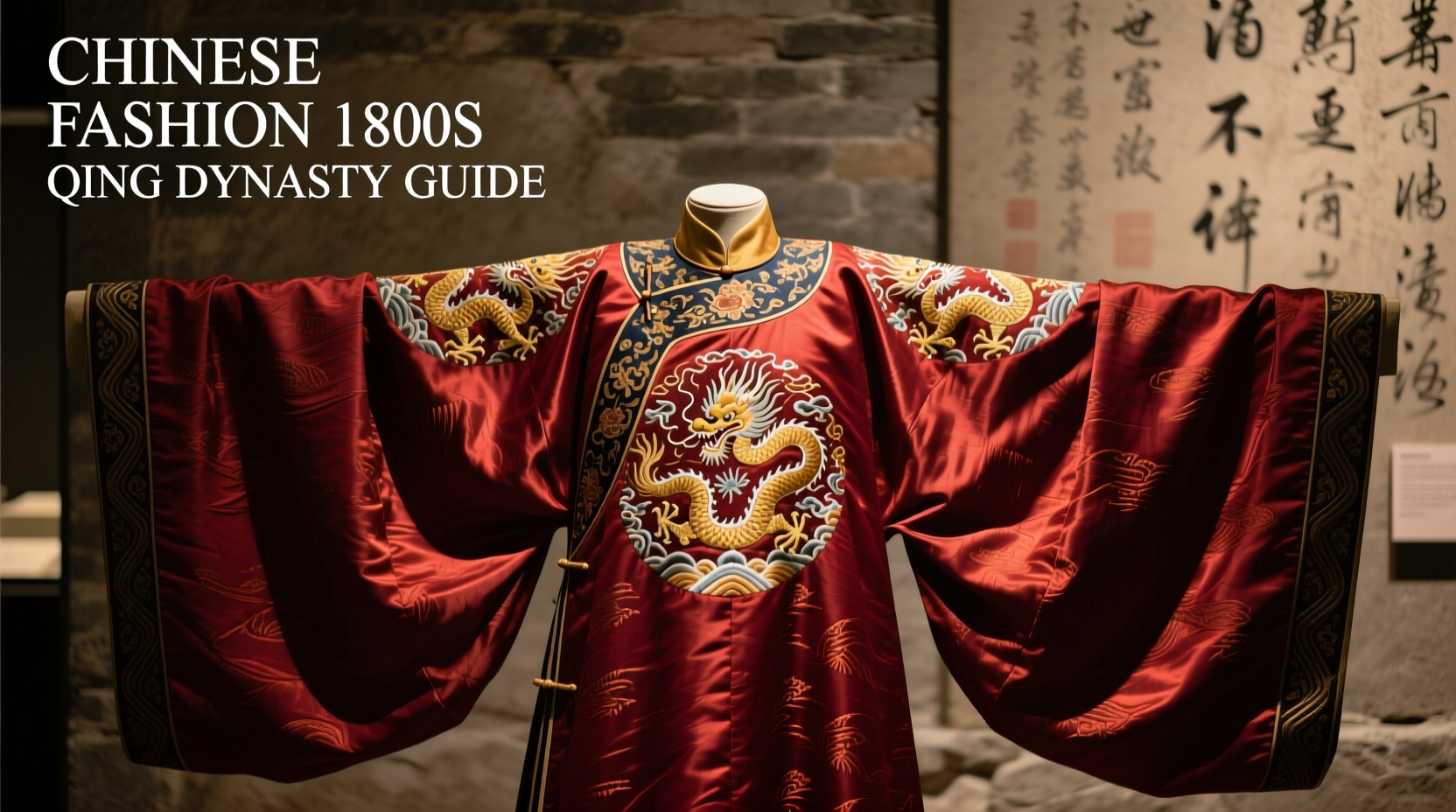
- The Dragon: Strictly reserved for the Imperial family. The five-clawed dragon (Long) was for the Emperor, while four-clawed dragons (Mang) were permitted for high-ranking nobles.
Collecting Today: Antiques vs. Modern Reproductions

For collectors and historians, acquiring pieces of Chinese fashion 1800s is a rewarding but challenging endeavor. The market is divided between fragile antiques and high-quality modern reproductions crafted by heritage artisans.
Sourcing Authentic Antiques
Authentic late-Qing garments frequently appear in specialized auction houses and antique textile dealers. A well-preserved Han women's Ao jacket from the late 1800s, featuring heavy metallic thread embroidery, typically ranges from $600 to $2,500 USD. Antique Mamianqun skirts in pristine condition can fetch between $800 and $3,000 USD, depending on the complexity of the pleating and the rarity of the woven motifs. However, buyers must be cautious of 'married' pieces—garments where modern fabrics have been grafted onto antique collars to inflate the price.
Institutions like the Victoria and Albert Museum and The Palace Museum in Beijing offer extensive digital archives that serve as invaluable reference points for verifying the cut, collar shape, and button placement of authentic 19th-century pieces.
The Rise of Historical Reproductions
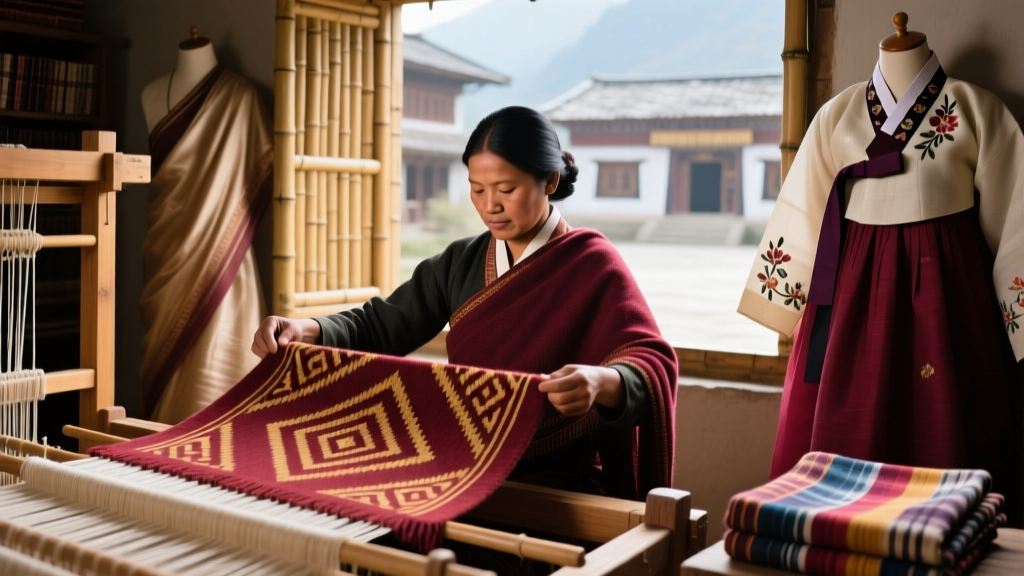
For those wishing to wear these garments without risking the degradation of 150-year-old silk, the modern Hanfu and historical dress movement offers exceptional reproductions. Artisan studios now use traditional wooden looms to recreate Qing-era damasks and brocades. A bespoke, historically accurate Mamianqun reproduction, utilizing genuine mulberry silk and traditional pleat-setting techniques, generally costs between $250 and $600 USD. These modern pieces honor the structural integrity of the 1800s while providing the durability required for contemporary wear and cultural exhibitions.
Final Thoughts on 19th Century Dress
Understanding Chinese fashion 1800s requires looking beyond the surface beauty of the silk. It is a study in resilience, cultural negotiation, and masterful textile engineering. Whether you are examining the precise geometry of a Mamianqun's pleats or decoding the auspicious bats on a Magua, the garments of the 19th century remain a vital, living bridge to China's rich sartorial heritage.