Caring for Qipao, Hanfu & Silk Garments
The Fabric Foundation: Understanding Chinese Textiles
The global resurgence of Chinese dress fashion has brought traditional garments like the qipao (cheongsam), hanfu, and tangzhuang into contemporary wardrobes. However, wearing these cultural artifacts requires a deep understanding of their material composition. Unlike fast fashion, authentic Chinese garments are often constructed from highly sensitive natural fibers and dyed using ancient, pH-reactive methods. Preserving these pieces is not merely about laundry; it is an act of cultural conservation.
Before applying water or detergent, one must identify the textile. The China National Silk Museum in Hangzhou categorizes historical weaves into distinct families, each demanding unique care protocols. Modern Guochao (national trend) fashion often blends traditional aesthetics with modern fabrics, but purist collectors and cultural practitioners invest heavily in heritage materials.
Heritage Silks and Brocades: Value and Vulnerability
- Xiangyunsha (香云纱 - Mud Silk): Originating from Guangdong, this fabric is dyed with the tannin-rich juice of the Dioscorea cirrhosa yam and coated in iron-rich river mud. Price Range: $400 to $1,500+ USD for an authentic qipao. Care Note: Highly alkaline detergents will strip the mud coating and ruin the structural integrity. It must only be washed with pH-neutral silk washes or dry-cleaned by specialists.
- Song Brocade (Songjin) & Shu Brocade: Characterized by intricate, multi-colored weft threads woven into complex geometric or floral patterns. Often used in structured Tang suits and ceremonial Hanfu. Price Range: $200 to $800+ USD per yard. Care Note: Water immersion causes the varying tension threads to shrink at different rates, leading to irreversible puckering. Dry cleaning is mandatory.
- Standard Mulberry Silk (Si Chou): The foundation of most everyday qipaos and flowing Hanfu layers. Price Range: $80 to $300+ USD. Care Note: Susceptible to water spotting and UV degradation. Requires gentle hand-washing in cool water (below 30°C/86°F).
Step-by-Step Cleaning Protocols by Garment Type
The construction of Chinese garments dictates their cleaning methodology. The structural elements—such as the stiff collars of a qipao or the knife-pleats of a Hanfu skirt—can be destroyed by improper agitation.
The Qipao (Cheongsam): Handling Delicate Embroidery and Pankou
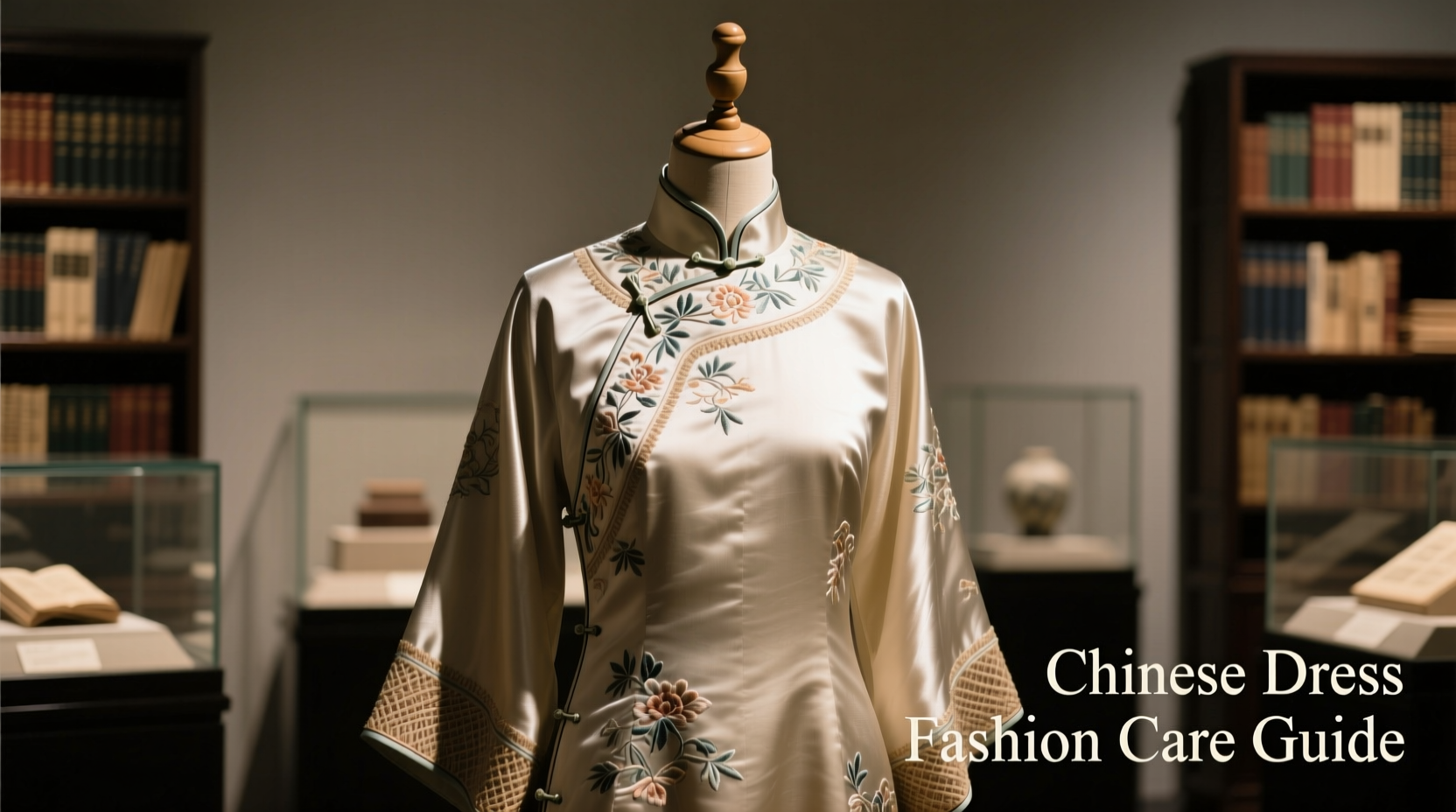
The qipao is defined by its tailored fit and intricate pankou (frog buttons). These knotted buttons are often made from the same silk as the dress, stiffened with wire or heavy thread. According to textile conservation guidelines from the Victoria and Albert Museum, structural elements like these must be protected from mechanical stress.
- Prep the Pankou: Always fasten all frog buttons before cleaning. Washing an unbuttoned qipao allows the knots to unravel and the loops to warp, making re-fastening nearly impossible.
- Spot Treatment: For localized stains on the silk body, use a microfiber cloth dampened with distilled water and a drop of pH-neutral silk detergent. Blot—never rub—to avoid fraying the embroidery floss.
- Hand Washing: If the garment is unlined and made of standard crepe de chine, submerge it in a basin of cool water with silk wash for no more than 3 minutes. Do not wring. Roll the garment in a clean, dry cotton towel to press out excess moisture.
Hanfu: Washing Multi-Layered Ensembles and Pleated Skirts
Hanfu ensembles often consist of multiple layers, including the yisan or mamianqun (horse-face skirt), which features deep, structured pleats. The pleats are traditionally set using heat and tension.
- The Mamianqun Rule: Never machine-wash or aggressively hand-wash a pleated horse-face skirt. The agitation will blow out the pleats. Instead, spot clean the flat panels. If the entire skirt requires freshening, steam it lightly and lay it flat on a mesh drying rack, manually pinning the pleats into place with rust-proof glass-head pins until dry.
- Cross-Collar Tops (Shangyi): The wide sleeves and cross-collars accumulate sweat and oils at the neckline and cuffs. Pre-treat these areas with a mild enzymatic cleaner designed for protein-based fibers (silk) before a gentle, cold-water soak.
Storage & Preservation: Protecting Your Investment
Proper storage is where the longevity of Chinese dress fashion is truly determined. Silk is a protein fiber, making it highly attractive to pests like clothes moths and carpet beetles, while also being vulnerable to acid migration from improper storage materials.
| Garment Type | Recommended Storage Method | Support Materials | Optimal Climate (RH & Temp) |
|---|---|---|---|
| Heavy Brocade Tang Suit | Padded Hanger (Wide Shoulders) | Unbleached cotton garment cover | 45-55% RH / 65-70°F (18-21°C) |
| Silk Qipao (Unlined) | Folded Flat in Archival Box | Acid-free, unbuffered tissue paper | 45-55% RH / 65-70°F (18-21°C) |
| Mamianqun (Pleated Skirt) | Hanged by Skirt Clips or Flat | Padded clip hangers, muslin barrier | 40-50% RH / 65-70°F (18-21°C) |
| Xiangyunsha (Mud Silk) | Folded Flat, Avoid Creasing | Acid-free tissue, cedar wood blocks | 50-55% RH / 60-68°F (15-20°C) |
Note on Tissue Paper: When stuffing the sleeves or wrapping a qipao for long-term storage, always use unbuffered acid-free tissue paper. Buffered tissue contains calcium carbonate, which is excellent for cotton and linen but can cause chemical degradation in protein fibers like silk and wool over time.
Emergency Stain Removal for Traditional Dyes
Modern Chinese dress fashion frequently incorporates historically accurate natural dyes, such as indigo (lancao), lotus root, and tea. These botanical dyes are notoriously fugitive and react violently to modern stain removers.
'When dealing with ethnographic and historical textiles dyed with natural botanicals, the application of commercial oxidizing agents or alkaline spot removers will often strip the dye molecule entirely, leaving a permanent white halo. Conservation-grade cleaning relies on localized, low-moisture solvent sponging.' — Principles derived from the George Washington University Textile Museum conservation archives.
If you spill wine or oil on a naturally dyed Hanfu or an artisanal qipao, avoid club soda and commercial stain sticks. Instead, use an absorbent powder like cornstarch or talcum powder to draw out oils. For water-based stains, gently blot with a dry, lint-free cotton swab. If the stain persists, the garment must be taken to a textile conservator, not a standard commercial dry cleaner.
Professional Conservation vs. Commercial Dry Cleaning
The intersection of high-end Chinese dress fashion and garment care requires knowing when to hand a piece over to a professional. Standard commercial dry cleaners use perchloroethylene (perc) or hydrocarbon solvents in large, aggressive tumbling machines. While the solvents themselves may not harm silk, the mechanical tumbling will crush delicate pankou knots, fray hand-embroidered su xiu (Suzhou embroidery), and flatten the raised textures of brocade.
Seek out a wet cleaner who specializes in couture or a certified textile conservator if your garment meets any of the following criteria:
- It features metallic thread embroidery (gold or silver couched threads), which will tarnish or snap in standard dry-cleaning solvents.
- It is a vintage or antique qipao (pre-1970s), where the silk has experienced 'shattering' or dry rot due to historical weighting salts.
- It is constructed from Xiangyunsha (mud silk), as standard solvents can strip the iron-tannin complex that gives the fabric its signature crackled texture.
For further education on the preservation of Asian textiles, the Metropolitan Museum of Art's Costume Institute offers extensive public resources on how museums stabilize and store silk garments, providing a gold standard for private collectors looking to maintain their cultural wardrobes. By treating these garments not just as clothing, but as woven heritage, practitioners of Chinese dress fashion ensure these traditions endure for generations.