Black Hanfu: History, Cultural Symbolism, and Styling
The Celestial Hue: Black in Chinese Cosmology
To understand the profound significance of black hanfu, one must first look beyond modern Western associations with the color. In traditional Chinese cosmology, color is not merely decorative; it is a fundamental expression of the universe's mechanics. According to the Wu Xing (Five Elements) theory, black represents the Water element, the North direction, and the winter season. More importantly, in ancient Chinese philosophy, the concept of Xuan (玄)—a deep, mystical black with subtle reddish or dark blue undertones—was revered as the color of the heavens. The I Ching (Book of Changes) famously states that "Heaven is Xuan and Earth is Yellow," establishing black as the supreme, celestial hue long before it was adopted by imperial edicts.
When enthusiasts and historians discuss black hanfu today, they are engaging with a sartorial tradition that embodies scholarly elegance, martial prowess, and cosmic alignment. Unlike the Western tradition where black is predominantly associated with mourning, traditional Chinese mourning attire (Sangfu) was crafted from unbleached, raw white hemp. Black, conversely, was the color of emperors, high-ranking officials, and esteemed scholars.
A Dynastic Journey Through Dark Textiles
The Qin Dynasty and the Mandate of Water
The elevation of black hanfu to an imperial standard began with the Qin Dynasty (221–206 BCE). Qin Shi Huang, the first emperor of a unified China, aligned his reign with the Water element to legitimize his conquest over the preceding Zhou Dynasty (associated with Fire). According to the Victoria and Albert Museum's archives on Chinese dress, this cosmological alignment dictated that imperial robes, military standards, and official banners be dyed black. The Shenyi (deep robe) of this era, characterized by its seamless integration of the upper and lower garments, was frequently rendered in dark, unembellished textiles to reflect the solemnity and authority of the Water mandate.
The Ming Dynasty Scholar’s Aesthetic
Fast forward to the Ming Dynasty (1368–1644), and black hanfu evolved into the hallmark of the literati and officialdom. While the emperor favored bright yellows and reds, Ming scholars and lower-ranking officials frequently wore the Daopao (Daoist robe) or Yuanlingpao (round-collar robe) in deep blacks, navy blues, and dark browns. These garments were often woven with subtle, tone-on-tone jacquard patterns visible only in direct light, reflecting the Confucian ideal of inner virtue over outward ostentation. The dark silhouette became synonymous with intellectual rigor, moral integrity, and a connection to Daoist naturalism.
Mastering the Dye: Xiangyunsha and Traditional Pigments
The creation of black hanfu historically required immense artisanal skill. True black dyes were difficult to achieve and prone to fading, making dark garments a signifier of wealth and status. Artisans utilized complex over-dyeing techniques, repeatedly submerging silk or hemp in vats of indigo, oak galls, and iron-rich mud to achieve a colorfast, raven-black finish.
The crown jewel of dark Chinese textiles is Xiangyunsha (Gambiered Canton Gauze). Originating from the Pearl River Delta in Guangdong province, this heritage fabric is recognized by the China National Silk Museum as a masterpiece of intangible cultural heritage. The production of Xiangyunsha involves dyeing silk with the tannin-rich juice of the Dioscorea cirrhosa plant, followed by a critical step: coating the fabric in iron-rich river mud and baking it in the sun. The chemical reaction between the tannins and the iron oxide creates a stunning, dark brown-to-black fabric with a metallic, crackled-glaze sheen on one side and a matte finish on the other. A genuine Xiangyunsha black hanfu is highly prized, breathable, and naturally antibacterial, representing the pinnacle of dark textile craftsmanship.
Garment Architecture: Constructing the Dark Silhouette
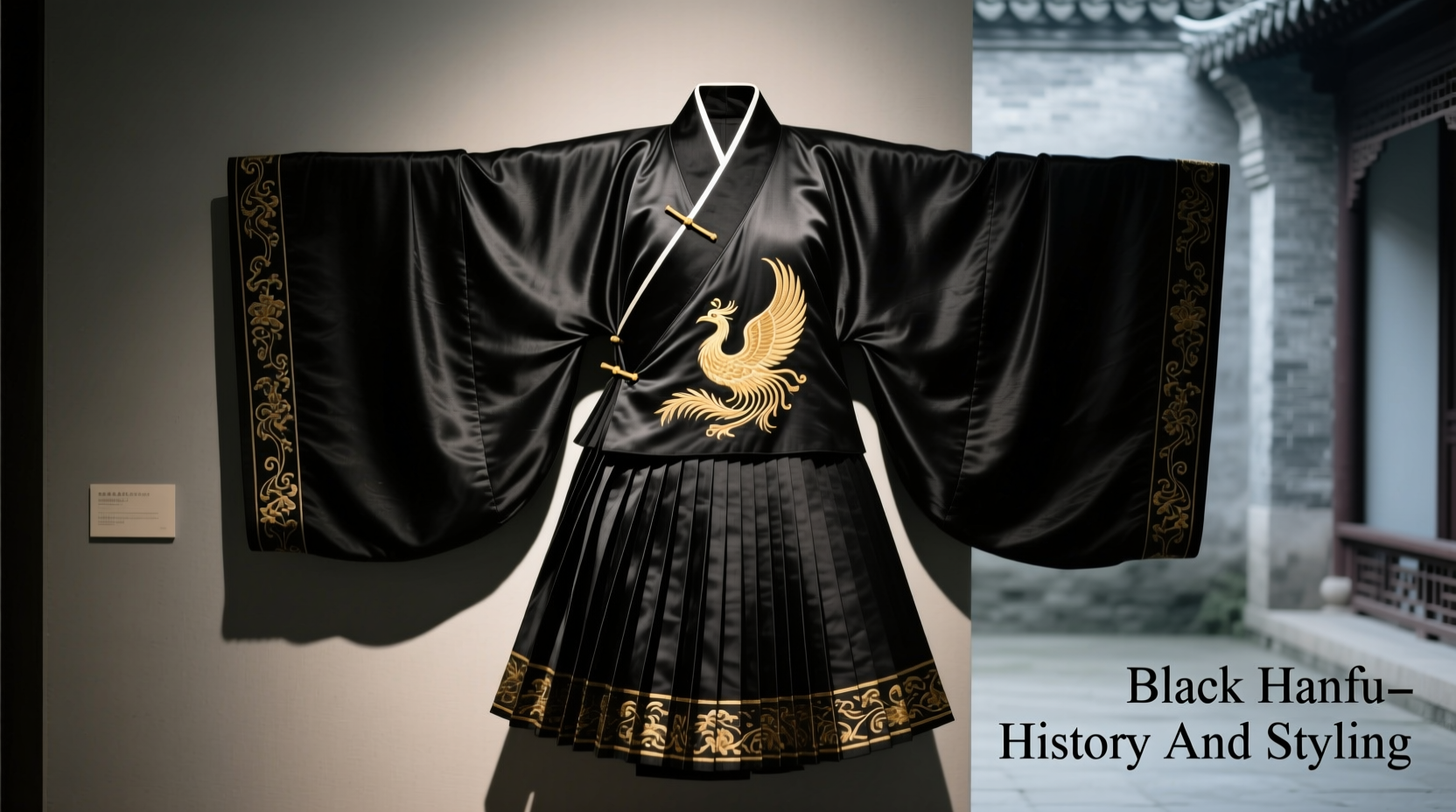
Black hanfu relies heavily on structural elegance rather than vibrant embroidery to make an impact. The architectural foundation of these garments adheres to strict historical protocols:
- Jiaoling Youren (Cross-Collar, Right Lapel): The defining feature of Hanfu. The left side of the collar must always cross over the right, symbolizing the triumph of life and order over death and chaos. In black hanfu, this intersection is often highlighted by a contrasting white or pale grey Zhongyi (inner garment) peeking through at the neckline and cuffs.
- The Daopao (Scholar's Robe): A sweeping, wide-sleeved robe with side slits and hidden pleats. When rendered in black silk or heavy cotton, the Daopao creates a striking, pillar-like silhouette that commands respect and emphasizes the wearer's posture.
- Mamianqun (Horse-Face Skirt): Frequently paired with a black Ao (jacket) or Shan (shirt), the black Mamianqun features flat front and back panels with pleated sides. Modern interpretations often use black brocade woven with subtle gold or silver threads, catching the light dynamically as the wearer moves.
Modern Hanfu Movement: The Wuxia and Scholar Archetypes
In the contemporary Hanfu revival (Hanfu Yundong), black hanfu has surged in popularity, largely driven by two distinct cultural archetypes. The first is the Wuxia (martial arts hero) aesthetic. Inspired by classic literature and cinema, the Wuxia black hanfu typically features narrower sleeves, leather waist guards (Huyao), and high boots, evoking the image of a wandering swordsman. The second is the Ming Scholar archetype, which favors the flowing, floor-length black Daopao paired with a traditional scholar's cap (Futou or Wangjin), projecting an aura of quiet intellect and refined taste.
Investment Guide: Pricing and Procuring Black Hanfu
For collectors and enthusiasts looking to invest in black hanfu, the market offers a wide spectrum of options. Below is a structured guide to navigating the pricing and material tiers available today.
| Tier | Material & Craftsmanship | Price Range (USD) | Best For |
|---|---|---|---|
| Entry-Level | Polyester-cotton blends, machine-printed jacquard, mass-produced tailoring. | $40 - $90 | Cosplay, casual streetwear, beginners. |
| Mid-Tier Artisan | Mulberry silk blends, genuine brocade, hand-finished seams, tone-on-tone weaving. | $150 - $350 | Festivals, formal photography, daily wear. |
| Heritage Luxury | Authentic Xiangyunsha (Gambiered Gauze), hand-embroidered metallic threads, bespoke tailoring. | $600 - $2,500+ | Collectors, tea ceremonies, high-end cultural events. |
Note: When purchasing Xiangyunsha, always request a certificate of authenticity from the artisan cooperative or vendor, as synthetic imitations are prevalent in the market.
Cultural Protocols and Wearing Etiquette
Wearing black hanfu carries specific cultural weight that demands respect and mindfulness. As noted by textile historians at the Metropolitan Museum of Art, the integrity of Chinese silk and dress is deeply tied to social harmony and ritual propriety (Li).
- Avoid Funereal Misconceptions: While black is not the traditional color of Chinese mourning, wearing an entirely unadorned, stark black outfit with white hemp accessories can inadvertently evoke funereal imagery. To maintain a vibrant, living aesthetic, pair black hanfu with jade green, cinnabar red, or silver accessories.
- Accessorizing the Dark Palette: Black hanfu serves as the perfect canvas for high-contrast accessories. A white jade Bi disk pendant, a silver Xiangyun (auspicious cloud) hairpin, or a dark sandalwood folding fan elevate the garment from simple clothing to a curated cultural expression.
- Respect the Collar: Never wear the right lapel over the left (Zuoren). In traditional Chinese culture, this configuration is strictly reserved for the deceased or certain historical nomadic tribes, and doing so is considered highly inauspicious and disrespectful to the Hanfu tradition.
Conclusion
Black hanfu is far more than a modern fashion statement; it is a wearable archive of Chinese philosophy, dynastic history, and artisanal mastery. From the cosmological depths of Xuan to the sun-baked mud of Cantonese silk gauze, the dark garments of the Han people offer a profound connection to the past. Whether worn to channel the quiet dignity of a Ming scholar or the dynamic grace of a martial artist, black hanfu remains a timeless testament to the elegance and complexity of Asian traditional dress.