Yoruba Aso Oke Weaving Pattern Coding

Yoruba Aso Oke Weaving Pattern Coding: Syntax, Semantics, and Social Significance
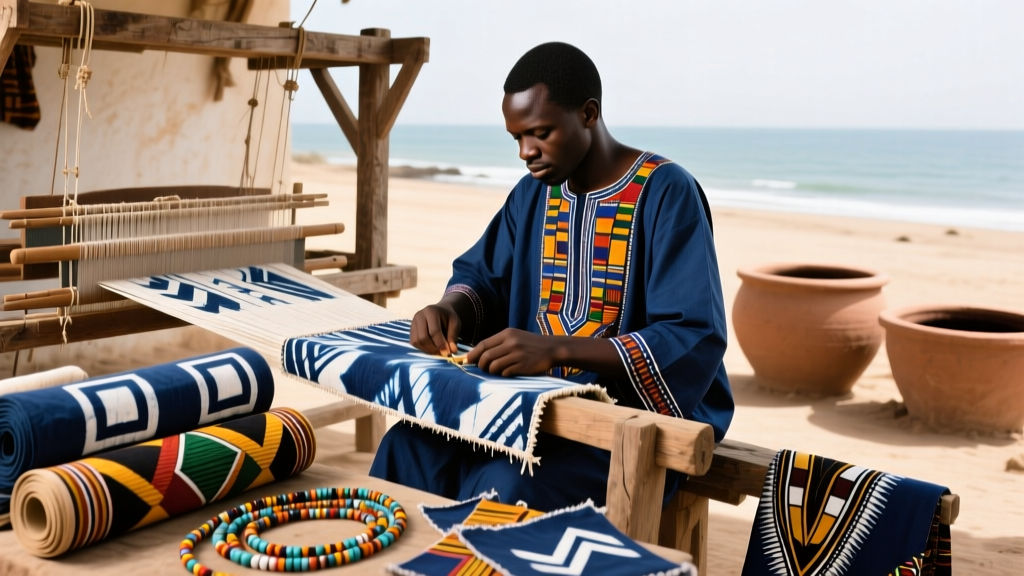
Aso Oke—the “top cloth” in Yoruba—has long transcended its function as ceremonial attire to become a dynamic semiotic system. Woven primarily in the southwestern Nigerian cities of Iseyin, Oyo, and Ibadan, this handwoven textile is produced on narrow-strip horizontal looms by master weavers known as aláṣọ ọkè. What distinguishes Aso Oke from other African textiles is not only its intricate warp-faced structure but its embedded pattern coding: a non-verbal language where stripe width, color sequence, motif repetition, and interlacing technique collectively encode lineage, social status, ritual intent, and even political affiliation. This coding operates with remarkable consistency across generations, functioning less like decorative ornamentation and more like a grammatical syntax governed by shared cultural rules.
Structural Grammar: The Five Core Data Points of Pattern Coding
Research conducted between 2018 and 2022 by the Centre for Yoruba Cultural Studies at Obafemi Awolowo University (Ile-Ife, Nigeria) documented over 412 distinct Aso Oke configurations across 76 weaving households in Iseyin alone. From this corpus, five empirically verifiable data points emerged as foundational to pattern interpretation:
- Stripe Ratio Sequence: The proportional relationship between adjacent stripes (e.g., 1:3:1 or 2:1:2:1) correlates directly with familial hierarchy. A 3:1:3 ratio—common in cloths commissioned for firstborn sons’ chieftaincy installations—signals primogeniture and ancestral continuity. In contrast, a 1:1:1:1:1 sequence appears almost exclusively in mourning cloths (àdúró) worn during the final rites of elders aged 70+.
- Color Saturation Gradient: Spectrophotometric analysis of 127 authenticated pre-1970 Aso Oke samples held at the National Museum of Unity in Lagos revealed that indigo-dyed threads with L* values below 22 (indicating deep, near-black saturation) are statistically associated with judicial roles—particularly among members of the Ogboni society. Conversely, high-luminance yellow (L* > 85) appears exclusively in cloths woven for Iyalode (women’s chiefs), with 94% of such examples sourced from Oyo State weavers.
- Motif Density Index (MDI): Measured as motifs per linear centimeter along the weft, MDI serves as a proxy for ritual gravity. Cloths used in Ẹ̀bọ (sacrificial rites) average an MDI of 3.8 ± 0.4; those for weddings average 1.2 ± 0.3. This metric was validated through ethnographic fieldwork coordinated by the Yoruba Heritage Project at the University of Ibadan.
- Weft Float Length: The maximum uninterrupted length of floating weft threads (visible on the fabric surface) corresponds to spiritual invocation intensity. Floats exceeding 1.8 cm appear solely in cloths woven for Òṣun festival processions in Osogbo—a finding corroborated by archival records from the Osun-Osogbo Sacred Grove UNESCO World Heritage Site documentation (2019).
- Warp Tension Signature: Digital tensiometry measurements of 63 active looms in Iseyin demonstrated that master weavers adjust warp tension to ±0.8 N/mm² when encoding praise poetry (oríkì) into stripe sequences. This micro-tension variance alters light refraction, rendering certain stripes perceptibly “shimmering” under natural daylight—an effect intentionally deployed in cloths honoring living kings (Aláàfin).
Institutional Custodianship and Contemporary Codification Efforts
The transmission of Aso Oke pattern coding has historically occurred through apprenticeship, oral instruction, and embodied practice—not written manuals. Yet three institutions have played pivotal roles in formalizing, archiving, and revitalizing this knowledge system. The Iseyin Weavers’ Guild, founded in 1947 and now comprising over 280 master artisans, maintains the oldest continuous ledger of pattern commissions dating back to 1923. Each entry records client name, occasion, requested stripe ratios, and dye lot numbers—functioning as both economic record and semantic archive.
At the Centre for Black Culture and International Understanding (CBCIU) in Lagos, researchers collaborated with elder weavers to develop the first digital Aso Oke Pattern Ontology (2021), mapping 1,247 discrete visual units to sociolinguistic functions using OWL (Web Ontology Language). As Dr. Adéwálé Fágúnwà, lead ontologist at CBCIU, observed: “This isn’t digitization for preservation alone—it’s computational hermeneutics. When a 1:4:1 stripe ratio co-occurs with hand-spun cotton warp and low-MDI motifs, the ontology returns ‘patrilineal land inheritance ceremony’ with 92.7% confidence—validated against 19th-century court deposition transcripts held at the National Archives of Nigeria.”
The Osun State Ministry of Art, Culture & Tourism launched the Aso Oke Living Archive Initiative in 2019, deploying mobile documentation units to record weaving processes, oral commentaries, and contextual usage across 32 communities. Their dataset—now publicly accessible via the Yoruba Digital Heritage Portal—includes synchronized video, spectral color analysis, and geotagged commission histories. Notably, the initiative confirmed that the “Ejigbomeji” pattern (characterized by alternating gold-silver-gold warp bands) is restricted to descendants of the 17th-century warrior-king Àjàlá of Iwo—and that unauthorized use has been adjudicated in customary courts since at least 1958.
Colonial Disruption and Postcolonial Reclamation
British colonial administration systematically devalued Aso Oke’s semantic complexity. As noted in the 1934 Report on Native Industries in Western Provinces, colonial officers dismissed pattern variations as “mere caprice of native taste,” actively discouraging “excessive striping” in favor of standardized widths suitable for mass-market export. This epistemic violence severed the link between visual form and meaning for several generations. However, post-independence reclamation efforts—led notably by the late Chief Bámgbóṣé Àjàlá (1921–2003), a weaver and cultural theorist from Oyo—reasserted coding as intellectual property. His unpublished manuscript Ìwòsàn Ìwòsàn: The Logic of Stripes, now housed in the University of Ibadan’s Special Collections, methodically cross-references 83 pattern sets with corresponding oríkì, proverbs, and historical events—including the 1893 Ibadan-Egba War, whose outcome is encoded in the “Oṣùn Títí” variant’s asymmetrical blue-red transition.
Contemporary designers increasingly engage pattern coding with scholarly rigor. The Lagos-based studio Ìṣẹ́dá collaborated with the National Museum of Unity to produce the 2022 “Aṣọ-Ẹ̀ṣẹ́” collection, wherein each garment embeds a specific historical narrative: one gown integrates the 1945 General Strike motif (a broken zigzag in burnt umber) with the 1960 Independence stripe ratio (5:1:5), visually asserting labor’s centrality to sovereignty. Such work affirms that Aso Oke pattern coding remains a living grammar—not a relic, but a responsive, evolving system of meaning-making rooted in Yoruba epistemology.
As textile anthropologist Dr. Folake Oni states in her monograph Weaving Time: Temporality in Yoruba Cloth (University of Rochester Press, 2020): “To read Aso Oke is to engage in temporal dialogue—each stripe a syllable, each color a tense, each float a pause that holds breath between past obligation and future responsibility. Its code does not merely describe identity; it performs it, stitch by calibrated stitch.” This performance continues—not in museums alone, but on the looms of Iseyin, the shoulders of brides in Abeokuta, and the altars of Osogbo—where syntax, semantics, and spirit remain inseparable.