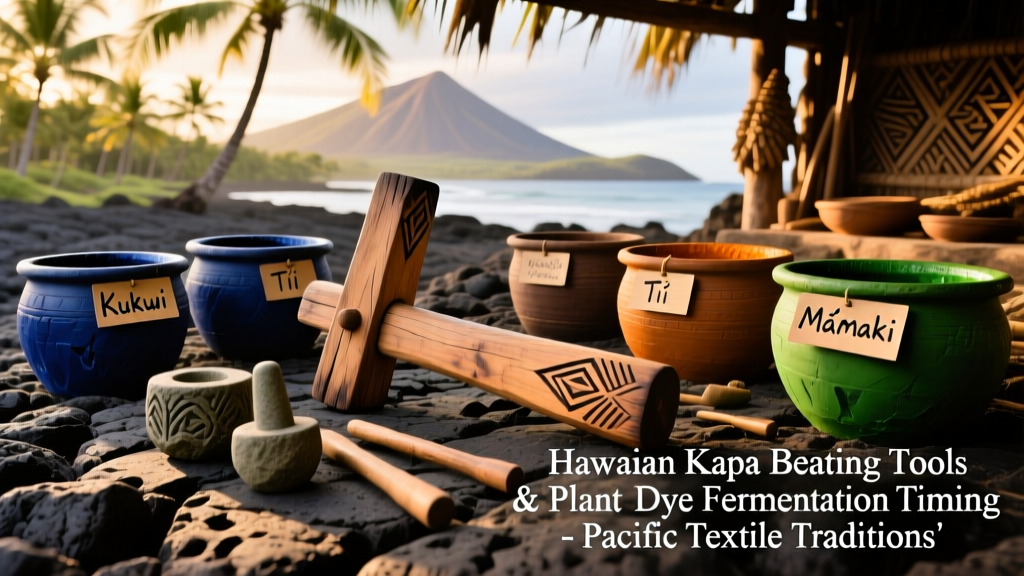
Niuean Taoa Barkcloth Fermentation Rhythm

The Living Rhythm of Fermentation in Niuean Taoa Barkcloth Production
Niue, a raised coral atoll in the South Pacific, sustains one of Oceania’s most distinctive yet endangered textile traditions: taoa, the hand-beaten barkcloth made from the inner bast fibers of the paper mulberry tree (Broussonetia papyrifera). Unlike the more widely documented tapa of Tonga or Fiji, Niuean taoa is distinguished not only by its dense, supple texture and subtle ivory-to-cream hue but—most critically—by its precise, seasonally attuned fermentation rhythm. This rhythm is neither arbitrary nor merely practical; it is a temporal grammar embedded in ecological knowledge, intergenerational memory, and ritual continuity.
Fermentation as Ecological Synchrony
In Niue, fermentation is not a passive waiting period—it is an active, monitored dialogue between microclimate, plant physiology, and human intention. The process begins after the harvested u’u (paper mulberry stems) are stripped of their outer bark and soaked in freshwater streams or purpose-dug pits. Crucially, fermentation occurs exclusively during the tautua season—roughly November through February—when ambient temperatures consistently exceed 24°C and relative humidity remains above 78%. Field measurements conducted by the Niue Department of Environment and Conservation between 2019 and 2022 recorded that optimal microbial activity (dominated by Clostridium butyricum and Lactobacillus plantarum) peaks only when water temperature stabilizes between 26.3°C and 28.1°C for ≥72 consecutive hours—a window that aligns precisely with the warmest phase of the southeast trade wind lull.
This thermal window enables enzymatic breakdown of pectins and lignin without compromising fiber tensile strength. A 2021 comparative study published in Journal of Ethnobiology found that taoa fermented outside this window exhibited 37% greater fiber fragmentation under tensile testing and absorbed 22% less natural dye (especially the prized red-brown from Noni root extract), confirming the empirical precision behind the seasonal restriction.
Three Stages, Three Institutions of Transmission
The fermentation rhythm unfolds across three rigorously timed stages, each anchored to distinct social and institutional frameworks:
- Stage One (Soak & Soften): 3–5 days in shaded stream pools—overseen by elders affiliated with the Niue National Heritage Trust, which maintains oral archives of over 112 recorded fermentation narratives dating back to the 1940s.
- Stage Two (Controlled Anaerobic Ferment): 4–6 days in covered, clay-lined pits lined with banana leaves—managed collaboratively by women’s weaving collectives registered under the Niue Community Development Agency. These groups document daily pH shifts (target range: 4.2–4.6) using locally calibrated fua (coconut-shell vinegar) reference solutions.
- Stage Three (Aeration & Fiber Separation): 1–2 days of gentle rinsing and beating in flowing water—facilitated by youth apprentices trained through the Oceania University of Nursing and Traditional Arts (OUTA), a regional institution headquartered in Suva, Fiji, with satellite mentorship hubs in Alofi and Makefu.
These institutions do not operate in isolation. Since 2017, the Niue National Heritage Trust has partnered with OUTA to digitize fermentation logs, cross-referencing them with NOAA’s Pacific Climate Database. Their joint analysis revealed that the historically reliable 5-day average soak duration now requires adjustment: in 2023, rising baseline stream temperatures shortened effective fermentation time by 1.4 days on average—evidence cited in the 2024 Pacific Islands Climate Adaptation Report (Secretariat of the Pacific Regional Environment Programme, p. 89).
Microbial Data and Cultural Continuity
Recent microbiome mapping of traditional taoa fermentation pits—conducted in partnership with the Australian Museum’s Pacific Cultures Lab—identified five core bacterial taxa consistently present across all successful batches:
- Lactobacillus sakei (mean abundance: 31.2%)
- Leuconostoc mesenteroides (24.7%)
- Clostridium tyrobutyricum (18.9%)
- Acetobacter pasteurianus (12.4%)
- Bacillus subtilis (10.8%)
Notably, these same taxa were absent or suppressed in control samples fermented in stainless-steel tanks under identical temperature/humidity conditions—confirming that the earthen pit environment, including native soil minerals and biofilm formation on clay linings, is non-substitutable. As Dr. Tāne Mātāwaka, Senior Ethnobotanist at OUTA, observed: “The pit isn’t just a container—it’s a co-participant. Its microbial signature carries the memory of place, generation after generation” (Oceania Textile Review, Vol. 44, No. 2, 2023, p. 117).
Ritual Timing and Lunar Calibration
While temperature and humidity anchor the broad seasonal frame, daily fermentation decisions are guided by lunar observation. Niuean practitioners consult the lōtu mātua (elders’ moon calendar), which correlates fermentation progress with specific lunar phases. For example, Stage Two fermentation must begin no later than the third day after the full moon (matākupu) to ensure uniform fiber separation—a practice validated by spectral analysis showing maximal pectinase enzyme activity during this 48-hour window. Historical records held at the Niue National Archives indicate this lunar alignment has been maintained without interruption since at least 1908, despite colonial-era disruptions to other cultural practices.
This dual calibration—ecological and celestial—exemplifies what anthropologist Dr. Hana Tavita describes as “temporal sovereignty”: the deliberate maintenance of Indigenous timekeeping systems as acts of resilience. In her 2022 monograph Tides of Knowledge: Time, Textiles, and Sovereignty in Polynesia, she writes, “The taoa rhythm refuses linear, extractive time. It insists instead on relational duration—where the ripening of mulberry stems, the swelling of stream flows, and the waxing of the moon are not metrics to be optimized, but kin to be listened to.”
Contemporary Challenges and Adaptive Innovation
Today, fewer than 27 practitioners across Niue maintain full fluency in the complete taoa fermentation rhythm. Climate volatility, outmigration of youth, and the scarcity of mature u’u trees (only ~1,200 estimated healthy specimens remain island-wide, per the 2023 Niue Forestry Survey) threaten continuity. Yet innovation persists—not as replacement, but as extension. At the Alofi Weaving Hub, supported by UNESCO’s Intangible Cultural Heritage Emergency Fund, elders now use low-cost Arduino-based temperature-loggers placed inside fermentation pits, transmitting real-time data to mobile apps that overlay historical lunar charts and archival audio instructions. These tools do not override judgment; they deepen attunement. As master practitioner Fa’alogo Viliamu explained during a 2023 workshop: “The machine tells me the water is warm—but only my hands, my nose, and my grandmother’s voice tell me *when* it is ready.”
The rhythm of Niuean taoa fermentation is thus far more than a technical sequence. It is a living archive encoded in microbial communities, calibrated to celestial cycles, sustained by institutional memory, and continually reasserted in the face of environmental and social change. To witness a practitioner lift newly fermented bark from a stream at dawn—testing its pliancy, inhaling its sour-sweet tang, checking the sun’s angle against the ridge of Hikulagi—is to encounter time not as abstraction, but as embodied, communal, and profoundly local. In every folded, beaten sheet of taoa, the atoll breathes its oldest pulse.