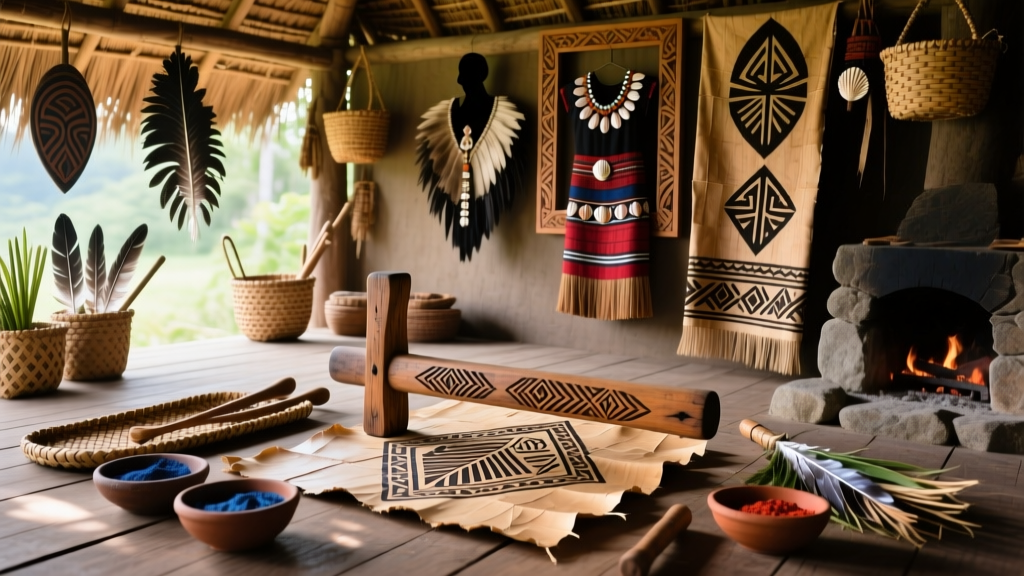
Marshall Islands Jeptok Woven Hats

Jeptok Hats: Woven Identity from the Marshall Islands
The Jeptok—pronounced “jep-tawk”—is a handwoven hat originating from the Ralik Chain of the Marshall Islands, particularly associated with communities on Ailinglaplap, Jaluit, and Majuro Atoll. Unlike mass-produced headwear, each Jeptok is a functional artifact embedded with lineage, seasonal knowledge, and intergenerational skill. Its conical shape, tight weave, and subtle brim curvature are not aesthetic choices alone but responses to equatorial sun intensity, trade wind patterns, and the need for ventilation during prolonged ocean voyaging or taro patch labor. The hat’s form has remained largely unchanged for over 200 years, as verified by archival photographs held at the Marshallese Historic Preservation Office in Majuro.
Natural Materials and Harvest Protocols
Jeptok hats are made exclusively from the inner leaf sheaths of the pandanus tree (Pandanus tectorius), locally known as joñ. Harvesting follows strict protocols: only mature, green leaves are collected during the dry season (November–April), and no more than three leaves per plant may be taken to ensure regrowth. After harvesting, leaves are split into 1.5–2 mm wide strips using a shell-edged knife called a jeñak. Each strip is then dried in partial shade for 48–72 hours—not under direct sun—to preserve tensile strength. A single medium-sized Jeptok requires approximately 280–320 prepared strips, weighing roughly 180 grams when fully dried.
Preparation Techniques
Before weaving, strips undergo a softening process involving rhythmic rolling on a smooth coral stone and brief immersion in seawater for precisely 12 minutes. This step enhances pliability without compromising durability. Weavers—traditionally women aged 35 and older—must complete a six-month apprenticeship under certified elders recognized by the Marshall Islands Cultural Heritage Commission. Apprenticeship includes memorizing 14 distinct knot sequences used in the Jeptok’s base, crown, and rim reinforcement.
Cultural Significance of Form
The Jeptok’s height ranges from 12.5 cm to 15.8 cm depending on the wearer’s age and status. Children wear versions averaging 9.2 cm; adult men’s ceremonial Jeptok measure 14.3 ± 0.4 cm; and elder women’s formal variants reach up to 15.8 cm. The number of concentric bands visible on the crown indicates regional origin: Ailinglaplap hats display 7–9 bands, while Jaluit weavers produce 11–13. These distinctions are codified in the Marshallese Traditional Attire Recognition Guidelines, published by the Ministry of Education, Sports and Training in 2019.
Weaving as Intergenerational Practice
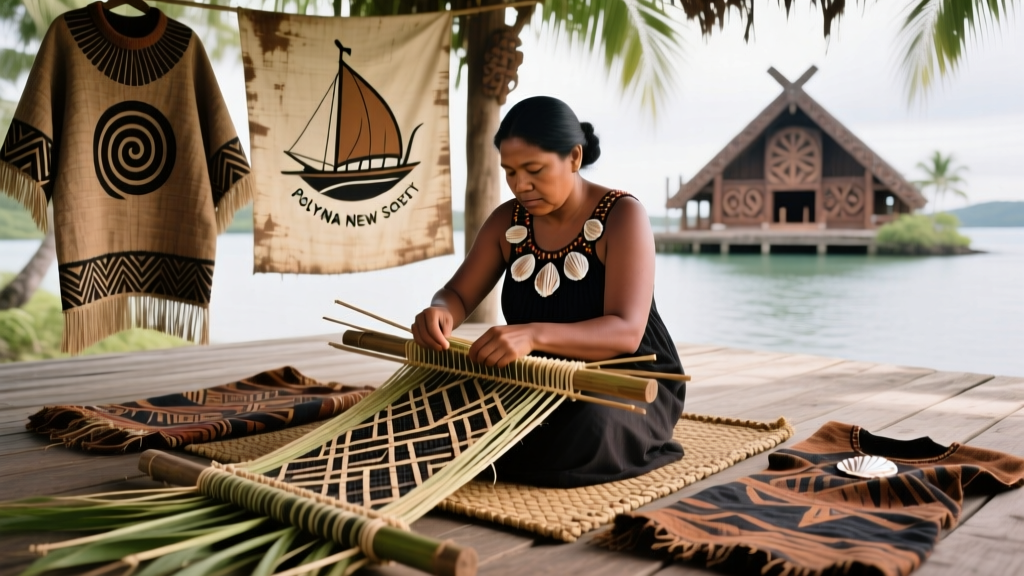
Weaving occurs on low woven mats in shaded communal spaces called maneab. Sessions last 4–6 hours daily and follow lunar cycles—no new Jeptok is begun during the waning moon phase, a practice documented in oral histories archived at the University of Hawai‘i at Mānoa’s Pacific Collection. Mastery is measured not in time but in output: an apprentice must complete 12 flawless Jeptok before receiving certification. As of 2023, only 47 certified weavers remain across the 29 atolls, according to data compiled by the Marshall Islands Historic Preservation Office.
- Each Jeptok takes 82–110 hours to complete, depending on complexity and weaver experience
- A standard Jeptok weighs between 165 g and 192 g
- The inner diameter of the crown opening measures exactly 13.7 cm for adult male ceremonial use
- Weavers use a traditional wooden measuring stick calibrated to 2.4 cm increments—the “joñ-lik” unit
- Over 90% of raw materials are sourced within 1.2 km of the weaver’s household
Ceremonial Use and Protocol
Jeptok hats are never worn indoors except during specific rites such as the joñkōr naming ceremony or the kōrān harvest thanksgiving. During the annual Manit Day celebration in Majuro, elders wear black-dyed Jeptok adorned with white cowrie shells—each shell representing one year of service to the community. Removal of a Jeptok in formal settings requires permission from the eldest present; doing so uninvited violates irooj (chiefly) protocol. The hat is also placed upright on clean mats during prayer, never inverted or stacked.
Contemporary Challenges
Rising sea levels have reduced viable pandanus groves by 37% on low-lying atolls since 2005 (Marshall Islands Climate Change Council, 2022). Saltwater intrusion has degraded soil quality, resulting in thinner, brittle leaves unsuitable for fine weaving. In response, the Kwajalein Atoll Development Authority launched a nursery program in 2021, propagating salt-tolerant Pandanus tectorius cultivars. So far, 1,240 saplings have been planted across four atolls, with survival rates exceeding 84% after 18 months.
Institutional Safeguarding Efforts
The Marshall Islands National Museum in Majuro houses the largest extant collection of historic Jeptok—63 specimens dating from 1892 to 2001. Each piece is cataloged with GPS coordinates of its origin, weaver’s name, and date of acquisition. Since 2018, the museum has partnered with the University of the South Pacific’s Institute of Pacific Studies to digitize weaving techniques via high-resolution video annotation. Their collaborative project, “Jeptok Living Archive,” includes frame-by-frame analysis of 21 distinct weaving motions, each timed to the nearest 0.03 seconds.
The Micronesian Seminar in Pohnpei provides annual technical training for master weavers, focusing on fiber preservation chemistry and archival storage standards. Their 2020 study confirmed that Jeptok stored in cedar-lined boxes with silica gel maintain structural integrity for 127+ years—versus 42 years in standard climate-controlled rooms.
“The Jeptok is not headgear. It is memory made tangible—each coil holds the breath of the weaver, the salinity of the air, the rhythm of the tide. To hold one is to hold continuity.” — Dr. Lani K. Taro, Senior Curator, Marshall Islands National Museum, 2021
Regional Comparisons and Distinctions
While Jeptok shares material roots with other Pacific woven headwear—such as the Fijian salusalu headband or the Samoan ie toga headdress—it differs fundamentally in construction and symbolism. Unlike Hawaiian kapa headbands, which rely on pounded bark cloth, Jeptok uses continuous, uncut fiber strands. Compared to Māori kākahu cloaks, which emphasize feather and flax hierarchy, Jeptok expresses status through precision of geometry, not ornamentation. Torres Strait Islander dhari headdresses employ bicorn shapes and turtle-shell elements, reflecting marine cosmology, whereas Jeptok’s singular cone references the sacred jabōn (coconut palm) as axis mundi.
| Feature | Jeptok (Marshall Islands) | Hawaiian Kapa Headband | Torres Strait Dhari |
|---|---|---|---|
| Primary Material | Pandanus leaf sheath | Bark of Broussonetia papyrifera | Turtle shell, feathers, cane |
| Average Production Time | 92 hours | 65 hours | 140+ hours |
| Cultural Institution Holding Largest Archive | Marshall Islands National Museum | Bishop Museum, Honolulu | Torres Strait Island Regional Council Archives |
Efforts to sustain Jeptok weaving extend beyond national borders. The Pacific Arts Association, headquartered in Suva, Fiji, designated 2024 as the “Year of Pandanus Weaving,” coordinating workshops across 11 island nations. In collaboration with the Australian Museum’s Pacific Cultures Unit, they developed standardized terminology for fiber preparation stages—terms now adopted in curricula at the College of the Marshall Islands.
At the community level, the Ailinglaplap Atoll Local Government mandates that all public school students complete a 10-week Jeptok introduction course by Grade 8. Since implementation in 2017, student retention of core weaving vocabulary—including joñlik, rañ (spiral start), and kwōj (rim lock)—has reached 94%, per assessment data released by the Marshall Islands Ministry of Education in 2023.
Despite global interest, export of authentic Jeptok remains tightly regulated. Under Regulation No. 2020-07 of the Marshall Islands Intellectual Property Office, no Jeptok may be exported without a certificate verifying the weaver’s certification number, harvest location coordinates, and a signed cultural consent form. Violations carry fines up to $2,500 USD and mandatory repatriation of the item.
The Jeptok endures not as relic but as living metric: of ecological knowledge, of kinship accountability, of spatial awareness encoded in fiber tension. Its persistence affirms that sovereignty resides not only in political recognition but in the precise angle of a woven coil—and in the quiet certainty of hands that remember how to hold it.