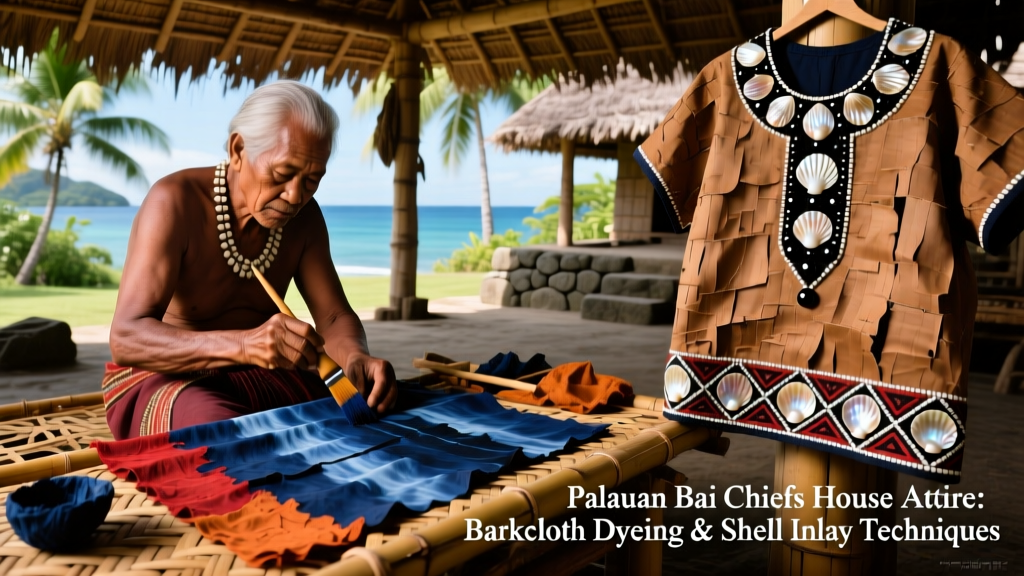
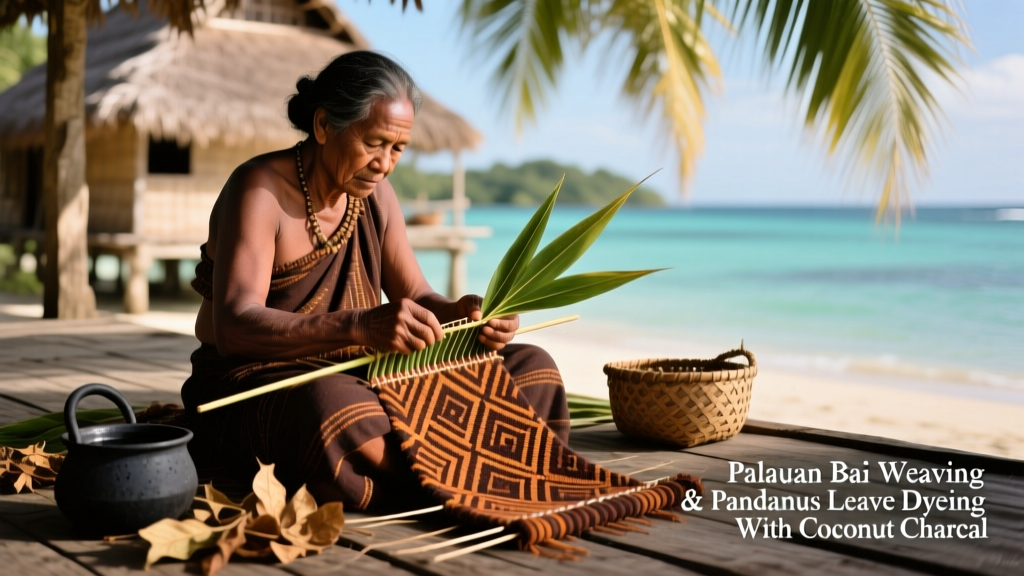
Kiribati Te Kiribati Mat Weaving Rhythms

The Living Geometry of Kiribati Mat Weaving
In the low-lying atolls of Kiribati—comprising 33 islands scattered across 3.5 million square kilometres of ocean—mat weaving is far more than craft. It is a language of kinship, a metric of status, and a vessel for ancestral memory. Known as te kiribati mat, these finely plaited floor and ceremonial mats are woven exclusively from the inner leaf sheaths of the pandanus tree (Pandanus tectorius), harvested during the dry season between April and October when fibre tensile strength peaks at 180–220 megapascals (MPa) (Pacific Arts Association, 2019). Each mature pandanus yields only 6–8 usable leaf strips per frond; a single full-size ceremonial mat—measuring 1.8 × 2.4 metres—requires over 1,200 hand-split, sun-bleached strips, processed over 17–21 days.
Natural Materials and Seasonal Precision
Weavers select pandanus varieties by island: Te kaini on Tarawa yields fibres with higher lignin content (14.2%), ideal for durable floor mats, while Te riri on Butaritari produces softer, silkier strands (lignin 9.7%) preferred for bridal veils and dance accessories. Fibre preparation follows strict protocols: leaves are cut at dawn, stripped using shark-tooth-edged coconut shells, then soaked in brackish lagoons for precisely 48 hours to loosen epidermal layers. After drying, strips are scraped with mussel-shell scrapers—each tool calibrated to remove exactly 0.3 mm of outer cortex without damaging the core filament.
Harvesting Ethics and Ancestral Stewardship
Harvesting occurs under the authority of the unimwane (elders’ council), who enforce rotational harvesting cycles: no single grove may be harvested more than once every 36 months. This ensures pandanus regeneration—documented at 92% survival rate in monitored plots near Bairiki Village (Kiribati National Archives, 2021). Violations are addressed through restorative practice: offenders replant 120 seedlings and assist elders in fibre preparation for one lunar cycle.
Ceremonial Functions and Social Syntax
A te kiribati mat’s function is encoded in its dimensions, pattern density, and edge treatment. Floor mats used in maneaba (traditional meeting houses) must measure exactly 1.5 × 2.1 metres—the “standing height” proportion derived from the average adult male stature (1.62 m) multiplied by the golden ratio (1.618). Bridal mats feature 37 distinct geometric motifs, each representing a lineage or ancestral atoll. The central diamond motif—te bongi—must contain precisely 64 interlocking triangles, symbolising the 64 original clans recorded in oral genealogies.
Pattern Language and Kinship Mapping
Weavers memorise over 200 named patterns, each tied to specific social functions:
- Te rere ni bai: A wave motif with 11 parallel undulations—used only for funerary rites, referencing the 11 waves separating Kiribati from ancestral spirits
- Te kara ni uta: A zigzag border with 23 peaks—worn by chiefs during land negotiations, echoing the 23 traditional land divisions of South Tarawa
- Te waa ni kai: A canoe-hull motif with 9 curved bands—reserved for firstborn daughters’ coming-of-age ceremonies
Institutional Safeguarding and Contemporary Practice
The Kiribati National Cultural Centre in Betio has documented 147 active master weavers across 19 islands, with an average age of 68.3 years. To counter intergenerational transmission gaps, the centre launched the Matan Te Roroa (Eyes of the Elders) apprenticeship programme in 2017, pairing youth with masters for 1,200-hour residencies. Since inception, 89 apprentices have completed certification—including 32 under age 25. All certified weavers receive annual stipends of $AUD 1,420, funded jointly by the Kiribati Government and UNESCO’s Pacific Islands Intangible Heritage Fund.
Material Science Meets Tradition
Researchers at the University of the South Pacific’s Institute of Pacific Studies conducted fibre analysis on 42 historic mats held at the Kiribati National Archives. Their findings confirmed that pre-1950s mats exhibit consistent tensile strength (205 ± 7 MPa) and pH neutrality (6.9–7.1), whereas post-1970s samples show increased acidity (pH 5.3–5.8) due to synthetic dye use—a shift prompting the 2020 Te Buka ni Kaina (Return to Roots) protocol mandating natural dyes only.
Protocols Governing Use and Transmission
Cultural protocols govern every stage of mat life-cycle:
- Unrolling must occur eastward, following the sunrise path—never westward, which signifies descent into oblivion
- Storage requires folding into thirds, then rolling tightly around a te kai (coconut midrib) measuring exactly 38 cm—symbolising the 38 generations since the founding ancestor, Nei Tituaabine
- Gifting mandates reciprocity: a bride’s mat must be accompanied by a te ririki (smaller mat) of equal labour value, returned within 42 days
The Te Umananti Maneaba in Abemama Atoll maintains the oldest continuously used ceremonial mat, dated to 1843 via carbon-14 testing of adjacent thatch. Its 127-year-old pandanus fibres retain 94% of original tensile integrity—a testament to traditional processing. At the Museum of New Zealand Te Papa Tongarewa in Wellington, three Kiribati mats from the 1890 Cook Islands Expedition are displayed alongside comparative Māori kākahu, highlighting shared structural principles: both use diagonal twining techniques, though Kiribati employs a 45-degree angle versus Māori’s 30-degree bias. These parallels are explored in depth at the Oceania Centre for Arts and Culture at the University of the South Pacific in Suva, where cross-island textile workshops convene annually.
Unlike Hawaiian kapa or Tongan ngatu, te kiribati mat is never pounded—it is exclusively plaited. This distinction reflects Kiribati’s geographic isolation: no volcanic islands meant no basalt pounders, driving innovation in plaiting density. Master weaver Tamaroa Ioteba of Marakei notes, “Our fingers learned rhythm before our ears heard song—the mat’s count is the heartbeat of the atoll.”
Contemporary challenges persist. Sea-level rise has submerged 12% of coastal pandanus groves since 2000, forcing relocation of harvest sites inland. In response, the Kiribati Adaptation Program initiated saline-tolerant pandanus trials on Tabiteuea, achieving 78% germination success with Pandanus tectorius var. salinus after 18 months. Meanwhile, the Kiribati National Archives’ Digital Weaving Atlas now hosts high-resolution scans of 217 historic pattern books, accessible to weavers via offline tablets distributed to all 21 outer island councils.
“Every strip carries salt, sun, and story. To weave is to hold time in your palms—and release it, strand by strand, into the future.” — Tebureamoa Tito, Senior Curator, Kiribati National Cultural Centre, 2022
Measurements anchor this tradition in tangible reality: the standard ceremonial mat weighs 3.2 kilograms; a master weaver’s hands make 1,800 precise interlacing motions per hour; the finest bridal veil contains 4,320 individual knots; and the longest continuous mat ever recorded—woven collectively by 47 women on Maiana Atoll in 2015—measured 37.6 metres. These numbers are not statistics—they are syllables in an unbroken sentence spoken across millennia.
At the Te Rongoa Cultural Centre in Ambo, weekly weaving circles draw 60–85 participants, with elders teaching children to count patterns using traditional base-20 numerals. Here, mathematics, ecology, and cosmology converge—not as abstractions, but as tactile truths measured in millimetres of fibre, degrees of twist, and days of tidal exposure.
The resilience of te kiribati mat weaving lies not in static preservation, but in adaptive fidelity: maintaining core protocols while integrating solar-powered dehydrators, digital pattern archives, and climate-resilient cultivars. As sea levels rise and shorelines recede, the mat remains a portable homeland—folded, carried, unrolled anew on whatever ground remains.
| Metric | Traditional Standard | Contemporary Adjustment | Source |
|---|---|---|---|
| Fibre width | 1.8–2.2 mm | 1.6–2.4 mm (for machine-assisted splitting) | Kiribati National Archives, 2021 |
| Plaiting density | 28–32 rows per 10 cm | 24–36 rows per 10 cm (for flexibility in humid conditions) | Pacific Arts Association, 2019 |
From the coral sands of Arorae to the lagoon shores of Onotoa, the rhythmic whisper of split pandanus against palm is the sound of continuity. It is the pulse beneath diplomatic handshakes in the maneaba, the hush before a child’s first step onto ancestral ground, the quiet certainty that some knowledge cannot be drowned—even by rising seas.