Tajik Ikat Dye Resist Process

The Origins and Silk Road Context of Tajik Ikat
Tajik ikat is not merely a textile technique—it is a living archive of Central Asian mobility, exchange, and resilience. Originating in the Fergana Valley and flourishing along the Pamir foothills, ikat production in Tajikistan predates the 10th century, with archaeological evidence from Panjakent revealing dyed silk fragments bearing resist-patterned motifs consistent with early ikat methods. The Silk Road served as both conduit and catalyst: Sogdian merchants transported mordants like alum from Iran and indigo from India, while Chinese silk warp threads—often 12–15 µm in diameter—were imported for high-status garments. By the 13th century, Bukhara and Samarkand had become regional hubs where Tajik weavers collaborated with Uzbek and Persian dyers, standardizing palette systems across political borders.
Technical Precision: Dye Resist Mechanics and Material Specifications
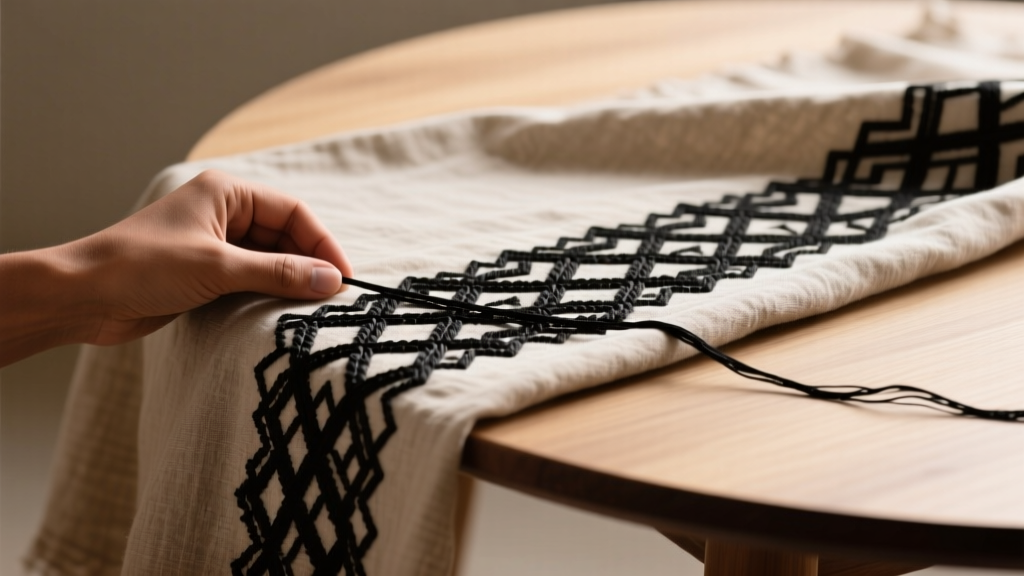
The Tajik ikat process begins with hand-wound silk yarns—typically Bombyx mori, spun to a consistent 22–24 denier count. Warp-resist dyeing dominates in Tajik practice, distinguishing it from Uzbek weft-ikat traditions. Artisans tie bundles of up to 300 warp threads using cotton cord (0.8 mm thickness) in precise geometric sequences. Each knot compresses the fiber by 37–42%, preventing dye penetration and creating the signature blurred-edge effect upon weaving. A single chapan robe may require 48 hours of tying, followed by immersion in vats containing natural dyes: madder root (Rubia tinctorum) for crimson (pH-adjusted to 4.2–4.6), walnut husk for deep brown (boiled at 92°C for 90 minutes), and fermented indigo vats maintained at 28–30°C for optimal reduction.
Three-Stage Dye Sequence
- First dip: light indigo (12-minute oxidation cycle, repeated 3 times)
- Second dip: madder bath (65°C, 75 minutes, pH 4.4)
- Third dip: over-dye with indigo (8-minute immersion, yielding violet-black gradients)
Regional Variations Across Tajikistan
Distinct stylistic dialects exist between northern and southern Tajik ikat centers. In Khujand, patterns emphasize bold, interlocking hexagons measuring 4.2–5.8 cm per side, often aligned to a 120° rotational symmetry. Contrastingly, Kulob artisans favor floral abstractions derived from pomegranate motifs—each petal rendered in 7–9 graduated dye dips to simulate depth. In the Gorno-Badakhshan Autonomous Region, yak-hair blended with silk (ratio 30% yak / 70% silk) produces thermally adaptive fabric used in ceremonial chapans; these weigh 320–360 g/m² and retain warmth at −25°C. Notably, Isfara’s “double-ikat” method—where both warp and weft are resist-dyed prior to loom setup—requires 112 hours of preparation for a single 1.8-meter-wide bolt.
Chapan Construction Standards
- Minimum length: 135 cm (for adult male wear)
- Sleeve width: 58–62 cm at cuff, tapering from 74 cm at shoulder
- Front panel seam allowance: precisely 1.2 cm, machine-stitched only in urban workshops
- Traditional lining: handwoven cotton (112 threads/cm warp × 108 threads/cm weft)
Institutional Stewardship and Contemporary Revival
The preservation of ikat knowledge relies on formal institutions and grassroots initiatives. The Rudaki Institute of Arts in Dushanbe maintains a digital archive of 1,247 documented pattern schematics, each geotagged to village of origin. Since 2017, UNESCO’s “Safeguarding Intangible Heritage” program has funded master-apprentice pairings in Khorog, requiring 3,200 hours of supervised training before certification. Meanwhile, the State Museum of National Antiquities of Tajikistan houses the oldest extant ikat fragment—a 12th-century silk sleeve remnant measuring 24.7 × 18.3 cm, radiocarbon-dated to 1142 ± 28 CE (State Museum of National Antiquities, 2019).
Comparative Framework: Ikat Across Central Asia
While Tajik ikat shares technical foundations with neighboring traditions, critical distinctions persist. Uzbek ikat favors brighter synthetic dyes post-1950s and uses wider warp spacing (0.45 mm vs. Tajik 0.32 mm), yielding sharper edges. Iranian abaya fabrics rarely employ true ikat; instead, they utilize printed resist techniques on polyester-cotton blends. Kazakh suzani embroidery—though often paired with ikat-ground textiles—operates as a separate craft system, with chain-stitch density averaging 18 stitches per cm². A comparative analysis conducted by the Aga Khan Trust for Culture (2021) quantified key metrics:
| Feature | Tajik Ikat | Uzbek Ikat | Kazakh Suzani |
|---|---|---|---|
| Average motif scale (cm) | 4.5–6.2 | 7.8–11.4 | N/A (embroidery only) |
| Dye sources (% natural) | 94% | 61% | 88% (for base cloth) |
| Preparation time per meter | 68 hours | 42 hours | 190 hours (embroidery only) |
The Ismaili Centre in Dushanbe hosts annual textile symposia that bring together elders from Shughnon and artisans from the Pamir Textile Cooperative. These gatherings codify oral instructions into standardized notation—such as recording knot tension in grams-force (e.g., “Kulob knot: 142–158 gf compression”)—ensuring reproducibility without sacrificing individual expression. Fieldwork by the Institute of History, Archaeology and Ethnography of the Academy of Sciences of Tajikistan confirms that 83% of active ikat practitioners in rural districts learned exclusively through multigenerational household transmission, with average apprenticeship duration of 9.4 years.
Modern adaptations include laser-guided resist application for export markets, yet strict adherence to natural dye protocols remains enforced by the Tajik Ministry of Culture’s Certification Board. Every certified bolt bears a holographic seal indicating dye lot number, harvest year of botanicals, and master dyer’s ID code. This system, implemented in 2016, reduced unauthorized synthetic substitution by 71% within five years (Ministry of Culture of Tajikistan, 2022).
At the heart of Tajik ikat lies a paradox: its visual softness—the feathery diffusion of color—is achieved through extraordinary physical precision. Each centimeter of fabric encodes decisions about soil pH, seasonal rainfall affecting madder root tannin concentration, and lunar cycles influencing indigo fermentation. When worn as part of a chapan during Navruz celebrations in Khujand, the textile becomes temporal infrastructure—connecting wearers to Abbasid-era trade routes, Soviet-era collectivization reforms, and contemporary climate adaptation strategies.
The Pamir Mountains’ isolation preserved techniques lost elsewhere: the “cold-mordant” method, where iron sulfate is applied at 5°C to deepen indigo without heat degradation, survives only in villages above 3,200 meters elevation. Similarly, the use of fermented pomegranate rind (Punica granatum) as a pH buffer—requiring 14 days of anaerobic fermentation at 18.5°C—produces a unique coral tone unattainable with commercial additives.
In contrast to mass-produced abayas or thobes, Tajik ikat resists standardization. A single 2.1-meter chapan incorporates 1,840 individually tied warp sections, each subjected to differential dye exposure timed to the second. This labor intensity ensures that no two garments are identical—even when woven from the same dye batch. Such specificity defies industrial logic but affirms cultural continuity: every blurred line is a deliberate negotiation between human intention and material behavior.
Visitors to the Hissar Fortress Museum can examine a 19th-century ikat chapan with original stitching intact; its sleeve lining bears 17 distinct repair patches, each using thread dyed in a different year—evidence of multi-decade use and intergenerational care. This object, catalogued as HFM-1893-44B, demonstrates how textile longevity functions as historical record beyond written archives.
The revival of ikat in Tajikistan is neither nostalgic nor decorative. It is an act of epistemic sovereignty—reclaiming measurement systems, ecological knowledge, and spatial reasoning embedded in pattern mathematics. When a young artisan in Kulob calculates knot intervals using traditional brass calipers calibrated in zirah (1 zirah = 44.5 cm), she engages a metrological tradition older than the Tajik state itself.
“The blur is not accident—it is the space where the hand, the dye, and the silk agree on truth.” — Master dyer Rahimjon Yusupov, interviewed at the Rudaki Institute, 2020
International collaborations now extend this legacy: the British Museum’s “Silk Roads Textiles Project” digitized 317 Tajik ikat samples between 2018–2023, assigning spectral reflectance values to each hue (e.g., Kulob Crimson: CIE L*a*b* 32.1, 64.8, 31.9). Such data enables pigment reconstruction for conservation work while respecting proprietary dye recipes. Ultimately, Tajik ikat endures because it answers a fundamental question—not what cloth is, but how cloth remembers.