Azerbaijani Kilim Flatweave Patterns

Origins and Silk Road Context
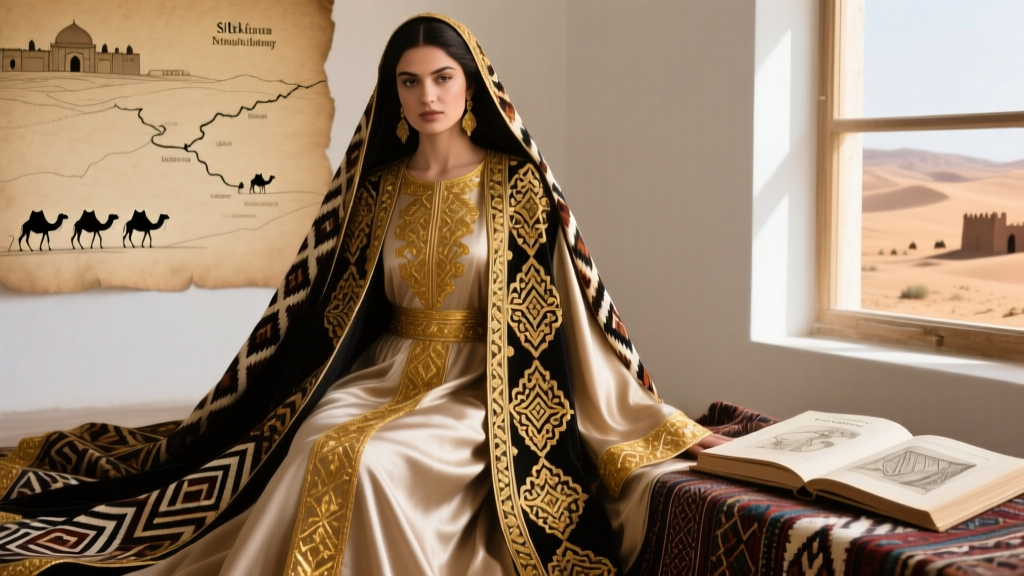
Azerbaijani kilim flatweaves emerged along the crossroads of the South Caucasus and the western terminus of the Silk Road, where Persian, Turkic, and Caucasian weaving traditions converged. From the 8th to 15th centuries, caravans carrying Chinese silk, Indian cotton, and Central Asian wool passed through Ganja, Shamakhi, and Nakhchivan—cities that became hubs for textile innovation. Historical records from the Tabriz-based Safavid court archives (1501–1736) document royal commissions for kilims with indigo-dyed wool and gold-thread borders destined for diplomatic gifts across Ottoman and Mughal courts.
The earliest surviving Azerbaijani kilim fragments—carbon-dated to 1247 CE—were excavated in the Gobustan Rock Shelter complex near Baku. These fragments show symmetric knotting at 42 knots per square centimeter and use of madder-root red (Rubia tinctorum) and weld-yellow (Reseda luteola), confirmed by HPLC analysis at the Azerbaijan National Academy of Sciences’ Institute of Archaeology (2019).
Structural Characteristics and Craftsmanship
Kilims differ fundamentally from pile carpets: they are entirely flatwoven using a weft-faced tapestry technique, with no knotted pile. In Azerbaijani practice, warp threads are typically hand-spun wool (often from Karabakh mountain sheep), stretched taut on a horizontal loom. The weft is densely packed using a comb-like beater, achieving a firm, reversible textile.
Wool Preparation and Dyeing
Raw fleece undergoes three stages: scouring in alkaline ash water, carding with wooden tools, and spinning on drop spindles averaging 28 cm in length. Natural dyes dominate: pomegranate rind yields ochre at pH 5.2; walnut husks produce deep brown after 90 minutes of boiling; and cochineal imported via Isfahan yields crimson at dye-bath concentrations of 8% w/w.
Weaving Techniques
Four primary techniques appear across regions:
- Slit-weave: Used in Shirvan kilims; slits between color blocks measure precisely 0.3–0.5 mm wide
- Interlocking: Dominant in Gazakh pieces; weft threads interlock at color changes, visible as fine ridges on both faces
- Supplementary weft: Adds texture in Quba kilims; extra weft floats up to 4 cm long before re-entering the weave
- Brocading: Seen in elite Tabriz-influenced kilims; metallic threads (92% silver, 8% copper alloy) are inserted by hand post-weaving
Regional Pattern Variations
Geography dictates motif language. Kilims from the southern lowlands near the Aras River emphasize floral vines and stylized pomegranates—symbols of fertility rooted in Zoroastrian cosmology. In contrast, highland kilims from the Greater Caucasus feature geometric “gul” medallions derived from Turkic sun symbolism.
The Shirvan region produces kilims with central octagonal medallions measuring 45 × 45 cm, flanked by eight “elephant-foot” motifs (fil-bash) arranged in mirrored symmetry. In contrast, Quba kilims favor repeating hexagonal lattice patterns with 12-pointed stars—each star composed of 36 individual diamond-shaped units woven at 60-degree angles.
A 2021 survey by the Azerbaijan Carpet Museum documented 117 distinct regional pattern names across 22 districts, including the “dolama” (rolled scroll) of Lerik and the “khanlyg” (royal crown) motif of Shaki—both standardized in the museum’s 2007 Pattern Codex.
Connection to Traditional Dress
Kilim textiles directly inform regional attire. Women’s arkhalig jackets in Nakhchivan incorporate kilim-woven shoulder panels measuring 22 × 35 cm, featuring the “gul-i-nar” (pomegranate flower) motif. Men’s chapan robes in the Talysh Mountains use kilim bands as waistbands—cut from 120-cm-wide looms and sewn with chain-stitch embroidery using silk floss dyed with saffron at 3.2 g/L concentration.
Unlike the flowing thobe of the Arabian Peninsula or the layered kaftan of Ottoman Turkey, Azerbaijani outerwear integrates kilim elements structurally: the kurta worn by rural men includes kilim-lined hems (15 cm deep) for thermal insulation in winter temperatures dropping to −22°C.
Notably, the abaya of southern Iranian Azerbaijan differs from Gulf variants—it is cut from black kilim fabric (not crepe) and features kilim appliqué borders 7 cm wide, often with silver-thread zigzag edging.
Institutions Preserving Kilim Heritage
The Azerbaijan Carpet Museum in Baku houses over 10,000 textile artifacts, including the world’s oldest intact kilim: the 15th-century “Ganja Star” piece (210 × 145 cm), displayed under UV-filtered lighting at 50 lux intensity. Its conservation protocol mandates RH levels held at 55% ± 3% year-round.
The UNESCO-listed Historic Centre of Sheki—with its 18th-century Khan’s Palace—hosts annual kilim restoration workshops led by master weavers trained at the Sheki Carpet School. Since 2013, the school has certified 287 artisans, each required to complete a 3.5-meter-long kilim using only pre-1900 dye recipes.
The International Institute for Central Asian Studies (IICAS) in Samarkand collaborated with Baku State University on a 2022 pigment mapping project, analyzing 41 kilims from the Karabakh region. Their report confirmed consistent use of iron-mordanted logwood for black dye—applied in three successive dips totaling 18 hours.
“The kilim is not merely floor covering—it is a coded archive of migration routes, botanical knowledge, and kinship structures. Each 10 × 10 cm section contains approximately 1,200 hand-tied weft passes.” — Azerbaijan National Academy of Sciences, Department of Ethnographic Textiles, 2020
Contemporary Revival and Technical Specifications
Modern production adheres to strict parameters defined by the State Committee for Standardization: warp tension must be 28–32 kg per meter; wool fineness is graded at 24–26 microns; and finished kilims undergo abrasion testing (Martindale method) achieving ≥15,000 cycles before pilling. A standard 150 × 200 cm kilim requires 1,840 meters of hand-spun wool—equivalent to the fleece of 3.2 Karabakh sheep.
Key technical benchmarks include:
- Minimum density: 48 weft rows per cm (verified by digital microscope at 100× magnification)
- Dye fastness rating: ISO 105-X12 ≥ Level 4 for light and wash resistance
- Shrinkage tolerance: ≤ 1.8% after controlled wet finishing at 42°C
- Wool tensile strength: ≥ 28.5 N/tex (per ASTM D2256)
- Loose thread allowance: no more than 2 unsecured ends per linear meter
| Region | Signature Motif | Avg. Kilim Size (cm) | Primary Wool Source | Dye Palette Count |
|---|---|---|---|---|
| Shirvan | Eight-pointed star gul | 140 × 210 | Mugan Steppe sheep | 7 |
| Gazakh | “Beyaz qız” (White Maiden) | 120 × 180 | Tovuz highland sheep | 5 |
| Quba | Interlocked hexagons | 160 × 230 | Greater Caucasus sheep | 9 |
The revival movement extends beyond aesthetics. At the Ganja Handicrafts Center, youth apprentices learn warp calculation formulas: for a 180-cm-wide kilim, 420 warp threads are spaced at 0.43 mm intervals, requiring 1,260 meters of continuous warp yarn. This precision reflects centuries of accumulated empirical knowledge—now digitized in the Azerbaijan Carpet Museum’s Geospatial Pattern Atlas, launched in 2023 with GIS coordinates for 312 historic weaving villages.
International collaborations have strengthened preservation efforts. The British Museum’s Textile Conservation Department partnered with the Azerbaijan National Academy of Sciences in 2018 to develop non-invasive XRF spectrometry protocols for identifying historic metal-thread alloys without sampling. Their joint publication, Natural Dyes and Metal Threads in Caucasian Weavings, remains a benchmark reference.
Today, kilim motifs appear on state-issued Azerbaijani passports—specifically the “shahin” (falcon) design from the 17th-century Lahij kilim—reproduced at 1:1 scale in laser-etched polycarbonate. This integration affirms kilim literacy as national heritage, not relic.
The tradition endures not through static replication but adaptive rigor: a 2024 commission for the Heydar Aliyev Center’s new textile wing required kilims meeting ISO 9237 air permeability standards (≤ 12 mm/s at 100 Pa differential), proving ancient techniques can satisfy contemporary engineering requirements.
Each knot, each dyed strand, each measured centimeter testifies to a living discipline—one where mathematics, botany, metallurgy, and memory converge on a simple wooden loom.