Central Asian Ikat: The Living Heritage of Uzbek Silk
Central Asian Ikat: The Living Heritage of Uzbek Silk
Long before the modern fashion world discovered the blurred, cloud-like patterns of ikat, artisans along the ancient Silk Road were perfecting one of humanity's most complex textile traditions. In the oasis cities of Central Asia — Bukhara, Samarkand, Margilan, and the Fergana Valley — master weavers developed a resist-dyeing technique so labor-intensive and visually mesmerizing that their fabrics became symbols of power, wealth, and cultural identity. Known locally as abrbandi (from the Persian words abr, meaning "cloud," and bandi, meaning "to tie"), Central Asian ikat represents a pinnacle of textile artistry that has survived empires, revolutions, and the relentless march of industrialization.
The story of Uzbek silk ikat is not merely a story of fabric. It is a narrative woven into the social, economic, and spiritual life of Central Asian peoples — a tradition that defined social hierarchies, sealed diplomatic alliances, and expressed the deepest aesthetic aspirations of entire civilizations. Today, as global interest in artisanal and heritage textiles continues to grow, understanding the origins, techniques, and cultural significance of Central Asian ikat has never been more important. For those exploring the broader world of Silk Road textiles and traditional garment-making, the Uzbek ikat tradition offers one of the most compelling chapters in the history of human craftsmanship.
The Historical Roots of Central Asian Ikat
The precise origins of ikat in Central Asia remain a subject of scholarly debate, but most historians trace the region's distinctive resist-dyeing tradition to the convergence of multiple cultural influences along the Silk Road. While ikat techniques appeared independently in various parts of the world — from Indonesia to South America to India — the Central Asian variant developed its own unmistakable character, shaped by the region's unique position as a crossroads of civilizations.
The earliest surviving examples of Central Asian ikat date to the late eighteenth and early nineteenth centuries, though textual and artistic evidence suggests the practice may be considerably older. Some scholars point to mural paintings in ancient Sogdian sites that appear to depict patterned silks resembling ikat, potentially pushing the tradition back to the early medieval period. What is certain is that by the era of the Bukharan Emirate and the Kokand Khanate, ikat production had become a highly organized, court-patronized industry concentrated in the cities and towns of modern-day Uzbekistan and Tajikistan.
The cities of Bukhara and Samarkand emerged as the great centers of ikat production, with Margilan in the Fergana Valley developing its own distinguished tradition. These urban workshops were often organized by religious and ethnic communities — Jewish artisans played a particularly prominent role in the dyeing processes, while Tajik and Uzbek weavers dominated the loom work. This collaborative, multi-ethnic character of ikat production reflects the cosmopolitan nature of Central Asian cities, where diverse communities contributed their specialized knowledge to a shared artistic tradition.
The Silk Road itself was instrumental in shaping the ikat tradition. Raw silk arrived from China and local sericulture operations, dyes were sourced from India, Persia, and local botanical supplies, and design motifs traveled with merchants, diplomats, and migrating peoples. The resulting textiles were truly products of interconnected civilizations — fabrics that embodied the cultural exchange and technical innovation that defined Silk Road commerce. Understanding this history enriches our appreciation of traditional silk garments and their place in global textile heritage.
The Art and Craftsmanship of Abrbandi
Creating Central Asian ikat is an extraordinarily demanding process that requires mastery of multiple specialized skills — from sericulture and yarn preparation to resist-dyeing, loom setup, and weaving. Unlike surface-printed textiles where patterns are applied to finished fabric, ikat patterns are embedded into the yarns themselves before weaving begins, requiring the artisan to visualize and calculate the final design with remarkable precision.
The Resist-Dyeing Process
The heart of the abrbandi technique lies in the meticulous binding and dyeing of warp threads. Artisans begin with bundles of raw silk warp yarns, which are stretched on a special frame. The design is then mapped out on these threads, and sections that should remain undyed in the first color are tightly bound with water-resistant material — traditionally cotton thread coated with wax or animal fat. The bound bundles are immersed in the first dye bath, typically the lightest color in the design sequence.
After the first dyeing, the bindings are selectively removed and reapplied to expose new sections of thread while protecting areas that have already received the desired color. This process is repeated for each color in the design, moving progressively from lightest to darkest. A complex ikat design might require five, six, or even seven separate dye baths, with the bindings adjusted each time. The slightest error in binding placement can distort the entire pattern, which is why master dyers — known as abrbandchi — were among the most respected artisans in Central Asian society.
Traditional dyes were derived from natural sources: pomegranate rinds and saffron for yellows, madder root for reds and oranges, indigo for blues, and walnut husks for browns and blacks. The knowledge of dye preparation — including the use of mordants to fix colors and the precise timing of immersion — was closely guarded within families and guilds. The depth and luminosity achieved with these natural dyes remain difficult to replicate with synthetic alternatives, which is one reason antique Central Asian ikats are so prized by collectors and museums.
Weaving and Finishing
Once the warp threads are fully dyed and dried, they are mounted on the loom — a process that itself requires extraordinary care, as each thread must be positioned precisely to ensure the pattern aligns correctly. Central Asian ikat is typically a warp-faced weave, meaning the warp threads dominate the surface of the fabric and carry the entire design. The weft threads, often undyed or simply colored, serve primarily to hold the structure together.
The characteristic "blurred" edges of ikat patterns — the quality that gives abrbandi its "cloud" name — are an inherent feature of the technique rather than a flaw. As the weaver passes the shuttle through the warp, slight shifts in thread positioning create the soft, feathered boundaries between colors that make ikat so visually dynamic. Master weavers minimize this blurring through exceptional skill, but a certain degree of softness in the pattern edges is considered an essential part of ikat's aesthetic character and a mark of its handcrafted authenticity.
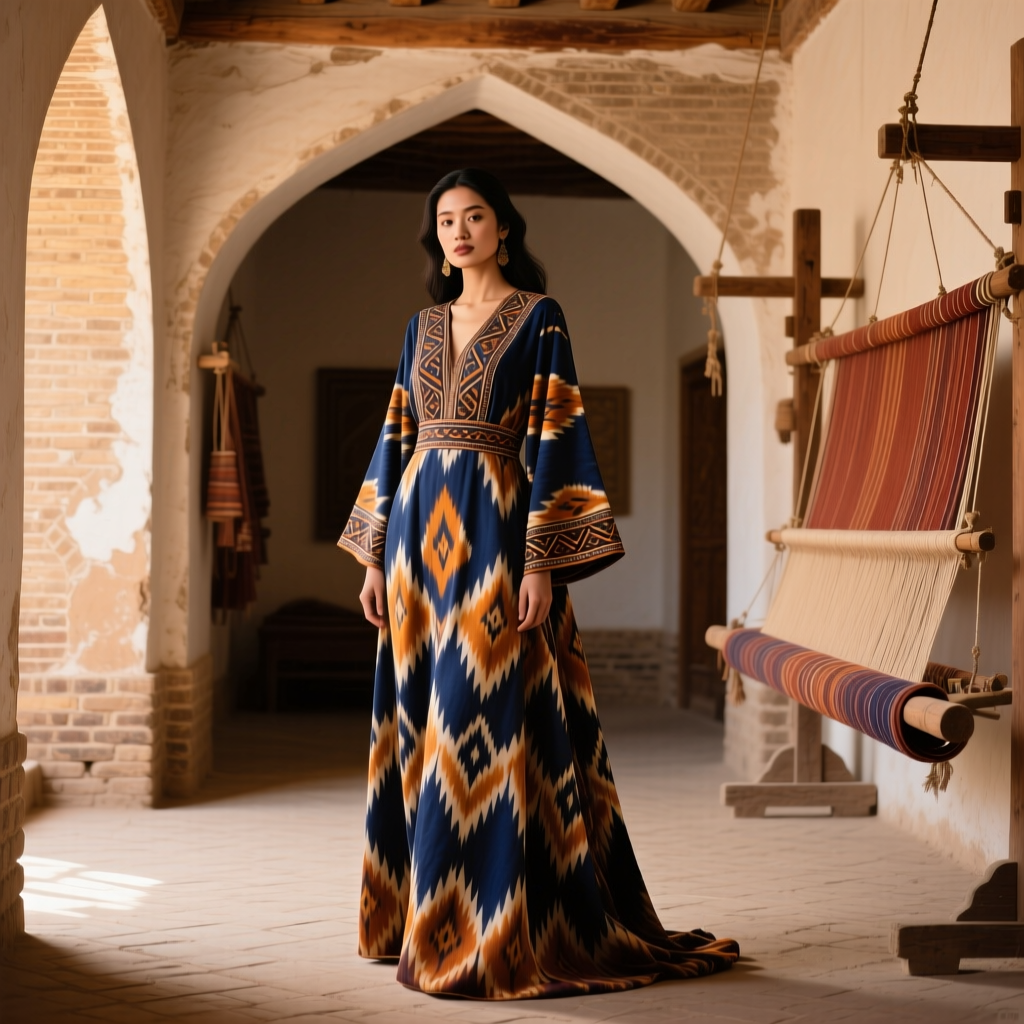
The finished fabric, known as khan atlas when made entirely of silk or adras when woven with a silk warp and cotton weft, was traditionally produced in narrow widths suitable for the construction of robes, known as chapan, and other Central Asian garments. The narrow loom widths meant that creating a single robe might require joining multiple panels of ikat, with the pattern alignment across seams serving as another indicator of the tailor's skill. Those interested in how these fabrics were transformed into clothing can explore our guide to traditional robes of Central Asia.
Cultural Significance and Social Meaning
In pre-modern Central Asian society, ikat textiles were far more than decorative fabrics — they functioned as a complex visual language that communicated social status, ethnic identity, regional origin, and ceremonial significance. The wearing and gifting of ikat robes was governed by elaborate social conventions, and the fabrics themselves were considered appropriate offerings for diplomatic exchanges, wedding gifts, and religious endowments.
Robes of Power and Prestige
The most visible expression of ikat's social significance was the khal'at system — the practice of bestowing robes of honor upon officials, diplomats, and distinguished visitors. A ruler's gift of an ikat robe signaled political favor and established relationships of patronage and loyalty. The quality and complexity of the ikat directly reflected the rank of the recipient and the importance of the occasion. Court workshops produced the finest grades of silk ikat specifically for this purpose, with some designs reserved exclusively for the emir and his immediate family.
Beyond the court, ikat garments played essential roles in life-cycle ceremonies across Central Asian society. Brides received ikat textiles as part of their dowries, and special patterns were associated with weddings, births, and religious holidays. In many communities, a family's social standing could be assessed by the quality and quantity of ikat textiles displayed during celebrations and stored in the household. The tradition of passing down ikat robes and hangings through generations created a material archive of family history that connected individuals to their ancestors and cultural heritage.
Spiritual and Symbolic Dimensions
The patterns woven into Central Asian ikat were not merely decorative — many carried symbolic meanings rooted in pre-Islamic traditions, Sufi mysticism, and folk beliefs. Common motifs included stylized representations of pomegranates (symbolizing fertility and abundance), peppers (believed to ward off the evil eye), tulips (representing spring and renewal), and geometric medallions that some scholars interpret as cosmological diagrams. The very name abrbandi — "cloud-tying" — carries spiritual resonance, as clouds in Central Asian poetic and religious traditions are associated with divine blessing, mercy, and the life-giving rain that sustains agriculture in the region's arid landscapes.
Some researchers have suggested that the repetitive, meditative process of binding and dyeing ikat threads carried its own spiritual significance for the artisans, connecting the craft to broader traditions of contemplative practice in Central Asian Sufism. Whether or not this interpretation is historically accurate, it is clear that the creation and use of ikat textiles was embedded in a rich web of cultural meaning that extended far beyond the purely material or economic.
Regional Variations Across Central Asia
While Central Asian ikat shares a common technical foundation, distinct regional traditions developed across the cities and valleys of modern-day Uzbekistan, Tajikistan, and Kyrgyzstan. These variations encompass differences in color palette, pattern composition, weave structure, and preferred fiber combinations — each reflecting local aesthetic preferences, available materials, and historical influences.
Bukhara: The Imperial Workshop
As the capital of the Bukharan Emirate, Bukhara developed perhaps the most refined and complex ikat tradition in Central Asia. Bukharan ikats are characterized by bold, large-scale patterns with dramatic color contrasts — deep crimsons, rich purples, vibrant yellows, and striking blacks set against undyed silk. The patterns often feature large, symmetrical medallions and bold geometric forms that create a powerful visual impact. The Jewish community of Bukhara was particularly renowned for expertise in dyeing, and their contributions to the city's ikat tradition were substantial.
Bukharan workshops also produced ikat velvets — an exceptionally difficult technique in which the resist-dyed warp is woven into a pile fabric. These luxurious textiles, used for the finest robes and ceremonial hangings, represent the absolute pinnacle of Central Asian textile artistry and are among the rarest and most valuable of all ikat textiles.
Samarkand: Elegance and Restraint
Samarkand's ikat tradition reflects the city's character as a center of learning and refined culture. Samarkandi ikats tend toward more restrained palettes and smaller, more intricate pattern repeats compared to the bold compositions of Bukhara. Soft blues, gentle greens, and warm earth tones predominate, with patterns that often feature flowing, vine-like motifs and delicate botanical forms. The Tajik weavers who dominated Samarkand's textile workshops brought their own aesthetic sensibilities to the tradition, creating a distinctive regional style that is immediately recognizable to knowledgeable observers.
Margilan and the Fergana Valley
Margilan, located in the fertile Fergana Valley, developed a thriving ikat tradition that differed in important ways from the urban workshops of Bukhara and Samarkand. Margilani ikats often feature lighter, more airy compositions with generous use of white and undyed silk. The patterns tend to be smaller in scale and more densely repeated, creating a shimmering, all-over effect that differs markedly from the bold medallion compositions of Bukhara. The Fergana Valley's strong tradition of sericulture ensured a ready supply of high-quality local silk, and Margilani weavers became known for the exceptional fineness and luster of their fabrics.
The Fergana Valley tradition also included distinctive adras fabrics — ikats woven with silk warps and cotton wefts — that were more affordable and practical for everyday use than pure silk khan atlas. These mixed-fiber textiles allowed ikat patterns to reach a broader segment of the population and helped sustain the tradition during periods when pure silk production faced economic challenges. Today, Margilan remains one of the most active centers of ikat production in Central Asia, with workshops that continue to use traditional techniques while adapting to contemporary markets.
Modern Preservation and the Future of Uzbek Ikat
The twentieth century posed existential threats to the Central Asian ikat tradition. Soviet industrialization policies favored mass-produced textiles over handcrafted fabrics, and the complex social structures that had sustained ikat production — the court patronage system, guild organizations, and traditional ceremonial practices — were dismantled or profoundly transformed. Many master artisans emigrated, particularly the Jewish communities of Bukhara and Samarkand who relocated to Israel and the United States, taking irreplaceable technical knowledge with them.
Despite these challenges, the ikat tradition never entirely disappeared. In workshops across Uzbekistan, dedicated artisans continued to practice abrbandi techniques, often adapting their production to meet Soviet-era demands while preserving core skills and knowledge. The post-independence period brought renewed interest in national heritage and traditional crafts, and ikat experienced a significant revival as both a symbol of Uzbek cultural identity and a commercially viable artisanal industry.
Contemporary Revival Efforts
Today, a combination of government support, international cultural heritage initiatives, and entrepreneurial artisan workshops is driving a renaissance in Central Asian ikat production. Organizations such as UNESCO and various cultural heritage foundations have recognized the importance of preserving abrbandi techniques, providing funding and training programs to support master artisans and apprentices. In Uzbekistan, the government has promoted ikat as a symbol of national heritage, featuring the textile prominently in cultural festivals, diplomatic gifts, and tourism promotion.
Private workshops and social enterprises have also played a crucial role in the revival. Organizations like the Margilan Craft Development Centre and various family-run ateliers have invested in training new generations of weavers and dyers, ensuring that the specialized knowledge required for high-quality ikat production is transmitted to younger artisans. These initiatives often combine traditional techniques with contemporary design sensibilities, creating ikat fabrics that appeal to modern fashion and interior design markets while maintaining the integrity of the craft.
Ikat in Contemporary Fashion and Design
The global fashion industry's growing appreciation for artisanal textiles has created new opportunities and new challenges for Central Asian ikat producers. International designers have incorporated ikat patterns and fabrics into luxury collections, raising the profile of the tradition and creating demand for authentic, handcrafted textiles. This international attention has provided economic incentives for continued production and has helped sustain artisan communities.
However, the popularity of ikat has also led to widespread imitation — industrially printed fabrics that mimic the appearance of true ikat without the labor-intensive resist-dyeing process. For consumers and designers who value authenticity and wish to support genuine artisanal production, understanding the difference between true ikat and printed imitations is essential. True ikat can be identified by examining the reverse side of the fabric (where the pattern should be visible, though softer, since the design is embedded in the yarns) and by observing the characteristic feathered edges of the pattern motifs. Those interested in building an authentic wardrobe rooted in textile heritage may find our heritage textile wardrobe guide a valuable resource for incorporating genuine artisanal fabrics into contemporary style.
The future of Central Asian ikat depends on a delicate balance between preservation and adaptation. The tradition must remain economically viable for artisans to continue practicing it, which requires access to markets and fair compensation for highly skilled labor. At the same time, the core techniques and aesthetic principles that define abrbandi must be safeguarded against dilution and loss. Supporting organizations that work directly with artisan communities, purchasing authentic handcrafted ikat rather than printed imitations, and educating consumers about the cultural value of this tradition are all essential contributions to its survival.
Frequently Asked Questions
What is the difference between ikat and other resist-dyeing techniques like batik or tie-dye?
While ikat, batik, and tie-dye all use resist methods to create patterns on textiles, they differ fundamentally in what is being resisted and when. In ikat, the yarns themselves are bound and dyed before weaving, so the pattern is integral to the structure of the fabric. In batik, wax is applied to the surface of a finished woven fabric to resist dye penetration. In tie-dye, finished fabric is bound, folded, or stitched to create resist patterns during dyeing. Ikat is generally considered the most technically demanding of these methods because the artisan must visualize and calculate the final woven pattern while working with loose, un-woven threads. For a deeper exploration of how different textile traditions compare, visit our guide to global resist-dyeing traditions.
How can I tell if a fabric is genuine handwoven Central Asian ikat?
Several characteristics distinguish genuine handwoven ikat from machine-made or printed imitations. First, examine both sides of the fabric — true ikat will show the pattern on both the front and back, though the reverse side will appear softer and less defined. Printed fabrics typically show the pattern only on one surface. Second, look closely at the edges of pattern motifs — authentic ikat will have the characteristic feathered or blurred edges that result from slight shifts in warp thread positioning during weaving. Sharp, perfectly defined edges suggest a printed fabric. Third, genuine handwoven ikat may show slight irregularities in thread spacing and pattern alignment that are natural results of handcraft production. Finally, authentic Central Asian ikat is typically woven in relatively narrow widths, usually no more than 40-60 centimeters, reflecting the dimensions of traditional handlooms.
What is the difference between khan atlas and adras?
Khan atlas refers to ikat fabric woven entirely from silk — both the warp (pattern-carrying threads) and the weft (crosswise threads) are silk. This produces the most luxurious and luminous ikat textiles, with a characteristic sheen and drape that only pure silk can achieve. Adras, by contrast, combines a silk warp with a cotton weft. The cotton weft creates a slightly matte, more structured fabric that is more durable and affordable than pure silk khan atlas while still displaying the vibrant ikat patterns carried by the silk warp. Historically, khan atlas was reserved for the wealthy and for ceremonial use, while adras was worn by a broader segment of society. Both types are still produced in Central Asian workshops today.
Why were Jewish artisans so important to Central Asian ikat production?
The Bukharan Jewish community played a disproportionately significant role in Central Asian ikat production, particularly in the dyeing stage of the process. Jewish artisans in Bukhara and Samarkand were renowned for their mastery of complex dyeing techniques, including the preparation of natural dyes and the precise application of mordants. This specialization likely developed because the dyeing trade was compatible with Jewish communal life — it could be practiced near the home and synagogue, and the scheduling of work could accommodate Sabbath and holiday observances. When large numbers of Bukharan Jews emigrated in the late twentieth century, much of this specialized knowledge left with them, creating a significant gap in the transmission of traditional dyeing expertise that preservation efforts are still working to address.
How should I care for authentic Central Asian ikat textiles?
Authentic handwoven ikat, particularly pure silk khan atlas, requires careful handling to preserve its beauty and structural integrity. Dry cleaning is generally recommended for silk ikat garments and textiles, as water immersion can cause colors to bleed and the fabric to shrink or distort. If gentle hand washing is necessary for adras (silk-cotton blend) fabrics, use cool water and a mild, pH-neutral detergent, and avoid wringing or twisting the fabric. Store ikat textiles away from direct sunlight, which can fade natural dyes over time, and avoid prolonged folding along the same lines, which can weaken fibers. For antique or vintage ikat pieces, consultation with a textile conservator is advisable before any cleaning or repair work. Proper care ensures that these heritage textiles can be enjoyed and passed down through generations, honoring the extraordinary craftsmanship invested in their creation. For more guidance on maintaining heritage garments, see our textile care and maintenance guide.