The Enduring Legacy of Al Sadu: Bedouin Tent Weaving Heritage
The Enduring Legacy of Al Sadu: Bedouin Tent Weaving Heritage
The vast, sweeping dunes of the Arabian Peninsula and the Levant have long been home to the Bedouin, a nomadic people whose survival, culture, and identity are inextricably linked to the harsh desert environment. At the very heart of this nomadic existence lies Al Sadu, an ancient and intricate weaving tradition that has provided shelter, warmth, and a profound canvas for cultural expression for countless generations. More than just a method of textile production, Al Sadu is the visual language of the desert, a testament to the resilience and creativity of the women who have kept its rhythms alive against the backdrop of shifting sands.
To understand Al Sadu is to understand the soul of the Bedouin. The textiles born from this craft are most famously utilized in the creation of the Bayt Al Sha'ar (the house of hair), the traditional black desert tent that serves as a mobile sanctuary. Yet, the reach of Sadu extends far beyond the tent itself. It encompasses floor cushions, saddlebags, camel trappings, and dividing screens, all adorned with striking geometric patterns that tell stories of the natural world, tribal lineage, and the spiritual beliefs of their creators. As we explore the depths of this remarkable heritage, we uncover a craft that bridges the ancient nomadic past with a continuously evolving cultural present.
The Cultural Significance of the Bayt Al Sha'ar
In the traditional Bedouin social structure, the Bayt Al Sha'ar is far more than a mere shelter from the relentless sun and biting sandstorms; it is a profound social institution and a symbol of hospitality, honor, and familial pride. The tent is constructed from long, narrow strips of Sadu weaving, stitched together to form a massive, breathable canopy. The dark color, typically derived from the natural black and brown hair of goats and camels, absorbs the sun's heat during the chilly desert mornings while the tightly woven, weft-faced fabric swells when wet, rendering it completely waterproof during rare but intense desert downpours.
The interior of the tent is meticulously divided by a beautifully woven screen known as the qata. This screen separates the majlis, the public reception area for men and guests where coffee is served and tribal affairs are discussed, from the private inner sanctum reserved for women and children. The qata is often the most ornately decorated of all Sadu pieces, featuring complex motifs, tassels, and sometimes even small mirrors or metallic threads, serving as a visual testament to the weaving prowess and artistic vision of the women of the household.
Weaving is fundamentally a female domain in Bedouin society, and the transmission of Al Sadu knowledge is a deeply intimate, matrilineal process. Mothers teach their daughters the intricate mathematics of pattern counting, the physical endurance required to tension the loom, and the symbolic vocabulary of the motifs. The rhythmic clacking of the wooden loom beater and the communal singing or poetry recitation that often accompanies the weaving process create a social space where women bond, share news, and preserve the oral history of their tribe. Through Al Sadu, women hold the architectural and aesthetic keys to the nomadic home, granting them a vital and respected role in the socio-economic fabric of the desert.
The Craftsmanship and Materials of Al Sadu
The creation of an authentic Al Sadu textile is a labor-intensive journey that begins with the flora & fauna of the desert landscape. The primary materials are the wool of Awassi or Najdi sheep, the hair of camels, and the coarse hair of goats. Each material is selected for its specific structural properties. Goat hair, being exceptionally strong and durable, is primarily used for the warp threads and the main structural panels of the tent. Camel hair provides excellent insulation and is often used for winter garments and saddlebags, while sheep's wool, being the softest and most receptive to dyes, is reserved for the intricate, colorful decorative bands.
Once the raw fibers are sheared and gathered, they undergo a rigorous cleaning and carding process to align the strands. The spinning is done using a mighzal, a simple drop spindle made of wood, which the weaver twirls with practiced dexterity to twist the fibers into strong, continuous yarn. The quality of the spin dictates the quality of the weave; uneven yarn will result in a weak textile that cannot withstand the brutal tension of the desert loom. For those interested in the broader history of fiber preparation, our textile loom history guide offers a deeper dive into ancient spinning technologies.
While the base of the tent remains the natural black and brown of the animal fibers, the decorative bands are brought to life using vibrant dyes. Historically, Bedouin weavers relied on natural dyeing methods, sourcing indigo for deep blues, madder root for rich reds, and saffron or pomegranate rinds for yellows and oranges. The dyeing process requires an intimate knowledge of botany and chemistry, utilizing local desert plants and trade-route spices to achieve colorfastness that can endure decades of harsh sunlight.
The weaving itself takes place on a horizontal ground loom, or nol, which is staked directly into the earth. This low-to-the-ground setup is perfectly adapted to the nomadic lifestyle, as it can be easily rolled up and transported. The weaver sits on the ground, using her body weight to maintain the immense tension required for a weft-faced plain weave. The weft threads are packed down so tightly with a heavy wooden beater (the madraj) that the warp threads are completely hidden, resulting in a dense, ribbed fabric that is highly resistant to wind and sand. The physical toll of this craft is immense, requiring incredible upper body strength, endurance, and an unyielding attention to detail.
Symbolism and Regional Variations in Sadu Patterns
The visual language of Al Sadu is written in geometry. Because the horizontal ground loom and the weft-faced technique naturally lend themselves to straight lines and angular shapes, the motifs are inherently abstract. However, to the trained eye of a Bedouin weaver, these geometric forms are deeply representational, drawing direct inspiration from the surrounding desert environment, the tools of daily life, and the spiritual realm. The patterns are not merely decorative; they serve as tribal identifiers, protective talismans, and historical records.
Common motifs include the snanah (the teeth of the camel), representing strength and survival; the dallah (the traditional Arabic coffee pot), symbolizing hospitality and generosity; and the shajarah (the tree of life), denoting growth, fertility, and deep roots. Triangles often represent the sand dunes or the peaks of the mountains, while zigzag lines mimic the flowing water of a wadi or the tracks left by a snake in the sand. The arrangement of these motifs follows a strict, inherited mathematical logic, where the repetition and mirroring of shapes create a sense of infinite harmony and balance.
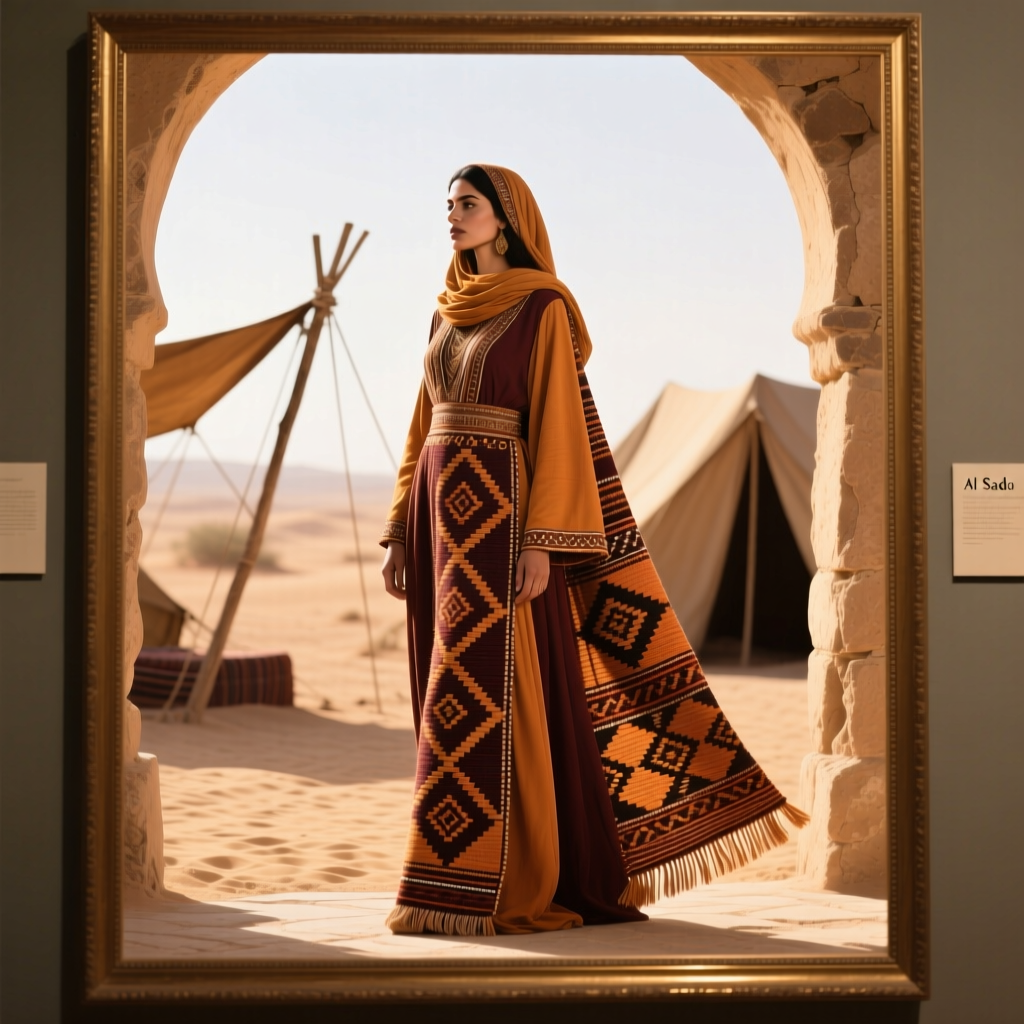
While the foundational techniques remain consistent, regional variations in Al Sadu are distinct and highly prized by collectors and historians. In the Najd region of the Arabian Peninsula, weavers traditionally favor stark, high-contrast palettes of black, white, and deep red, with wide, bold geometric bands. In contrast, the Bedouin tribes of the Levant and the Sinai Peninsula often incorporate a wider spectrum of colors, including vibrant pinks, oranges, and greens, reflecting historical access to diverse trade routes and different local flora. The Sinai weavers are also renowned for their intricate use of cross-stitch embroidery overlaid onto the woven Sadu bands, a technique that adds an extra layer of texture and visual complexity.
These regional and tribal distinctions allowed travelers to identify the origins of a tent or a caravan from a great distance. The specific combination of colors, the width of the bands, and the sequence of the motifs acted as a woven passport, communicating the weaver's lineage, social status, and tribal alliances before a single word was spoken. For a closer look at how camel hair specifically influences these regional textiles, explore our guide to camel hair textiles.
From Nomadic Necessity to Modern Preservation
The modern era has brought profound changes to the traditional Bedouin way of life. The widespread adoption of motorized vehicles, the establishment of national borders, and the rapid urbanization of the Gulf and Levant regions have led to a significant decline in full-time nomadic pastoralism. As the Bayt Al Sha'ar was gradually replaced by concrete homes and modern canvas tents, the utilitarian need for massive, hand-woven Sadu panels diminished. The grueling physical labor required to produce these textiles, coupled with the availability of cheap, mass-produced synthetic alternatives, pushed the craft to the brink of extinction.
Recognizing the imminent threat to this vital cultural heritage, various governmental and grassroots organizations have stepped in to preserve and revitalize Al Sadu. The establishment of specialized weaving cooperatives and cultural centers has provided a platform for elder weavers to pass on their skills to a new generation. These initiatives not only safeguard the technical knowledge of the craft but also provide sustainable economic opportunities for women in rural and semi-urban communities. The inscription of Al Sadu on the UNESCO Representative List of the Intangible Cultural Heritage of Humanity has further elevated its global profile, recognizing it as a masterpiece of human creative genius.
Today, Al Sadu is experiencing a renaissance, transitioning from a purely nomadic necessity to a celebrated element of contemporary art, fashion, and interior design. Modern designers are collaborating with traditional weavers to integrate Sadu motifs and techniques into haute couture, luxury home decor, and architectural installations. This fusion of ancient heritage and modern aesthetics ensures that the visual language of the desert remains relevant and visible. Those interested in how traditional desert textiles influence modern clothing can find inspiration in our desert apparel guide.
Furthermore, the preservation of Al Sadu extends to the careful conservation of vintage textiles. Museums and private collectors now treat antique Sadu tent panels and qata screens as fine art, employing specialized wool garment care and textile conservation techniques to halt degradation. By valuing these pieces not just as ethnographic artifacts, but as masterworks of textile engineering and abstract art, society ensures that the poetic voice of the Bedouin weaver continues to echo through the corridors of time.
Frequently Asked Questions
What does the word Al Sadu mean?
The term 'Al Sadu' is derived from the Arabic root word 'sada', which translates roughly to 'to weave' or 'to braid'. In the context of Bedouin culture, it refers specifically to the traditional weft-faced weaving technique used to create the heavy, durable textiles required for desert tents, animal trappings, and household furnishings. It encompasses both the physical act of weaving and the distinct geometric style of the resulting patterns.
How long does it take to weave a traditional Bedouin tent?
The creation of a full-sized Bayt Al Sha'ar is a monumental task that can take several months to over a year, depending on the size of the tent, the number of women working on it, and the complexity of the decorative bands. Because the weaving is done on a narrow ground loom, the tent must be constructed from multiple long strips that are later stitched together. It is often a communal effort, with women from extended families gathering to weave, spin, and assemble the massive structure.
What materials are used in authentic Sadu weaving?
Authentic Al Sadu relies entirely on natural, locally sourced animal fibers. The primary materials include the coarse hair of black goats (used for the structural warp and main tent panels due to its strength and water-resistant properties), the soft wool of desert sheep (used for the colorful, decorative weft threads), and camel hair (prized for its insulation and used in saddlebags and winter garments). Natural dyes derived from plants, minerals, and insects are traditionally used to color the sheep's wool.
How can I identify genuine vintage Al Sadu textiles?
Genuine vintage Al Sadu can be identified by several key factors. First, examine the material; authentic pieces will use hand-spun wool, goat hair, or camel hair, which have a distinct, slightly irregular texture compared to machine-spun commercial yarns. Second, look at the dyes; vintage pieces often feature the muted, complex tones of natural dyes like indigo and madder, rather than the harsh, uniform brightness of synthetic aniline dyes. Finally, inspect the weave; traditional Sadu is incredibly dense and heavy, with the warp threads completely hidden by the tightly beaten weft. For more tips on identifying and caring for heritage textiles, visit our heritage archives.
Is Al Sadu weaving still practiced today?
Yes, Al Sadu is still practiced today, though its context has evolved. While it is no longer a widespread necessity for daily nomadic survival, it is actively preserved through cultural heritage programs, women's cooperatives, and specialized weaving schools across the Gulf and the Levant. Contemporary weavers often create smaller, more manageable pieces such as wall hangings, cushion covers, and fashion accessories, blending traditional motifs with modern color palettes to keep the craft economically viable and culturally relevant.