South Asian Dress: Regional Variants and Ties

The Global Tapestry: Defining South Asian Traditional Dress
While the study of European folk dress often focuses on indigenous tailoring and regional embroidery, no sartorial tradition exists in a vacuum. The history of European regional costumes is inextricably linked to the global textile trade, particularly the profound influence of south asian traditional dress. From the chintz craze of the 17th century that revolutionized European peasant bodices, to the Kashmiri shawls that birthed the Scottish Paisley motif, understanding South Asian garments provides crucial context for global textile history. This comparative analysis explores the construction, regional variants, and cross-cultural echoes of South Asian dress, offering a unique lens through which to view both Eastern heritage and Western folk adaptations.
Core Garments and Construction
South Asian traditional dress is defined by its diversity, shaped by climate, religion, and indigenous weaving techniques. The foundational garments include the sari (an unstitched drape), the salwar kameez (a tunic and trouser ensemble), and the lehenga choli (a stitched skirt and blouse). Unlike the heavily tailored and structured garments of 19th-century European folk dress, traditional South Asian clothing often relies on the mathematics of the loom and the geometry of the drape. The preservation of the fabric's integrity—leaving it unstitched so it can be passed down through generations regardless of body size—mirrors the utilitarian draping found in ancient European garments, though South Asian traditions maintained this practice continuously into the modern era.
Draped Elegance: The Sari and the Scottish Arisaid
The sari is perhaps the most iconic element of south asian traditional dress. Consisting of a single piece of fabric ranging from five to nine yards in length, the sari is wrapped, pleated, and pinned without the use of buttons or zippers. Regional variants dictate the drape: the Nivi drape (originating in Andhra Pradesh) features front pleats and a pallu (loose end) thrown over the left shoulder, while the Coorg drape (Kodagu) features reverse pleats and a pallu pinned at the back shoulder, allowing for movement in hilly terrains.
From a comparative folk-dress perspective, the sari shares functional DNA with the Scottish women's earasaid (arisaid). Worn in the Highlands through the 18th century, the earasaid was a large, unstitched expanse of tartan wool that was belted at the waist and pinned at the shoulder, serving as both a garment and a weather-proof wrap. Both the sari and the earasaid represent a brilliant adaptation to local climates using continuous yardage, eliminating the need for complex tailoring while allowing the wearer to adjust the garment's insulation and modesty on the fly. According to the Victoria and Albert Museum's extensive textile archives, the evolution of the sari's drape was heavily influenced by both indigenous modesty norms and the introduction of the tailored choli (blouse) during various periods of trade and colonization.
Embroidered Narratives: Phulkari vs. The Vyshyvanka
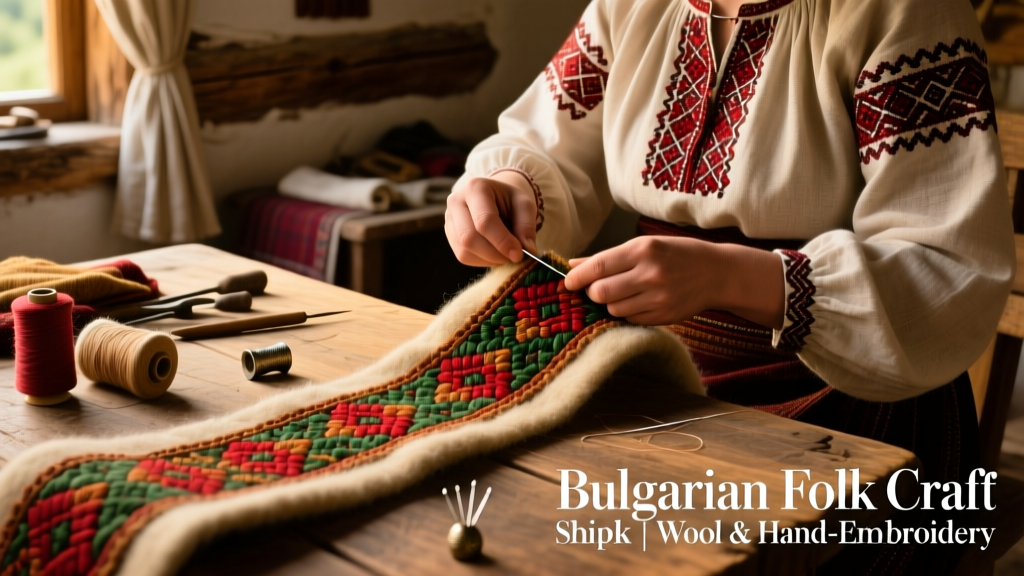
Embroidery in South Asia is not merely decorative; it is a geographic identifier and a protective talisman. In the Punjab region, Phulkari (literally 'flower work') is embroidered on handspun khaddar cotton using brightly colored floss silk. The stitches are worked from the reverse side of the fabric, creating a dense, shimmering geometric or floral pattern on the front. Traditionally, Phulkari shawls and odhnis (veils) were created by grandmothers and mothers for their daughters' dowries, encoding blessings and regional identity into every stitch.
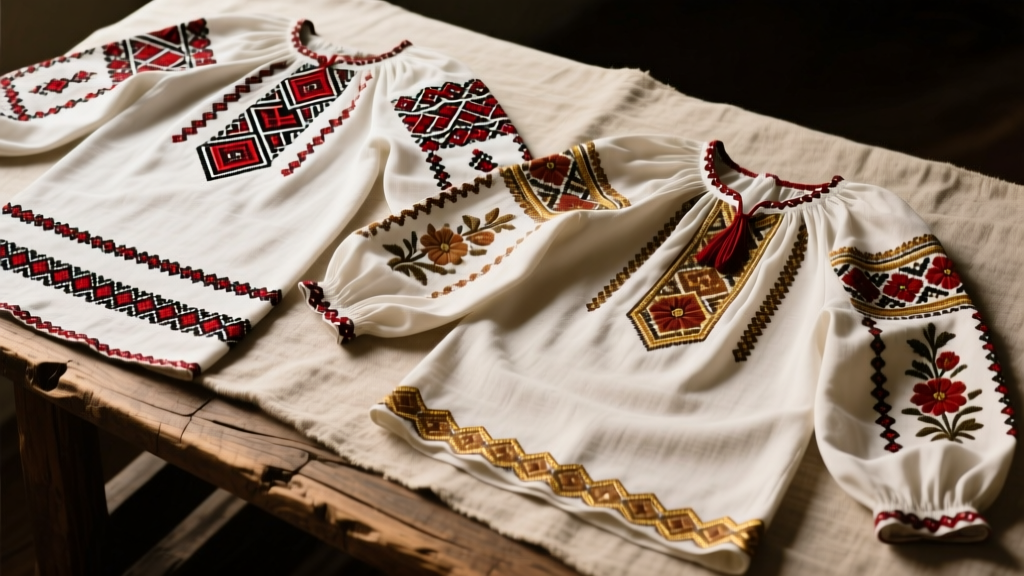
This tradition bears a striking sociological and technical resemblance to the Eastern European vyshyvanka (Ukrainian) or ie (Romanian). In these European folk traditions, geometric cross-stitch and darning patterns were also worked on indigenous linen and hemp. Both Phulkari and the vyshyvanka utilize specific color palettes (red and white in Eastern Europe; mustard, magenta, and orange in Punjab) believed to ward off the evil eye and protect the wearer's vital organs. The Metropolitan Museum of Art notes that these parallel developments in protective embroidery highlight a universal human tendency to encode spiritual safeguarding into the very garments that cover the body's core.
The Kashmiri Shawl and the Birth of Paisley
No discussion comparing South Asian and European dress is complete without the Kashmiri shawl. Woven from the ultra-fine undercoat of the Changthangi goat (pashmina), these shawls were historically woven using the Kani technique, where small wooden bobbins are manipulated like a tapestry to create intricate patterns. The quintessential motif was the buta—a curved, mango-like cypress shape symbolizing life and eternity.
When European merchants brought these shawls back to France and Britain in the late 18th century, they became the ultimate status symbol, often incorporated into European regional dress as prestigious wedding accessories. The demand quickly outstripped supply, leading weavers in Paisley, Scotland, to reverse-engineer the buta motif using the newly invented Jacquard loom. The resulting 'Paisley' pattern became a staple of European folk accessories, permanently embedding a South Asian design philosophy into Western sartorial heritage.
Comparative Matrix: Regional Variants and Textile Lineages
| Garment / Textile | South Asian Region | Primary Material & Technique | European Folk Counterpart / Influence |
|---|---|---|---|
| Sari (Kanjeevaram) | Tamil Nadu, South India | Mulberry silk, heavy gold zari brocade, interlocking warp borders | French Lyon silk brocades used in regional festival bodices |
| Mekhela Chador | Assam, Northeast India | Muga (golden silk) or Eri silk, cylindrical two-piece drape | Functionally similar to the wrapped skirts of Baltic folk dress |
| Phulkari Odhni | Punjab, India/Pakistan | Handspun cotton, silk floss darning stitch from the reverse | Eastern European cross-stitch protective blouses (Vyshyvanka) |
| Kani Shawl | Kashmir, Himalayas | Pashmina wool, tapestry weave using wooden bobbins | Scottish Paisley shawls, Jacquard-woven regional wraps |
| Chikankari Kurta | Lucknow, Uttar Pradesh | Muslin or cotton, white-on-white shadow-work embroidery | Whitework embroidery of Madeira and traditional Swiss folk dress |
Buyer’s Guide: Sourcing Authentic Garments
For collectors, cultural practitioners, and historians, sourcing authentic south asian traditional dress requires an understanding of textile composition and artisan cooperatives. The market is currently flooded with mass-produced, synthetic imitations that undermine indigenous weavers.
Price Ranges and Fabric Identification
- Authentic Banarasi Silk Sari: Woven in Varanasi using silk and metallic zari threads. Expect to pay between $150 and $2,500+ USD depending on the density of the brocade and the purity of the silver/gold zari. A genuine handloom piece will have slight irregularities and a distinct 'reverse' side with floating threads.
- Hand-Embroidered Phulkari: Sourced directly from artisan cooperatives in Patiala or Amritsar. A genuine hand-stitched vintage or contemporary Phulkari dupatta ranges from $120 to $400 USD. Machine-made versions, often sold for $25, lack the reverse-side darning structure.
- Assamese Muga Silk Mekhela Chador: Muga silk is geographically indicated (GI) and naturally golden. Authentic sets cost between $200 and $800 USD. Beware of artificially dyed polyester marketed as Muga; real Muga has a subtle, warm luster and softens with washing.
When purchasing, always request the 'burn test' certification or buy from certified GI-tagged cooperatives. The Royal Ontario Museum's textile conservation guidelines emphasize that natural fibers like silk and cotton will turn to ash and smell like burning hair or paper, whereas synthetic fast-fashion alternatives will melt into hard plastic beads.
Cultural Protocols and Wearing Etiquette
Wearing south asian traditional dress, particularly outside of its native context, requires cultural sensitivity and respect. Unlike European folk costumes, which are often reserved for specific national holidays or festivals, South Asian garments like the sari and salwar kameez are living, everyday traditions worn by millions of women globally.
If you are invited to a South Asian wedding or cultural event and choose to wear a sari or lehenga, ensure the drape is respectful. The pallu (the decorative end of the sari) should be draped securely over the shoulder or head, depending on the regional custom and the formality of the event. Avoid pairing traditional garments with overly revealing alterations or treating the attire as a 'costume.' Furthermore, accessories like the bindi or maang tikka hold cultural and sometimes spiritual significance; they should be worn with an understanding of their context rather than as mere aesthetic props. By approaching these garments with the same reverence and historical curiosity applied to the study of European folk dress, we honor the living artisans and the profound global legacy of South Asian textiles.