The National Costume of China: Hanfu and Qipao Deep Dive
Beyond Borders: Why the National Costume of China Matters to Global Textile History
While The Garment Atlas primarily catalogs European folk dress and regional traditions, tracing the national costume of China is essential for understanding the broader global textile trade. The historic Silk Road did not merely transport goods; it fundamentally altered European sartorial DNA. The damasks, brocades, and silks that defined Renaissance court fashions and Eastern European folk embroidery originated from Chinese looms. To truly grasp global garment history, one must study the Eastern pillars of textile-making. Today, the concept of a singular Chinese national costume is beautifully complex, primarily represented by two distinct garments: the ancient Hanfu and the modern Qipao (Cheongsam). This deep dive explores their structural anatomy, cultural weight, and how to ethically source them today.
Hanfu: The Ancient Roots of Han Identity
Before the 20th century, there was no singular term for Chinese traditional clothing. The modern term Hanfu (汉服) translates literally to 'Han clothing,' referring to the historical dress of the Han ethnic group, which spans over three millennia. The contemporary 'Hanfu Movement' (Hanfu yundong), which began in the early 2000s, sparked a massive cultural renaissance, encouraging youth to wear these garments in daily life rather than reserving them for theatrical or ceremonial use.
Structural Anatomy and the Rule of the Right Lapel
The defining characteristic of traditional Hanfu is jiaoling youren (交领右衽), meaning a cross-collar that wraps with the left side over the right side. In traditional Chinese cosmology, the left represents life and the yang principle, while the right represents death and yin. Wrapping left-over-right is a strict cultural protocol for the living; reversing it is reserved exclusively for burial garments.
A standard Hanfu ensemble consists of several key components:
- Yi (衣): The upper garment, often featuring wide, flowing sleeves that act as a canvas for intricate embroidery.
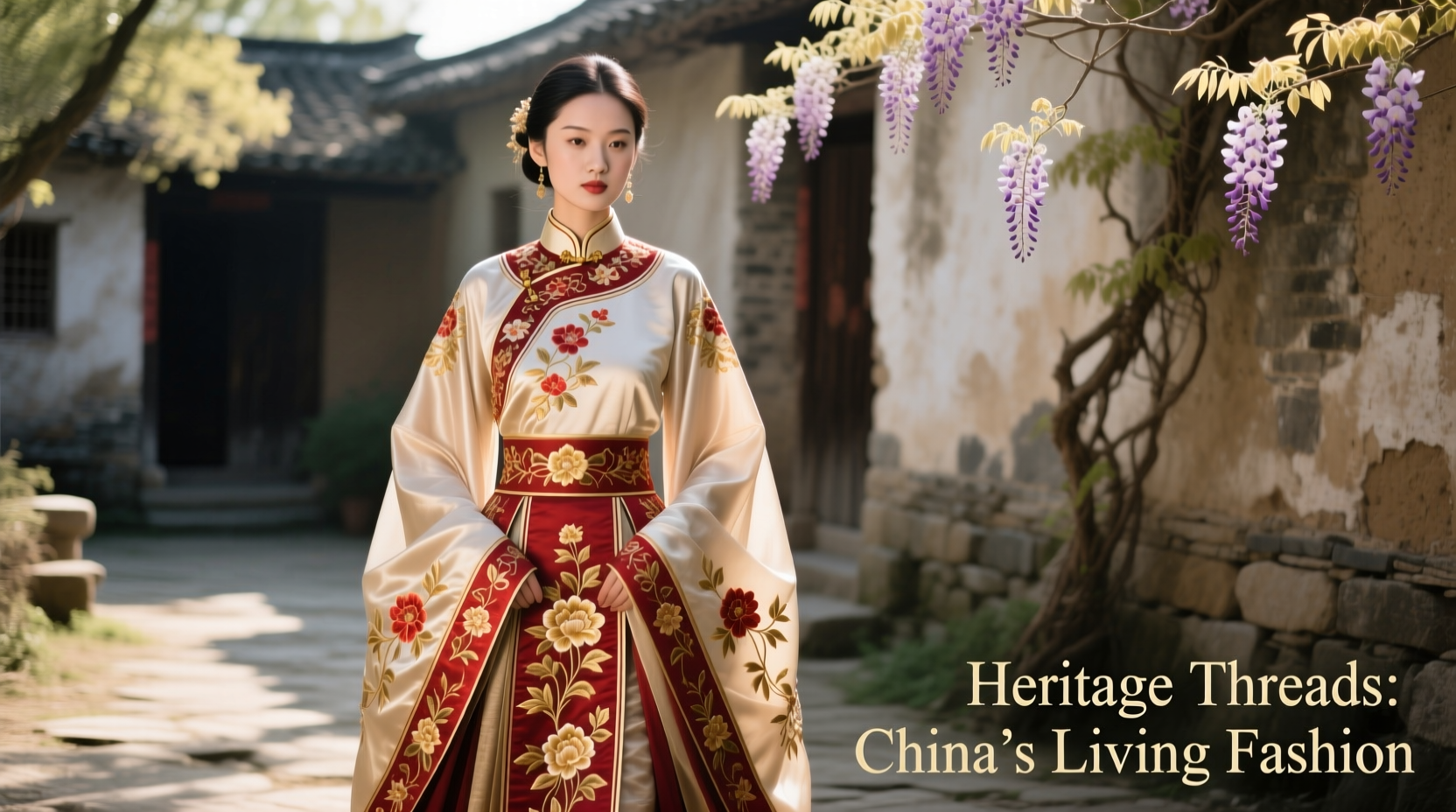
- Chang (裳): The lower skirt. The most iconic iteration is the Mamianqun (horse-face skirt), characterized by flat front and back panels with deeply pleated sides, allowing for both modesty and ease of movement.
- Bixi (蔽膝): A decorative knee-cover or apron worn over the skirt, denoting rank and formality in historical contexts.
Fabric Composition and Regional Looms
Authentic Hanfu relies heavily on regional silk weaving techniques. Shu Brocade from Sichuan province is renowned for its vibrant, multi-colored geometric patterns, while Song Brocade from Suzhou features a softer, more subdued palette with intricate floral motifs. For summer garments, historical practitioners utilized Xiangyunsha (gambiered Canton gauze), a labor-intensive fabric where silk is dyed with yam juice and sealed with iron-rich river mud, resulting in a crisp, rustling textile that is naturally cooling and water-resistant.
The Qipao: A Modern Icon of Elegance
If Hanfu represents ancient ancestry, the Qipao (旗袍), also known in the West as the Cheongsam, represents China's dynamic entry into modernity. Originating from the loose-fitting changpao (long robe) worn by the Manchu people during the Qing Dynasty (1644–1912), the Qipao was radically transformed in the 1920s and 1930s in Shanghai.
Tailoring, Darting, and the Shanghai Silhouette
The modern Qipao is a masterclass in structural tailoring. Unlike the flat, zero-waste cutting of traditional Hanfu, the Shanghai Qipao adopted Western darting techniques to contour the fabric to the wearer's body. Key structural elements include:
- Mandarin Collar: A stiff, high-standing collar that elongates the neck.
- Pankou (盘扣): Intricate, hand-knotted frog buttons made from silk cords, serving both as functional fasteners and symbolic motifs (e.g., butterfly knots for romance, plum blossoms for resilience).
- Side Slits: Originally introduced for mobility, the side slits (开叉) became a defining aesthetic feature, revealing glimpses of the lower leg and underskirts.
According to archival research from the Metropolitan Museum of Art's Costume Institute, the 1930s Shanghai Qipao represents a unique hybrid of Eastern textile traditions and Western Art Deco geometry, making it one of the most globally recognized garments of the 20th century.
Comparative Analysis: Hanfu vs. Qipao
Understanding the distinction between these two garments is vital for cultural accuracy and appropriate wear.
| Feature | Hanfu | Qipao (Cheongsam) |
|---|---|---|
| Historical Era | Ancient to Ming Dynasty (c. 3000 BCE – 1644 CE) | Qing Dynasty to Modern (17th Century – Present) |
| Cultural Origin | Han Ethnic Group | Manchu Ethnic Group / Shanghai Modernism |
| Silhouette | Flowing, voluminous, A-line, zero-waste cutting | Form-fitting, contoured, Western darting |
| Collar Style | Cross-collar (left over right) or round collar | Stiff Mandarin collar |
| Primary Fasteners | Hidden ties and sashes | Pankou (knotted frog buttons) and hidden zippers |
| Best Suited For | Festivals, tea ceremonies, historical reenactments | Formal events, banquets, modern professional wear |
Sourcing and Buying Guide: Price Ranges and Artisans
For collectors, cultural enthusiasts, and those attending global formal events, acquiring authentic garments requires navigating a market flooded with mass-produced synthetic imitations. Here is a practical framework for sourcing genuine pieces.
Authentic Hanfu Sourcing
The epicenter of modern Hanfu production is Cao County in Shandong province, which produces the majority of the world's Hanfu. However, for museum-quality or high-end daily wear, buyers should seek out specialized artisan studios.
- Entry-Level / Mass Market ($40 – $90 USD): Typically made from polyester blends or basic cotton. Suitable for casual wear or photography, but lacks breathability and historical drape.
- Mid-Tier Artisan ($150 – $400 USD): Woven from genuine mulberry silk, linen, or high-grade ramie. Features machine-assisted but historically accurate embroidery. Brands like Shisanyu or Zhongzheng offer excellent entry points into authentic construction.
- Heirloom / Custom ($800 – $2,500+ USD): Hand-woven Song brocade, real gold thread embroidery, and custom-tailored Mamianqun. These are commissioned directly from master weavers in Suzhou or Hangzhou.
Investing in a Bespoke Qipao
A true Qipao is not bought off the rack; it is engineered to the wearer's body. The Victoria and Albert Museum's Asian Collections frequently highlights the architectural precision required in traditional Chinese tailoring.
- Ready-to-Wear Commercial ($80 – $200 USD): Often features fake pankou (buttons glued on over a hidden zipper) and standard sizing that compromises the garment's structural integrity.
- Custom Tailored in Shanghai/Beijing ($400 – $1,200 USD): Involves multiple fittings. The tailor will measure over 30 distinct body points. Fabrics include heavy crepe de chine or Xiangyunsha. The pankou are fully functional and hand-knotted.
- Master Couture ($2,000 – $10,000+ USD): Created by heritage tailors (such as those on Shanghai's historic Changle Road). Includes hand-painted motifs, invisible seam finishes, and antique silk brocades.
Cultural Etiquette: Appreciation vs. Appropriation
As global interest in traditional garments grows, wearing the national costume of China requires mindfulness. Chinese culture is generally highly appreciative of non-Chinese individuals taking the time to wear Hanfu or Qipao with respect and accuracy. However, there are vital protocols to observe.
First, never reverse the collar of a Hanfu. As mentioned, the right-over-left overlap is strictly associated with mourning and the deceased. Wearing it incorrectly in a casual or festive setting is considered deeply inauspicious and offensive. Second, avoid mixing sacred or imperial motifs (such as the five-clawed dragon or specific Buddhist iconography) into everyday garments unless you understand their historical weight. Finally, when purchasing, prioritize transparency. Support heritage artisans and cooperatives that preserve traditional looming and knotting techniques, rather than fast-fashion conglomerates that exploit indigenous patterns without context.
Conclusion: A Living Sartorial Heritage
The national costume of China is not a static museum exhibit; it is a living, breathing dialogue between antiquity and modernity. Whether it is the sweeping, wind-caught sleeves of a Ming Dynasty aoqun or the sharp, elegant lines of a 1930s Shanghai Qipao, these garments carry the weight of philosophy, cosmology, and unparalleled textile engineering. For the global garment historian, studying these silhouettes offers a profound lens into how cloth shapes identity, and how Eastern looms have historically dressed the world.