The Hong Kong National Costume: Craftsmanship & Materials

When cultural historians and textile experts discuss the Hong Kong national costume, they are referring to a fascinating sartorial duality. Because Hong Kong is a Special Administrative Region rather than a sovereign nation, it does not possess an official 'national' dress in the strict diplomatic sense. However, the cultural consensus points to two distinct garments that define its heritage: the globally recognized Cheongsam (Qipao) and the deeply rooted, working-class Samfu (specifically the Da Jin Saam). As an encyclopedia traditionally focused on European folk dress, examining the Hong Kong national costume offers a brilliant comparative lens into how Eastern and Western tailoring philosophies diverge—and where they brilliantly intersect.
This guide explores the meticulous craftsmanship, indigenous material science, and bespoke tailoring techniques that define Hong Kong’s traditional garments, providing a comprehensive framework for collectors, historians, and cultural enthusiasts.
The Cheongsam: Silk, Structure, and the Cantonese Tailor
While the Qipao originated in Shanghai in the 1920s, it was in Hong Kong during the 1950s and 60s that the garment underwent its most radical structural evolution. Fleeing tailors from Shanghai brought their mastery of flat-pattern cutting to Hong Kong, where they encountered Western fashion influences and a demand for a more form-fitting silhouette. The result was the modern Hong Kong Cheongsam—a masterclass in hybrid craftsmanship.
Xiangyunsha: The Gambiered Canton Gauze
The pinnacle of material luxury in traditional Cantonese tailoring is Xiangyunsha (gambiered Canton gauze). This extraordinary silk textile is native to the Pearl River Delta, encompassing Hong Kong and Guangdong. The craftsmanship required to produce Xiangyunsha is staggering and entirely reliant on environmental conditions.
- The Dyeing Process: Raw silk is repeatedly soaked in the astringent juice of the Dioscorea cirrhosa (a local yam), which is rich in tannins.
- The Mud Coating: The silk is then coated with iron-rich river mud from the Pearl River. The chemical reaction between the tannins and the iron creates a deep, lustrous black-brown hue on one side, while the reverse remains a rich amber.
- Sun Curing: The fabric must be dried in the sun on grassy fields, a process that can take weeks and requires intense manual labor to ensure even curing.
The resulting fabric is water-resistant, naturally cooling in humid subtropical climates, and possesses a distinctive, paper-like rustle. According to exhibitions curated by the Hong Kong Heritage Museum, Xiangyunsha represents the zenith of regional textile engineering, prized for its durability and its ability to soften beautifully with the wearer's body heat over time.
The Art of 3D Darting and Bias Cutting
Traditional Chinese clothing was historically cut flat, utilizing straight lines to minimize fabric waste and preserve the integrity of woven motifs. The Hong Kong Cheongsam, however, introduced European-style 3D darting and bias cutting. Master tailors in districts like Wan Chai and Mong Kok learned to manipulate heavy silk crepe and brocade around the bust, waist, and hips without disrupting the continuous flow of the fabric's embroidery. This requires an intimate understanding of fabric grain—a skill mirrored in the haute couture houses of Paris but adapted here for the high-collared, side-slit silhouette.
The Da Jin Saam and Samfu: Agrarian and Maritime Roots
While the Cheongsam represents urban elegance, the Da Jin Saam (big lapel shirt) and Samfu (jacket and trousers) represent the agrarian and maritime soul of Hong Kong. Before the metropolis was paved, Hong Kong was a network of fishing villages and farming communities, primarily inhabited by the Tanka boat people and the Hakka.
Hemp, Cotton, and Indigo Dyeing
The traditional Samfu was constructed for extreme utility. Worn by Hakka women working the terraced hillsides and Tanka women navigating the sampans of Aberdeen Typhoon Shelter, these garments were crafted from robust hemp or heavy cotton.
The material was often dyed using natural indigo or, similarly to the Xiangyunsha process, treated with yam juice to stiffen the fabric and provide a degree of waterproofing against the harsh maritime elements. The Da Jin Saam features a distinctive wide, overlapping lapel that fastens on the right side using simple fabric ties or basic copper buttons. The cut is intentionally boxy and loose, allowing for maximum mobility and air circulation, a stark contrast to the restrictive tailoring of the urban Cheongsam.
'The true heritage of Hong Kong textiles is not just in the silk of the elite, but in the indigo-stained hemp of the Tanka boat people, whose garments were engineered to survive the salt and wind of the South China Sea.' — Archival notes on regional maritime dress, Leisure and Cultural Services Department (LCSD).
Cross-Cultural Tailoring: Hong Kong vs. European Folk Dress
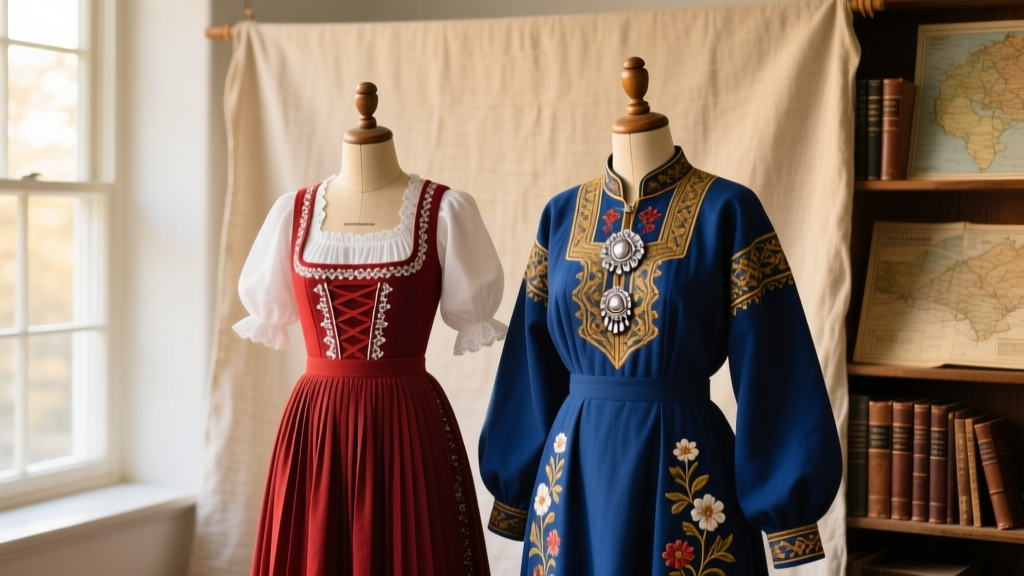
As a publication dedicated to the study of global traditional garments, comparing the Hong Kong national costume to European folk dress reveals profound insights into how different cultures solve the problem of clothing the human body. While a Bavarian Dirndl or a Norwegian Bunad relies on heavy wools, linen underlayers, and external corsetry to shape the silhouette, the Hong Kong Cheongsam relies on the structural manipulation of a single layer of silk.
| Garment Element | Hong Kong Cheongsam / Samfu | European Folk Equivalent (e.g., Dirndl / Bunad) |
|---|---|---|
| Primary Structure | Bias-cut silk, internal darting, side slits (kaicha) | Wool bodice, linen blouse, structured lacing or hooks |
| Fasteners | Hand-knotted Pankou (frog buttons) made of silk cord | Cast metal hooks, horn buttons, silver filigree clasps |
| Heritage Dyes | Dioscorea cirrhosa (yam juice) & iron-rich river mud | Woad, madder root, indigo, cochineal, and weld |
| Embellishment | Suzhou or Cantonese silk thread embroidery (motifs: peony, crane) | Wool crewelwork, ribbon appliqué, glass beadwork |
| Climate Adaptation | Breathable silk, high slits for humidity and mobility | Layered wool and linen for thermal insulation |
Research from the Hong Kong Polytechnic University's Institute of Textiles and Clothing highlights that the Pankou (frog fasteners) of the Cheongsam are not merely decorative; they are structural knots engineered to withstand the high tension of the garment's tight collar and chest, functioning much like the tension-bearing silver clasps of a Scandinavian Bunad.
Commissioning a Bespoke Garment: Buyer’s Guide
For those looking to acquire an authentic piece of Hong Kong’s sartorial heritage, the city remains one of the world's premier destinations for bespoke tailoring. However, navigating the market requires an understanding of material grades and artisan tiers.
Price Ranges and Material Tiers
- Off-the-Rack / Mass Market ($80 - $250 USD): Typically made from polyester blends or low-grade printed cotton. The pankou buttons are usually machine-made and glued. These lack the structural integrity and breathability of traditional garments.
- Standard Bespoke Silk Crepe ($600 - $1,200 USD): Commissioned from established tailors in Tsim Sha Tsui or Central. Includes precise 3D measuring, genuine hand-rolled hems, and hand-knotted silk pankou. Fabric is usually mid-weight silk crepe de chine or floral brocade.
- Heritage Xiangyunsha & Master Embroidery ($2,500 - $5,000+ USD): The apex of the craft. Utilizes genuine, sun-cured Gambiered Canton Gauze. The garment is cut by a master tailor (often with decades of experience) and features hand-embroidered motifs by artisans from the Guangdong region. This is an investment-grade garment meant to be passed down as a family heirloom.
Fitting Protocols and Etiquette
When commissioning a Cheongsam in Hong Kong, expect a minimum of three fittings. The first fitting is a 'shell' fitting, where the garment is basted together in white cotton thread to check the bias drape and dart placement. The second fitting refines the collar height—a crucial element, as a traditional Hong Kong collar should stand rigidly against the neck without choking the wearer, requiring a specialized internal canvas backing. The final fitting ensures the kaicha (side slits) fall at the exact midpoint of the thigh, allowing for graceful movement without compromising modesty.
Preserving the Legacy
The craftsmanship behind the Hong Kong national costume is a testament to the region's ability to synthesize indigenous material science with global tailoring techniques. Whether it is the mud-dyed resilience of the Tanka Samfu or the architectural elegance of the bespoke silk Cheongsam, these garments are not mere costumes; they are living archives of South Chinese history. For cultural garment enthusiasts, studying these pieces provides a vital counter-narrative to Eurocentric fashion history, proving that the highest levels of structural tailoring and textile engineering have long thrived on the shores of the Pearl River Delta.