China's National Costume Origins: Hanfu to Qipao

Defining the National Costume in China: A Tapestry of Millennia
When textile historians and cultural anthropologists investigate the national costume in China, they quickly discover that the term encompasses far more than a single, monolithic garment. Instead, it represents a complex sartorial continuum spanning over three millennia, shaped by dynastic shifts, philosophical movements, and the vast ethnic diversity of the region. While the modern world often defaults to the Qipao (Cheongsam) as the definitive Chinese garment, the true historical origins of Chinese dress are rooted in the ancient Hanfu system, the intricate weaving techniques of the Silk Road, and the vibrant traditions of regional minority groups.
Understanding this evolution requires looking beyond the surface aesthetics and examining the structural anatomy, fabric composition, and philosophical underpinnings that have dictated how these garments are cut, dyed, and worn. Furthermore, as global interest in traditional dress grows, European textile institutions have played a pivotal role in archiving and preserving these fragile silk artifacts, bridging Eastern sartorial heritage with Western curatorial science.
The Hanfu: Ancient Origins and Structural Anatomy
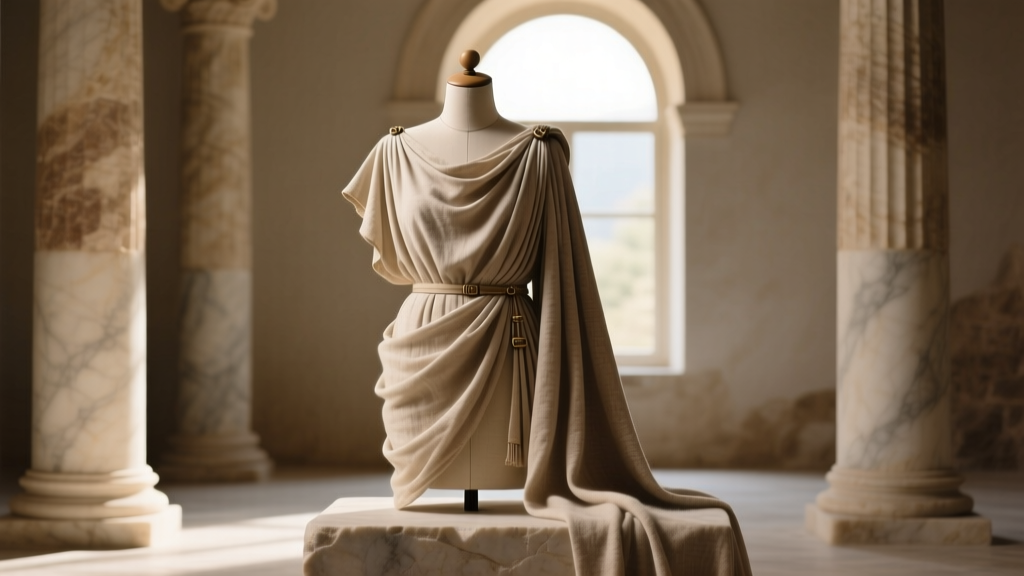
The Hanfu, the traditional dress of the Han Chinese, dominated the sartorial landscape from the legendary Huangdi period through the Ming Dynasty (1368–1644). Unlike Western tailoring, which relies on darts and seams to contour the fabric to the human body, the historical Hanfu was constructed using flat-pattern cutting. Fabric was woven to specific widths and draped, folded, and tied, honoring the integrity of the textile and reflecting the Daoist principle of harmony with nature.
The Philosophy of the Cut: Jiaoling Youren
The most defining characteristic of the Hanfu is the jiaoling youren—the cross-collar that wraps over the front, with the left lapel crossing over the right. In ancient Chinese cosmology, the left represented Yang (life, the east, the sun), while the right represented Yin (death, the west, the moon). Covering the right side with the left was a profound symbol of life and civilization. Conversely, the zuoren (right over left) was historically reserved for burial garments or associated with nomadic tribes of the northern steppes.
The wardrobe was primarily divided into two structural categories:
- Ruqun: A two-piece ensemble consisting of a short jacket (ru) and a long, pleated wrap skirt (qun). This style was particularly prominent among women during the Tang and Song dynasties, allowing for high-waisted silhouettes and layered color blocking.
- Shenyi: A one-piece deep robe that connected the upper and lower garments, symbolizing the unity of heaven and earth. The Shenyi was heavily regulated by Confucian sumptuary laws, with sleeve widths and collar colors denoting the wearer's social and scholarly rank.
Mastery of Materials: Silk, Ramie, and Xiangyunsha
While the elite adorned themselves in complex silk brocades (zhi) and delicate damasks (duan), the common populace relied on breathable plant fibers like hemp and ramie. However, one of the most remarkable historical textiles to emerge from southern China is xiangyunsha (mud silk). Originating in Guangdong province, this fabric is woven from wild silk, dyed with the tannin-rich juice of the薯莨 (shuliang) yam, and then coated with iron-rich river mud. The resulting chemical reaction creates a dark, lustrous, and water-resistant fabric that rustles softly when worn, historically prized for its cooling properties in humid subtropical climates.
The Dynastic Shift: Manchu Influence and the Birth of the Qipao
The trajectory of the national costume in China shifted dramatically with the establishment of the Qing Dynasty (1644–1912) by the Manchu people. The ruling class mandated the wearing of the changpao (long robe) and the magua (riding jacket), characterized by high mandarin collars, straight silhouettes, and the use of pankou (knotted frog fasteners) instead of woven sashes.
Following the fall of the Qing Empire and the rise of the Republic in the early 20th century, the changpao underwent a radical modernization in the cosmopolitan hub of Shanghai. The resulting garment, the Qipao (or Cheongsam), merged Manchu structural elements with Western tailoring techniques. By the 1930s, the Qipao featured set-in sleeves, bust and waist darts, and high side slits, transforming it from a modest, loose-fitting robe into a figure-hugging symbol of modern femininity. The intricate pankou knots evolved from simple functional fasteners into elaborate, decorative motifs shaped like lotuses, butterflies, and longevity symbols.
European Archival Perspectives: Curating Chinese Dress Abroad
The preservation of historical Chinese garments is not confined to East Asia; some of the most pristine examples of Ming and Qing court textiles are housed within European museums. These institutions provide vital comparative studies for historians of European folk dress, highlighting the profound impact of the Silk Road on global textile trades.
The Victoria and Albert Museum in London holds an extraordinary collection of Qing dynasty dragon robes (longpao) and kesi (cut silk tapestries). European curators utilize advanced spectrometry to analyze the metallic threads and natural dyes used in these garments, offering insights into historical trade routes where Chinese silk was exchanged for European silver and glassware. Similarly, the Museum für Asiatische Kunst in Berlin preserves significant examples of Han Chinese ceremonial wear and minority textiles, providing a crucial academic bridge for Western scholars studying the intersection of Asian sartorial traditions and European textile collecting during the 19th century.
Beyond the Han: The Richness of Regional Minority Dress
Any comprehensive guide to the national costume in China must acknowledge the 55 recognized ethnic minority groups, each possessing distinct textile heritages that predate or run parallel to Han traditions. The UNESCO Silk Roads Programme frequently highlights how these regional garments served as vital nodes of cultural exchange.
For instance, the Miao (Hmong) people of Guizhou province are globally renowned for their mastery of indigo resist-dyeing (lajian) and intricate pleated skirts, which can require up to 20 meters of hand-woven hemp. Their elaborate silver horn headdresses and embroidered jackets serve not merely as decoration, but as wearable genealogies, with specific stitch patterns denoting clan lineage and migration histories. In contrast, the Bai people of Yunnan are celebrated for their vibrant tie-dye (zharam) techniques, utilizing locally grown indigo to create striking blue-and-white geometric patterns that reflect the region's mountainous topography.
Comparative Analysis: Structural Evolution of Chinese Dress
| Garment Type | Era of Prominence | Key Structural Features | Primary Materials & Techniques |
|---|---|---|---|
| Hanfu (Ruqun / Shenyi) | Han to Ming Dynasties (206 BC – 1644 AD) | Cross-collar, right lapel, flat-pattern cutting, wide sleeves, sash ties | Hemp, Ramie, Silk Damask, Song Brocade |
| Qing Court Robe (Chaofu) | Qing Dynasty (1644 – 1912) | Mandarin collar, horse-hoof cuffs, dragon motifs, rank badges (buzi) | Kesi (cut silk), Gold-wrapped thread, Pearl embellishments |
| Qipao (Cheongsam) | Republic Era (1920s – Present) | High collar, Western darts, set-in sleeves, side slits, Pankou knots | Printed Cotton, Crepe de Chine, Silk Velvet, Brocade |
| Miao Festival Dress | Continuous Regional Tradition | Indigo pleated skirts, heavy silver jewelry, cross-stitch embroidery | Hand-spun Hemp, Indigo, Beeswax resist, Silver alloys |
Conclusion: The Living Revival of Traditional Garments
The historical origins of the national costume in China reveal a narrative of profound philosophical depth, technological innovation in weaving, and continuous adaptation. Today, the Hanfu Yundong (Hanfu movement) has sparked a massive cultural revival among Chinese youth, who meticulously research museum archives and historical texts to recreate accurate, period-specific garments for daily wear. This living tradition ensures that the national costume in China is not relegated to the glass cases of European or Asian museums, but remains a dynamic, evolving expression of cultural identity in the modern era. Whether through the flowing sleeves of a Ming dynasty Shenyi or the tailored elegance of a 1930s Shanghai Qipao, these garments continue to weave the past into the fabric of the present.