European Traditional Clothing: Materials & Craftsmanship

When examining European traditional clothing, historians and textile experts are not merely looking at festive costumes; they are observing a profound dialogue between human ingenuity and local geography. Long before globalized supply chains, communities relied entirely on the flora, fauna, and minerals within a day’s walk of their villages. The resulting garments—whether a Scottish Highlander’s plaid or a Bavarian forester’s breeches—are masterclasses in localized material science. Today, the preservation of European traditional clothing relies on a dedicated network of artisan cooperatives, master weavers, and heritage councils who refuse to let these tactile histories fade into synthetic reproductions.
The Architecture of Fleece: Wool Weaving Traditions
Wool is the undisputed backbone of Northern and Alpine European folk dress. However, the preparation of the fleece dictates the garment's function, drape, and cultural significance.
Scottish Tartan and the Worsted Warp
Authentic Highland tartan is not simply a printed pattern; it is a structural weave. Traditional tartans are woven from worsted wool—yarn that has been combed to align the fibers parallel, resulting in a smooth, strong, and slightly lustrous thread. According to archives at National Museums Scotland, historical tartans utilized natural mordants like alum and clubmoss to fix dyes derived from local lichens (crottle) and roots (madder). The pattern, known as the sett, is created by matching the exact thread count of the warp and weft. A true artisan-woven tartan selvedge will often feature a distinct, tightly bound edge that prevents fraying without the need for modern hemming, a crucial detail for the pleating of a traditional 8-yard kilt.
Norwegian Bunad and the Art of Vadmal
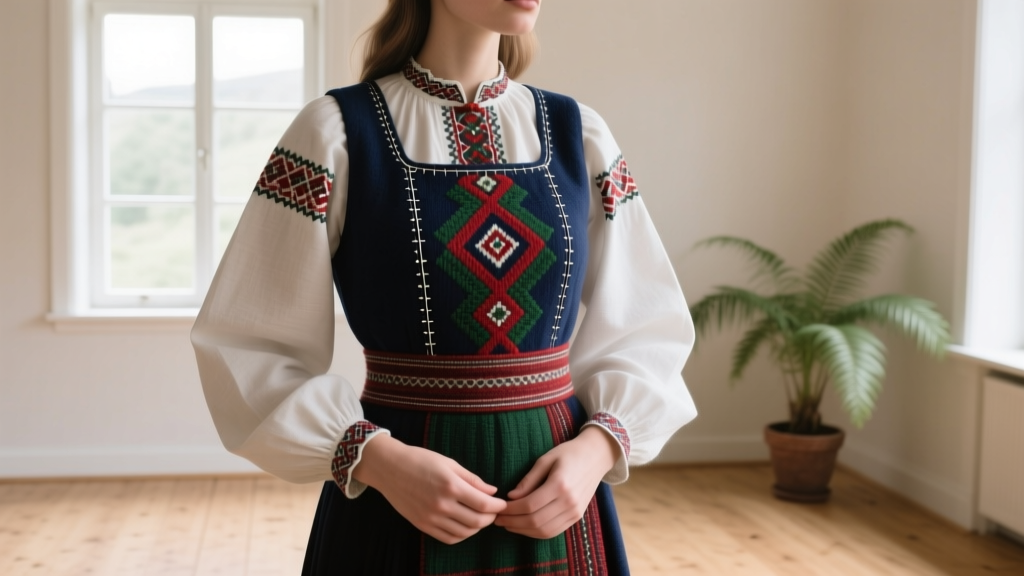
In Scandinavia, the craftsmanship of wool takes a different form. The Norwegian bunad (national romantic folk dress) frequently utilizes vadmal, a heavily fulled and felted woolen cloth. The weaving process involves a loose twill weave that is subsequently pounded and washed in hot water, causing the wool scales to interlock. This creates a dense, windproof, and nearly waterproof fabric ideal for harsh Nordic winters. The Norsk Folkemuseum (Norwegian Museum of Cultural History) highlights that regional bunads, such as the Hardangerbunad, pair this robust vadmal with intricate opphampt (brocade weaving) and silk ribbon embroidery, strictly regulated by the National Council for Bunad and Folk Costume to ensure historical accuracy down to the specific twist of the embroidery thread.
The Awl and the Hide: Bavarian Sämischleder
While wool dominates the loom, leather dominates the Alpine workshops. The iconic Bavarian and Tyrolean Lederhosen (leather breeches) represent one of the most demanding leatherworking traditions in Europe. Mass-market tourist versions are often made from chrome-tanned cowhide, which is stiff, unbreathable, and cracks over time. Authentic European traditional clothing of this region demands Sämischleder.
Sämischleder is chamois or deerskin tanned using an ancient oil-tanning method (often utilizing cod liver oil or animal fats). This brain-tanning or oil-tanning process breaks down the collagen fibers differently than chemical tanning, resulting in a leather that is incredibly soft, supple, and uniquely washable. A master Säckler (leatherworker) will hand-cut the hide and use a Plattstich (saddle stitch) with waxed linen thread, ensuring that if one stitch breaks, the entire seam does not unravel. The embroidery, or Stickerei, is traditionally executed in silk or heavy linen thread, featuring motifs of edelweiss, oak leaves, and hunting horns.
Artisan Price Guide: A factory-made, chrome-tanned pair of Lederhosen costs between €150 and €300. A bespoke, hand-stitched pair of Sämischleder Hirschleder (deer leather) breeches from a master artisan in Miesbach or Garmisch-Partenkirchen typically ranges from €1,200 to €2,800, reflecting the hundreds of hours of specialized labor.
From Flax Field to Needle: The Romanian Ie
Moving from the Alps to the Carpathians, the craftsmanship of plant fibers reaches its zenith in the Romanian Ie (traditional blouse). Before the widespread availability of cotton, rural communities cultivated flax and hemp. The processing of these fibers was a grueling, multi-month endeavor involving retting in rivers, scutching, and hackling to separate the bast fibers from the woody core.
The resulting homespun linen or hemp cloth served as a canvas for some of Europe’s most complex surface embroidery. The defining feature of the Ie is the Altâță, a dense, rectangular band of embroidery situated just below the shoulder seam. Artisans utilized a technique called Târnăviță, a type of geometric cross-stitch and counting-thread work that required mathematical precision. Historically, threads were dyed using walnut husks for deep browns, onion skins for vibrant yellows, and madder root for reds. The Breazără (a complex gathering and smocking stitch) at the neckline allowed the rigid linen to drape elegantly over the shoulders, showcasing a profound understanding of textile manipulation without the use of modern elastic.
Material & Craftsmanship Matrix
To understand the diverse material landscape of European folk dress, we must compare the physical properties and cultural applications of these foundational textiles.
| Material / Fiber | Primary Region | Signature Garment | Traditional Preparation Method | Authentic Artisan Price Range |
|---|---|---|---|---|
| Worsted Wool | Scottish Highlands | 8-Yard Kilt / Arisaid | Combed, tightly spun, natural mordant dyeing | £450 - £800+ (Kilt only) |
| Fulled Wool (Vadmal) | Norway / Scandinavia | Bunad (Skirt/Vest) | Loose twill weave, hot-water fulling/pounding | €2,500 - €4,500 (Full Bunad) |
| Sämischleder (Deer) | Bavaria / Tyrol | Lederhosen | Oil/brain tanning, hand-stitched saddle stitch | €1,200 - €2,800 |
| Homespun Linen | Romania / Eastern Europe | Ie (Blouse) | Flax retting, scutching, drop-spindle spinning | €200 - €600 (Hand-embroidered) |
Identifying Authentic Artisan Work
As global interest in heritage fashion grows, the market has been flooded with 'costume-grade' approximations. Distinguishing authentic European traditional clothing from fast-fashion replicas requires a keen eye for material truth. For wool garments, examine the drape and the smell; genuine lanolin-rich wool has a distinct, faintly earthy scent and a heavy, fluid drape that synthetic blends cannot replicate. For leather, authentic Sämischleder will feel almost like thick suede on both sides and will not possess the harsh, chemical odor of chrome tanning. Finally, for embroidered linen, turn the garment inside out. True counting-thread embroidery (like the Romanian Altâță) will look nearly as neat on the reverse side as it does on the front, with no chaotic web of machine-lockstitches or synthetic stabilizers.
The survival of these garments relies on the continued patronage of master craftspeople. Institutions like the Bayerisches Nationalmuseum (Bavarian National Museum) continually emphasize that preserving traditional clothing is not about freezing a culture in the past, but about maintaining the living, breathing techniques of the artisans who stitch history into every seam. By understanding the profound craftsmanship behind these materials, we elevate these garments from mere souvenirs to respected works of wearable art.