European National Costumes: Materials & Techniques
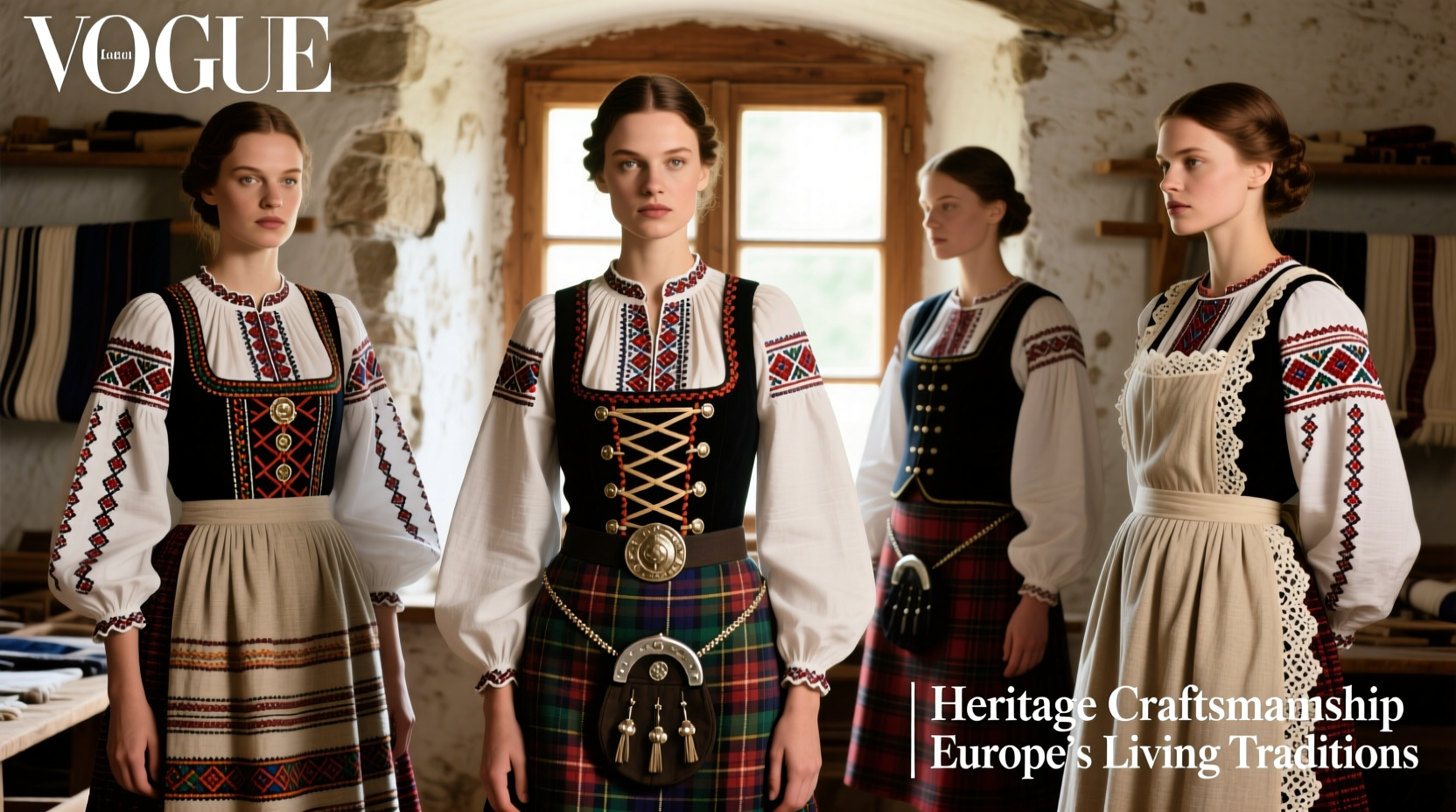
When discussing the national costumes of Europe, it is vital to recognize that these garments are rarely monolithic state uniforms. Instead, they are deeply regional folk dresses—such as the Norwegian bunad, the Austrian and Bavarian tracht, and the Scottish Highland dress—rooted in agrarian histories, local climates, and indigenous artisan guilds. The true value of these garments lies not merely in their visual silhouettes, but in the extraordinary craftsmanship and raw materials required to bring them to life.
At The Garment Atlas, we believe that understanding the anatomy of traditional dress requires looking beneath the surface. This explainer delves into the specialized weaving, metalwork, and embroidery techniques that define Europe’s most iconic folk garments, providing a comprehensive guide to the materials that make them enduring cultural artifacts.
The Textile Foundation: Weaving Regional Landscapes
The foundation of any authentic European folk costume is its textile. Before the industrial revolution, communities relied on locally sourced fibers, resulting in fabrics uniquely adapted to their specific environments.
Walkloden and the Alpine Climate
In the Alpine regions of Austria, Bavaria, and South Tyrol, the defining fabric is Loden. Originally woven from the coarse, greasy wool of mountain sheep, Loden undergoes a rigorous finishing process known as walken (fulling or boiling). The woven wool is submerged in hot water and mechanically agitated, causing the fibers to shrink and mat together. This creates Walkloden, a dense, windproof, and naturally water-resistant fabric. A high-quality Loden jacket or dirndl skirt requires up to 40% more raw wool than its finished weight suggests. Authentic Alpine Loden retains a subtle lanolin scent and possesses a stiff, structured drape that is impossible to replicate with modern synthetic blends.
Vadmel: The Scandinavian Warp
In Norway and Sweden, the historical backbone of folk dress is vadmel (or wadmal). This is a thick, heavily fulled woolen cloth that was traditionally woven on warp-weighted looms. Today, authorized bunad manufacturers utilize heavy floor looms to produce a dense, twill-weave wool that provides immense insulation against Nordic winters. The wool is often left undyed to showcase the natural grey, black, and white hues of the Spælsau (Norwegian short-tailed sheep), or dyed using deep indigos and madder roots.
Worsted Wool and the Tartan Sett
Scottish Highland dress relies on the precise geometry of tartan. Authentic kilts are not made from lightweight costume wool, but from heavy worsted wool, typically woven in a 2/2 twill structure. The Scottish Tartans Authority notes that a proper kilt requires 8 yards of single-width (approx. 27 inches) or 4 yards of double-width fabric. The wool is spun tightly to withstand the tension of the pleating process, with traditional kilts weighing in at a substantial 13oz to 16oz per yard. This weight ensures the pleats swing correctly and hold their knife-edge structure over decades of wear.
The Alchemy of Natural Dyes and Mordants
While modern chemical dyes offer absolute colorfastness, the historical authenticity of Europe's national costumes is deeply tied to botanical dyes. Master dyers historically relied on complex mordanting processes to bind color to protein (wool) and cellulose (linen) fibers.
- Weld (Reseda luteola): Used across Northern Europe to produce vibrant, sun-resistant yellows, often overdyed with woad to create the iconic 'Lincoln Green' or specific regional tartan greens.
- Madder (Rubia tinctorum): The cornerstone of red dyes in Alpine and Scandinavian embroidery. The root is fermented and heated carefully; excessive heat turns the dye brown, requiring immense artisan skill to achieve a true crimson.
- Clubmoss (Lycopodium): In parts of Scandinavia, this rare plant was historically used to produce a vivid, colorfast red for high-status embroidery threads, a practice documented by the Norsk Folkemuseum in their archival textile research.
Metalwork and Adornment: The Silversmith’s Legacy
For rural European communities, silver was not merely decorative; it was a portable bank account and a display of generational wealth. The metalwork found on folk costumes represents some of the highest levels of regional silversmithing.
Norwegian Sølje and Filigree
The Norwegian bunad is heavily adorned with sølje (silver jewelry), including brooches, cufflinks, and belt buckles. The most prized technique is filigran (filigree), where fine silver wires are twisted into intricate lace-like patterns and soldered onto a silver backplate. Another traditional method is støp (casting), which yields heavier, solid pieces often featuring dangling 'teardrop' elements designed to catch the light and, according to folklore, ward off evil spirits. A complete set of handcrafted bunad silver can easily cost between €800 and €2,500, reflecting the hundreds of hours of benchwork required.
Scottish Sporran Cantles and Kilt Pins
In Highland dress, silver is utilized both structurally and decoratively. The cantle (the metal top frame) of a formal dress sporran is frequently cast from sterling silver or silver-plated brass, featuring Celtic knotwork or thistle motifs. Kilt pins, used to weigh down the outer apron of the kilt, are forged from heavy-gauge silver to prevent tearing the delicate worsted wool. Master silversmiths in Edinburgh and the Highlands still employ traditional chasing and repoussé techniques to give these pieces a three-dimensional, tactile finish.
Embroidery as Cartography: Stitching Local Identity
Embroidery in European folk dress is highly codified; a specific stitch or color palette can pinpoint the wearer’s exact valley or parish of origin.
In the Hardanger region of Norway, Hvitsøm (whitework) embroidery is a hallmark of the local bunad and traditional aprons. This technique involves drawn-thread work, where warp and weft threads are selectively removed from the linen base and the remaining threads are wrapped and woven with white cotton or linen thread to create geometric, lace-like patterns. It requires exceptional eyesight and tension control, as a single miscounted thread ruins the symmetry of the motif.
Conversely, in the Black Forest and Alpine regions, Goldstickerei (goldwork embroidery) is prevalent on bodices and waistcoats. Artisans use purl (tightly coiled gold wire) and spangles, couching them onto the fabric with silk threads. The Victoria and Albert Museum highlights that historical goldwork in European folk dress often utilized silver-gilt threads to reduce costs while maintaining the luminous, opulent effect required for festival and wedding attire.
Comparative Material Breakdown of Major European Folk Garments
To understand the investment and material reality of these garments, consult the breakdown below. Prices reflect authentic, artisan-crafted pieces, not mass-produced tourist apparel.
| Garment / Region | Primary Textile | Key Adornment | Artisan Price Range (EUR) | Lifespan |
|---|---|---|---|---|
| Hardanger Bunad (Norway) | Heavy black/blue wool, linen shift | Handmade filigree silver, Hvitsøm apron | €3,500 - €5,500 | Multi-generational |
| Handmade Kilt (Scotland) | 16oz worsted wool tartan | Silver cantle sporran, horn/antler buttons | €600 - €1,200 | 50+ years |
| Salzburger Dirndl (Austria) | Walkloden (boiled wool), silk blouse | Goldwork bodice, horn toggles, silk apron | €800 - €2,200 | 20-30 years |
| Dalecarlian Dress (Sweden) | Wadmal, hand-blocked linen | Pewter clasps, intricate wool yarn embroidery | €1,200 - €2,500 | Multi-generational |
Sourcing Authentic Craftsmanship in the Modern Era
The market is unfortunately saturated with fast-fashion approximations of the national costumes of Europe. Synthetic 'dirndls' made of polyester and velcro-fastened 'kilts' strip these garments of their cultural and material integrity. For those seeking authentic pieces, provenance is paramount.
When purchasing a Norwegian bunad, buyers must engage with authorized Husfliden (Norwegian Home Crafts Association) cooperatives. These institutions guarantee that the wool is domestically sourced, the silver is hallmarked by Norwegian assay offices, and the embroidery is completed by certified local artisans. Similarly, authentic Scottish kilts should be commissioned from kiltmakers registered with the Scottish Tartans Authority, who will take up to 25 distinct body measurements to ensure the garment is tailored to the wearer's exact anatomy, allowing the pleats to sit perfectly at the small of the back.
Investing in the true materials of European folk dress is an act of cultural preservation. By supporting the weavers, silversmiths, and embroiderers who maintain these ancient techniques, collectors and wearers ensure that the tactile history of Europe's regions continues to be lived in, rather than merely observed behind museum glass.