The Dirndl Blouse Long Sleeve: A Historical Origins Guide

When observing contemporary Alpine festivals, one might assume the dirndl is defined by its off-the-shoulder or short-sleeved silhouettes. However, the true historical bedrock of the Tracht (traditional folk dress) lies in the dirndl blouse long sleeve style, known in German-speaking Alpine regions as the Langarmbluse. Far from being a mere afterthought to the bodice (Mieder) and skirt (Rock), the long-sleeved blouse carries centuries of socio-economic history, regional tailoring nuances, and strict cultural etiquette.
The Evolution of the Dirndlbluse: From Alpine Fields to Festhalls
The origins of the dirndl trace back to the 18th and 19th centuries, worn by Dirnen (maidservants) and peasant women across Bavaria, Austria, and South Tyrol. Originally, the undergarment was a simple, utilitarian linen shift known as a Hemd. This single-piece garment served as both a nightgown and a working dress. As the 19th century progressed, the shift evolved into a two-piece ensemble: a separate bodice and a distinct blouse.
The long sleeve was not a fashion choice but a geographical and practical necessity. The Alpine climate demands protection against harsh mountain winds, morning frosts, and the physical rigors of agricultural labor. By the late 1800s, as the Tracht was romanticized by the urban bourgeoisie and aristocracy during the Sommerfrische (summer retreat) movement, the rustic long-sleeved work blouse was refined. Artisans began utilizing finer cotton batiste, adding delicate smocking (Smokarbeit), and incorporating lace trims, elevating the Langarmbluse from field wear to acceptable formal attire.
Anatomy of the Langarmbluse: Construction and Tailoring
To appreciate the historical weight of a long sleeve dirndl blouse, one must examine its structural anatomy. Authentic historical pieces and high-end contemporary reproductions share specific tailoring hallmarks that separate them from modern fast-fashion interpretations.
Sleeve Variations: The Puffärmel vs. The Fitted Cuff
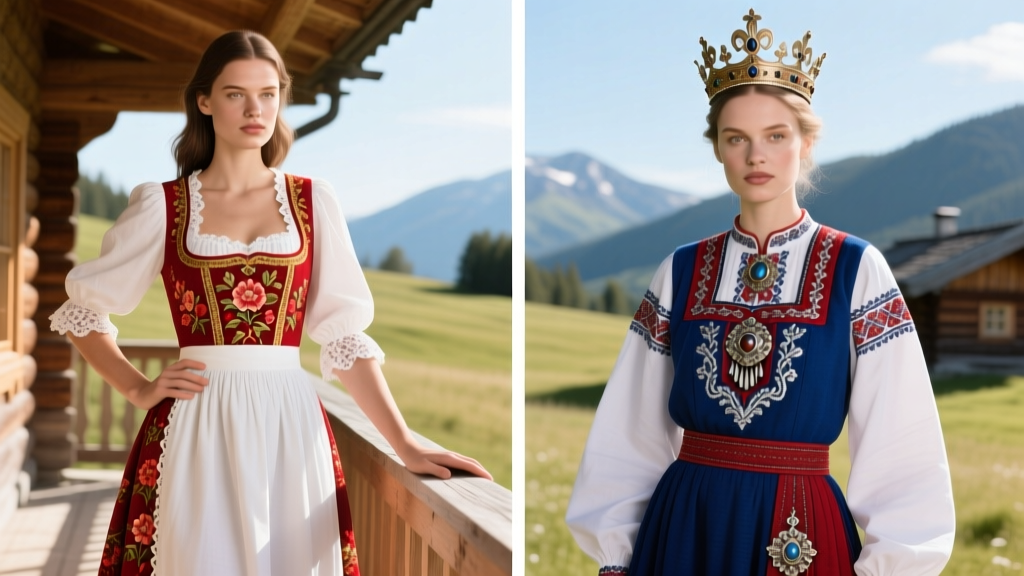
The most iconic historical sleeve is the Puffärmel (puff sleeve). Unlike the exaggerated, cartoonish puffs found in cheap tourist-shop costumes, authentic historical puff sleeves are gathered tightly at the shoulder and taper down to a fitted, buttoned cuff at the wrist. This design allowed for freedom of movement in the shoulders while keeping the forearms and wrists warm and protected from dirt and brambles during harvest season.
Alternatively, the Wintertracht (winter traditional dress) features a completely fitted long sleeve, often ending in a subtle flare or a scalloped lace edge. This style is heavily associated with the more conservative, deeply Catholic regions of Upper Bavaria and Tyrol, where modesty in church settings dictated fully covered arms year-round.
Necklines and the Role of the Kropfband
Long-sleeved blouses historically feature higher necklines compared to their summer counterparts. A square neckline (Eckausschnitt) or a modest round neckline is standard. In many Austrian and Bavarian traditions, the high neckline of a long-sleeved blouse is paired with a Kropfband (a velvet choker, often adorned with a silver or pearl medallion) or a Brusttuch (an embroidered silk scarf pinned inside the bodice) to bridge the gap between the blouse and the Mieder, ensuring no skin is exposed during formal or religious events.
Regional Divergence: Long Sleeve Styles Across the Alps
The Alpine region is not a monolith; it is a patchwork of micro-cultures, each with distinct sartorial rules. The table below outlines how the long sleeve dirndl blouse varies across major Tracht regions.
| Region | Sleeve Style | Typical Fabric | Neckline & Details |
|---|---|---|---|
| Upper Bavaria (Oberbayern) | Fitted with subtle wrist gathering | White cotton poplin or batiste | High square; often paired with silk Brusttuch |
| Salzburg (Salzkammergut) | Moderate Puffärmel with smocked cuffs | Fine linen or batiste with lace inserts | Round or heart-shaped; delicate Spitzen (lace) trim |
| Tyrol (Tirol) | Strictly fitted, often buttoned to wrist | Heavier cotton or light wool blends for winter | High, closed collar (Stehkragen) for church wear |
| Styria (Steiermark) | Bishop sleeves (Puffärmel) | White or ecru cotton with floral embroidery | Modest V-neck or square; regional cross-stitch motifs |
Fabric, Weave, and Authenticity: What to Look For
Historically, the Hemd was woven from unbleached flax or hemp. As trade routes expanded and the textile industry modernized in the late 19th century, white cotton became the standard. Today, a high-quality long sleeve dirndl blouse is crafted from Baumwollbatist (cotton batiste) or Halbleinen (a linen-cotton blend).
When evaluating authenticity, look for the Smokarbeit (smocking) on the shoulders and cuffs. Authentic smocking is done by hand, creating a honeycomb pattern that provides elasticity without the use of modern synthetic elastic bands. Mass-produced blouses often use shirred elastic, which lacks the structural integrity and historical accuracy of hand-smocked gathers. Furthermore, blouses from the Salzkammergut region often feature Klöppelspitze (handmade bobbin lace) at the cuffs, a craft that is still fiercely protected by local artisan cooperatives.
Cultural Etiquette: When to Wear the Long Sleeve Dirndl Blouse
In the living tradition of the Trachtenvereine (traditional costume clubs), the choice of sleeve length is governed by strict seasonal and situational protocols. Wearing the correct sleeve length signals respect for the community and the occasion.
- Seasonality: The long sleeve is the undisputed standard from late autumn through early spring (roughly October to April). Wearing a short-sleeved blouse in November is considered a faux pas in rural Alpine communities, signaling a disconnect from the agricultural calendar.
- Religious Observance: When attending church services, weddings, or funerals, modesty is paramount. A long-sleeved blouse with a higher neckline is mandatory, often worn beneath a dark, conservative Mieder made of wool or heavy silk.
- Formal Evening Wear: The Festtagstracht (festive costume) worn to evening balls or formal cultural events frequently utilizes a long-sleeved silk or fine batiste blouse to convey elegance and formality, distinguishing the wearer from casual festival-goers.
"The Tracht is not a costume to be worn at will; it is a reflection of the seasons, the occasion, and the wearer's respect for their community's heritage." — Guidelines derived from the Bayerischer Trachtenverband.
Sourcing Authentic Pieces: Price Ranges and Artisan Makers
Navigating the market for a historically accurate dirndl blouse long sleeve requires an understanding of price tiers and manufacturing origins. Investing in the correct garment ensures both longevity and cultural accuracy.
Mass-Market and Fast Fashion (€30 – €60)
Typically manufactured overseas using polyester blends and machine-shirred elastic. These lack the breathability required for all-day wear and feature historically inaccurate, overly dramatic sleeve puffs. They are best avoided by those seeking authentic Tracht.
Mid-Tier Tracht Retailers (€70 – €120)
Established heritage brands offer high-quality cotton batiste blouses with machine-assisted smocking and genuine mother-of-pearl buttons. These are excellent for regular festival wear, seasonal transitions, and provide a reliable foundation for a traditional wardrobe.
Artisan and Massgeschneidert (€150 – €300+)
For true historical accuracy, enthusiasts turn to local Schneider (tailors) or specialized artisan cooperatives in regions like Salzburg and Tyrol. These bespoke pieces feature hand-smocked cuffs, antique lace inserts, and custom tailoring that accommodates the specific drape required by the Mieder. The higher cost reflects the dozens of hours of specialized hand-sewing required.
Preserving the Alpine Heritage
Understanding the historical origins of the long sleeve dirndl blouse transforms it from a mere garment into a textile document of Alpine life. Institutions like the Bayerisches Nationalmuseum in Munich and the Volkskundemuseum in Vienna house extensive archives of 19th-century Hemden, showcasing the incredible durability and regional pride woven into every stitch. Furthermore, the Tiroler Volkskunstmuseum provides vital context on how Tyrolean women adapted their sleeve lengths and fabrics to survive and thrive in high-altitude environments.
By choosing historically grounded pieces and respecting the cultural protocols of the Tracht, modern wearers help preserve the legacy of the Alpine women who first stitched these garments together, ensuring the Langarmbluse remains a living, breathing element of European folk dress.