Chinese New Year Costume: Silk & Symbols Guide
The Global Tapestry of Festive Dress
While The Garment Atlas primarily catalogs European folk dress and regional costumes, the global textile trade inextricably links the historic brocades of Lyon and Spitalfields to the legendary silks of Suzhou and Nanjing. To understand the evolution of global festive wear, we must examine the chinese new year traditional costume not merely as a seasonal uniform, but as a wearable archive of sericulture, dynastic history, and artisanal mastery. Today, the garments worn during the Lunar New Year—ranging from the Hanfu revivalist skirts to the structured Tangzhuang—represent a pinnacle of material craftsmanship that continues to influence global textile arts.
Structural Anatomy: From Mamianqun to Tangzhuang
The modern perception of the chinese new year traditional costume is not a monolith; it is a vibrant intersection of historical revival and 20th-century innovation. Two primary silhouettes dominate contemporary Lunar New Year celebrations: the Mamianqun and the Tangzhuang.
The Mamianqun (Horse-Face Skirt)
Originating in the Song and Ming dynasties, the Mamianqun has experienced a massive resurgence among young Hanfu enthusiasts. Structurally, it is a marvel of flat-pattern cutting. The skirt consists of two overlapping panels of fabric that wrap around the body, featuring flat, unpleated sections at the front and back (the 'horse faces') flanked by deeply pleated sides. This construction allowed for ease of movement while horseback riding in antiquity, yet it drapes with architectural elegance. Artisans construct these skirts using precise mathematical ratios to ensure the pleats remain razor-sharp, often weighting the hem with hidden silk cording to maintain the garment's structural integrity during movement.
The Tangzhuang (Tang Suit)
Despite its name, the Tangzhuang does not originate from the Tang Dynasty. It is a modern adaptation of the Qing Dynasty Magua (a short riding jacket), popularized globally during the 2001 APEC summit. The defining structural elements of the Tangzhuang are the standing Mandarin collar and the Pankou (knotted buttons). Unlike Western buttonholes, which require cutting and reinforcing the fabric, Pankou are crafted from silk-wrapped copper wire, coiled into intricate auspicious shapes like plum blossoms or longevity knots. This preserves the continuous weave of the silk brocade, a crucial consideration when working with fragile, high-value textiles.
Material Mastery: Decoding Chinese Silks
The true value of a traditional Lunar New Year garment lies in its fabric. Authentic costumes eschew modern polyester satins in favor of complex, multi-layered silk weaves that require specialized draw-looms.
Yunjin (Cloud Brocade) and Songjin (Song Brocade)
Yunjin, originating from Nanjing, is historically reserved for imperial dragon robes and remains one of the most expensive textiles in the world. It incorporates peacock feather yarns, gold leaf strips, and silver threads into a heavy, warp-faced brocade. The loom requires two operators: one to manage the warp threads and another to pass the intricate weft shuttles. Songjin from Suzhou is slightly lighter, characterized by its geometric, interlocking patterns and subtle, matte-finish elegance, making it the preferred choice for refined Qipao and Tangzhuang jackets worn during indoor family reunions.
Xiangyunsha (Gambiered Canton Gauze)
For those in warmer southern climates or overseas diaspora communities, Xiangyunsha is the ultimate luxury. This unique textile is woven from raw silk, dyed repeatedly in the tannin-rich juice of the Dioscorea cirrhosa tuber, and then coated with iron-rich river mud. The chemical reaction between the tannin and the iron creates a distinctive dark, glossy surface on one side and a matte, rust-colored reverse. It is entirely water-resistant, naturally cooling, and develops a beautiful patina over time, often compared to the aging of fine European leather.
The European Loom Connection
The craftsmanship of the chinese new year traditional costume shares a fascinating technological lineage with European folk textiles. In 1804, Joseph Marie Jacquard invented the programmable loom in Lyon, France, revolutionizing European silk brocade production. This punch-card technology eventually made its way to East Asia in the late 19th and early 20th centuries. Today, many of the intricate, continuous-pattern brocades used in mass-market Tangzhuang are woven on modern, computerized Jacquard looms—a direct technological descendant of the French innovation. Institutions like the Victoria and Albert Museum house extensive collections that trace this cross-pollination, displaying both Qing dynasty festive robes and European silk waistcoats that share identical damask weaving techniques.
Embroidery and Symbolic Motifs
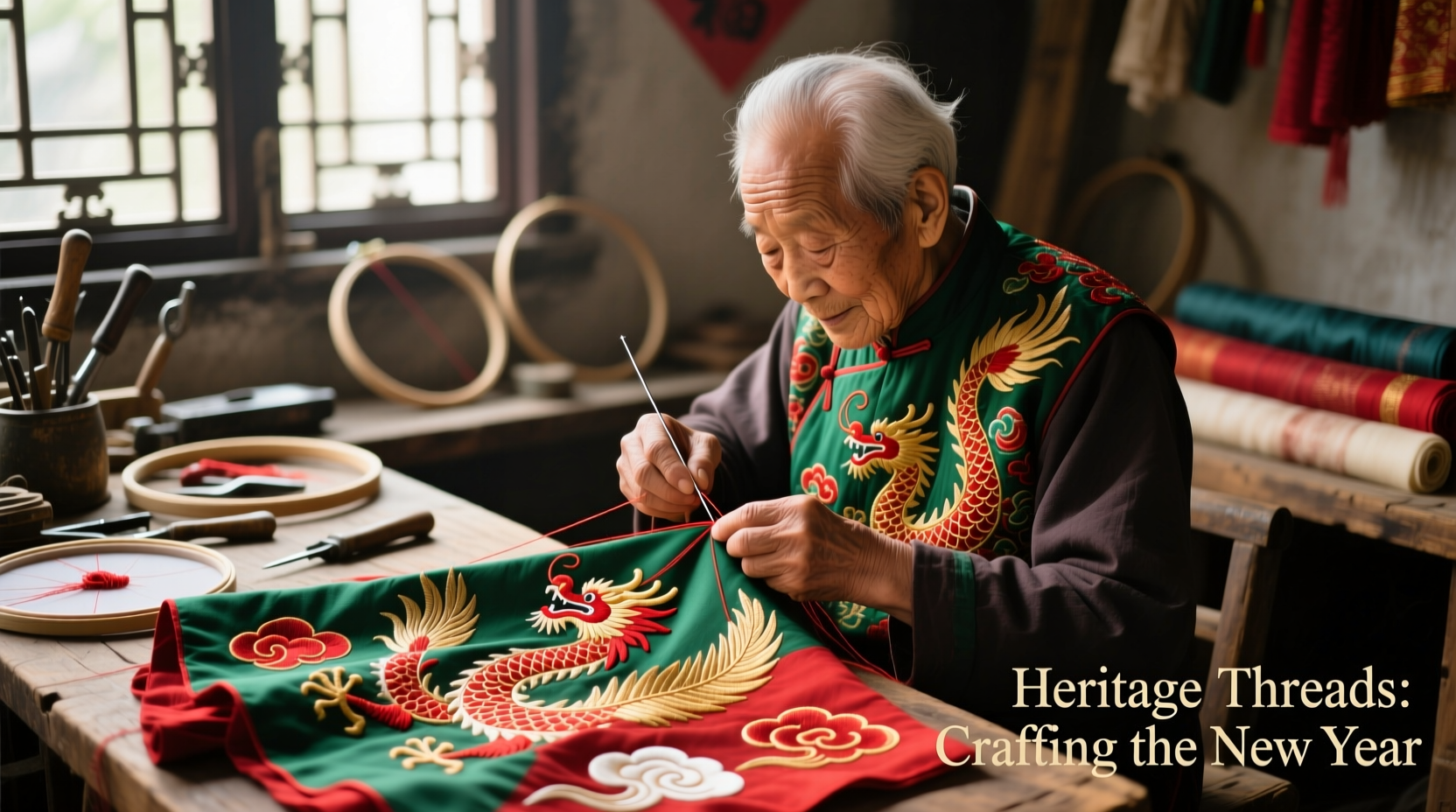
Embroidery transforms the woven silk into a canvas of cultural symbolism. Su Xiu (Suzhou embroidery) is the premier technique applied to high-end New Year garments. Master artisans can split a single strand of silk thread into 1/16th or even 1/48th of its original thickness, allowing for hyper-realistic shading. Common New Year motifs include the peony (wealth and honor), the bat (good fortune, as the word for bat, fu, is a homophone for blessing), and the koi fish (perseverance). The Metropolitan Museum of Art's Silk Road archives highlight how these motifs were historically standardized, with specific colorways denoting different branches of a family during ancestral worship ceremonies.
Fabric and Construction Comparison Guide
| Garment / Material | Primary Weave / Technique | Drape & Weight | Typical Price Range (USD) |
|---|---|---|---|
| Mass-Market Tangzhuang | Polyester/Silk-blend Jacquard | Stiff, Medium-Heavy | $45 - $120 |
| Authentic Songjin Qipao | 100% Mulberry Silk Brocade | Fluid, Medium | $350 - $800 |
| Mamianqun (Hanfu) | Silk Taffeta or Woven Damask | Structured, Heavy Pleats | $150 - $500 |
| Xiangyunsha Jacket | Gambiered Raw Silk Gauze | Crisp, Lightweight, Rustling | $600 - $1,500+ |
| Bespoke Yunjin Robe | Gold/Peacock Thread Brocade | Extremely Heavy, Rigid | $3,000 - $10,000+ |
Sourcing Authentic Garments: A Buyer's Framework
When sourcing a chinese new year traditional costume, buyers must navigate a market saturated with synthetic 'costume' replicas. For genuine craftsmanship, seek out specialized ateliers rather than generic festival vendors. In Europe and North America, diaspora hubs like London's Chinatown or Paris's 13th arrondissement host heritage tailors who import authentic Songjin and Xiangyunsha directly from Zhejiang and Guangdong provinces.
Always inspect the Pankou knots; genuine knots will have a firm, wire-reinforced core that holds its shape, whereas synthetic imitations will collapse when pinched. Furthermore, authentic silk brocade will exhibit a 'slub' or slight irregularity in the weft, and the reverse side of the fabric should show a clean, albeit negative, image of the brocade pattern, proving it is woven rather than printed. For academic and historical reference on authentic textile aging and dyeing methods, the China National Silk Museum provides invaluable open-access resources for collectors and historians.
Ultimately, investing in an authentic, handcrafted Lunar New Year garment is an act of cultural preservation. It supports the dwindling number of master weavers and embroiderers, ensuring that the tactile language of silk, mud, and thread continues to be spoken for generations to come.